
VRLA battery full form: Valve Regulated Lead Acid battery. A VRLA battery is a lead-acid battery in which the electrolyte is immobilised and the container is sealed with one-way pressure-relief valves. Gases produced on charge are retained and recombined inside the cell, so the battery never needs water addition over its service life. The two VRLA constructions are AGM (absorbed glass mat) and GEL (gelled electrolyte).
The problem VRLA batteries solve
Charge a flooded lead-acid battery and, near the top of charge, some of the water in the electrolyte is electrolysed into hydrogen and oxygen. That single fact creates most of the running costs of flooded batteries: gases must be ventilated away because hydrogen is combustible, and the lost water must be replaced — cell by cell, with demineralised water, on a schedule. The VRLA battery was developed to remove both burdens.
How a VRLA battery works — the oxygen recombination cycle
The overall chemistry is the same double-sulphate reaction as every lead-acid battery:
Pb + PbO₂ + 2H₂SO₄ ⇌ 2PbSO₄ + 2H₂O (discharge →, charge ←)
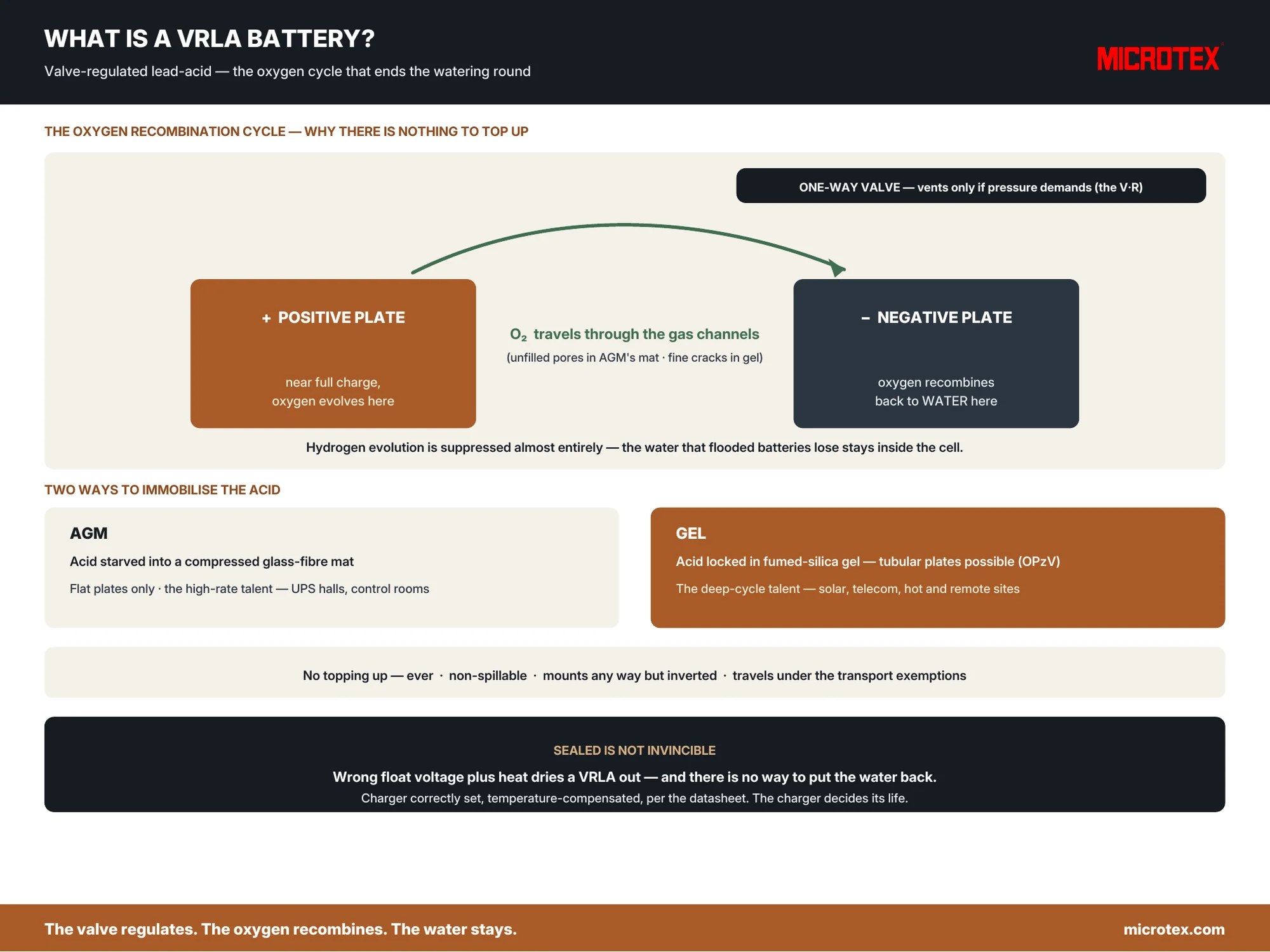
The difference lies in what happens to the gas. In a VRLA battery the electrolyte is not a free liquid: it is either absorbed into a fine glass mat (AGM) or set into a gel with fine silica (GEL). In a free liquid, gas bubbles simply rise and escape. In the immobilised electrolyte they cannot. The separator or gel is deliberately left slightly unsaturated, so a network of gas channels exists. Oxygen produced at the positive plate near top-of-charge travels through these channels to the negative plate, where it is chemically reduced back towards water.
On overcharge, at the positive plate, water is oxidised:
H₂O → 2H⁺ + ½O₂ + 2e⁻
The oxygen reaching the negative plate reacts with the sponge lead (net reaction):
Pb + ½O₂ + H₂SO₄ → PbSO₄ + H₂O
The charger immediately converts that lead sulphate back to lead:
PbSO₄ + 2H⁺ + 2e⁻ → Pb + H₂SO₄
Add the three steps together and nothing is consumed: the oxygen cycle closes, the overcharge energy appears as heat, and the water stays in the cell. Hydrogen, meanwhile, is largely never produced — oxygen reduction keeps the negative plate slightly depolarised, suppressing hydrogen evolution. The small residue that does form escapes through the one-way valve, which opens only above its set pressure and reseals — hence valve-regulated. Water loss is measured in grams over years, not litres.
Two practical consequences follow. First, a VRLA battery generates more internal heat on charge than a flooded battery, so charger settings and temperature compensation matter even more. Second, “sealed” is conditional: chronic overcharging produces gas faster than the cell can recombine it, the valve vents, and the lost water can never be replaced. In a VRLA battery, the charging regime determines the service life.
AGM and GEL — the two VRLA constructions
All VRLA batteries immobilise the acid one of two ways. AGM absorbs it into a highly compressed fine-glass-fibre mat pressed against flat plates; the low internal resistance gives excellent high-rate discharge and fast recharge, which suits UPS and float standby duty. GEL sets the acid with fumed silica; combined with tubular positive plates — a construction that cannot use a glass mat — it gives superior deep-cycle life and immunity to acid stratification, which suits solar, telecom and cycling duty. All AGM batteries are VRLA; not all VRLA batteries are AGM.
You will meet the same family under several acronyms: SLA (sealed lead acid), SMF (sealed maintenance-free) and VRLA all describe the sealed, valve-regulated construction; AGM and GEL describe how the electrolyte inside is immobilised.
A short history
Gelled-electrolyte lead-acid batteries were developed by Sonnenschein in Germany and commercialised from the late 1950s. The AGM battery followed in the early 1970s from the Gates Rubber Corporation, first as a spirally wound cell. In the 1980s, UK manufacturers including Chloride and Tungstone introduced the familiar flat-plate AGM construction. Today the technology divides along the lines above: flat-plate AGM for high-rate float duty, tubular-plate GEL for deep-cycle service.
What “maintenance-free” really means
Maintenance-free means one thing precisely: no water additions over the battery’s service life. It does not mean no care. A VRLA installation still needs correct, temperature-compensated charger settings, clean and tight connections, and periodic voltage and internal-resistance checks. Monitoring alone never prevented an early failure — monitoring plus maintenance does.
Where VRLA batteries are used
Telecom and remote sites. Most telecom towers stand where maintenance visits are expensive. A battery that needs no watering, produces no acid fumes and can be installed in confined spaces is the natural fit — commonly 12V monoblocs, or 2V cells for larger high-power installations.
UPS and data rooms. An uninterruptible power supply demands short bursts of high current, delivered indoors, near people and sensitive electronics. AGM’s high-rate capability and the absence of gas and acid fumes make it the standard choice, from a single desktop unit to three-phase industrial supplies (400–440 V), typically 25–250 Ah.
Solar storage. Solar is the fastest-growing renewable energy source, and off-grid installations store their energy for the night. Batteries often live indoors, so gas-free charging matters; daily cycling favours tubular gel. Deficit charging is the enemy here — the system must return the battery to full charge regularly.
Leisure: marine, campervan, golf. Deep discharges, irregular use and safe handling define this group — from a 12V 18–35 Ah golf caddy to a 48V golf buggy bank, 85–220 Ah campervan monoblocs, and marine banks up to 110V series-parallel strings of 2V gel cells on electric barges. The common failure is off-season neglect: a VRLA battery stored discharged sulphates like any other lead-acid battery.
Motive power. Where ventilation is restricted or hygiene matters — food warehouses are the classic case — sealed gel traction batteries remove acid fumes from the workspace entirely. The trade-offs against flooded traction cells are honest ones: slower recharge, higher price, shallower permitted discharge. For many operations the removal of watering labour and fume extraction wins the calculation. See our traction battery range for both answers to that question.
Engine starting and special duties. AGM starter batteries resist stratification and vibration, which suits stop-start vehicles and off-road machines. At the extreme end, submarines — where gas-free operation is not a preference but a survival requirement — use very large 2V cells, well over a hundred in series; the deep-cycle duty points the same way as ever, towards tubular plates.
The Microtex VRLA range
Microtex has manufactured batteries since 1969 and builds both VRLA constructions: Eternia Gel — tubular-plate OPzV cells for deep-cycle and long-duration duty, and the 2V AGM VRLA range for high-rate float and UPS applications — with many of the constructional materials made in-house. If your application sits anywhere in the list above, tell us the duty cycle and we will put the right chemistry, plate and capacity behind it.