
🌎 Español · 🇷🇺 Русский · Français · Português
/ RESERVE POWER · FLOODED TUBULAR STATIONARY · 2 V CELLS
OPzS battery — flooded tubular 2 V cells, 100 to 3000 Ah, made in Bengaluru
Specified, type-tested and delivered in 60 days: Microtex builds OPzS cells for substation, power-plant, railway and telecom DC systems, and is a registered vendor with NPCIL, BARC, ONGC, BPCL and IOCL — the registrations that nuclear and heavy-industry tenders ask for — with the test reports and tender documentation ready to go with your enquiry.
/ DOCUMENTS · PDF
Datasheets for a single type, test reports and tender documentation come with the offer — ask with your enquiry.
Registered vendor: NPCIL · BARC · ONGC · BPCL · IOCL — Seismically qualified (IEEE 344) — 2 V stationary cell type-tested to IS 1651 (CECRI, 2012) — 100–3000 Ah — 60-day delivery
Specification at a glance
| Item | Microtex OPzS |
|---|---|
| Cell type | 2 V flooded stationary cell with tubular positive plates (OPzS), built to the OPzS cell designations of DIN 40736-1 |
| Capacity range | 2 V cells from 100 Ah to 3000 Ah — the full size table, with dimensions and weights, comes with the offer |
| Standards | Designed to the OPzS designations of DIN 40736-1; a Microtex 2 V 800 Ah tubular stationary cell type-tested to IS 1651:1991 at CECRI, Karaikudi, 2012 — dimensions, capacity, loss of capacity on storage, endurance, ampere-hour and watt-hour efficiency and voltage during discharge, all within the standard’s limits (report supplied with the tender documentation); seismic qualification of our OPzS cells to IEEE Std 344:2013 at CPRI Bengaluru (2018). Indian tenders usually name IS 1651, the BIS specification for tubular-plate stationary cells, and international tenders IEC 60896-11:2002 — tell us which standard and clauses your tender calls for and we quote compliance against it |
| Type tests and reports | IS 1651:1991 type test of a Microtex 2 V 800 Ah tubular stationary cell at CECRI, Karaikudi, 2012; the CECRI report and the CPRI seismic reports, with their report numbers, go with the tender documentation we send with the offer |
| Seismic qualification | Resonance search, OBE and SSE tests per IEEE Std 344:2013 on the CPRI Bengaluru shake table, witnessed by NPCIL QA — 2 V OPzS cells (6 OPzS 300) in their steel stand, 2018 (report CPRIBLREVRC18T0116; test held by Mysore Thermo Electric Pvt Ltd, a Microtex group company). Our 2 V HDP stationary cells were further qualified to IEC/IEEE 60980-344:2020 at CPRI in May 2026 — five OBE and one SSE at 10% above the required spectrum, discharging without interruption, zero damage, zero spillage (report CPRIBLREVRC26T0049) |
| Vendor registrations | Registered vendor: NPCIL · BARC · ONGC · BPCL · IOCL — registration documents supplied with tender documents |
| Manufacturing | Alloys, oxide, plates, gauntlets and separators made in-house in Bengaluru; containers and covers moulded within the Microtex group |
| Container | Transparent or opaque to your specification — transparent lets levels, plates and sediment be seen on the walk-round; state your preference with the enquiry and we confirm it against the cell size |
| Delivery | 60 days |
| Warranty | 12 months from the date of invoice as standard; project terms stated in the offer against the tender conditions |
| Documentation | Datasheet, type-test reports, seismic qualification record, installation and maintenance manual, record book, factory acceptance test with customer witness |
Who specifies OPzS, and why
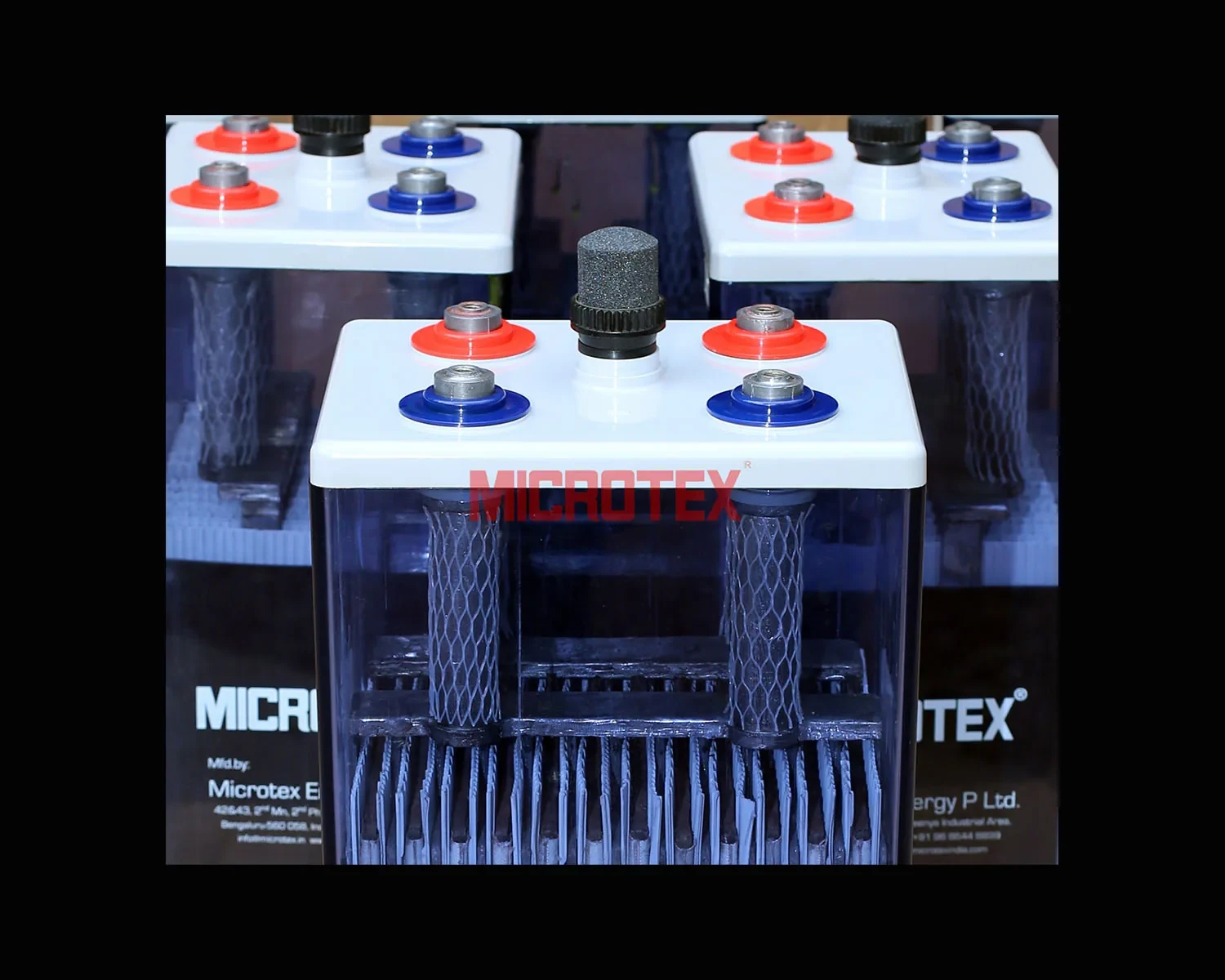
OPzS is the DIN designation for a stationary flooded cell built on tubular positive plates. The tubular plate is what earns the service life: active material is locked inside woven gauntlets around cast spines, so the cell survives decades of float duty punctuated by deep discharges when the supply fails — the exact profile of substation, power-plant and telecom DC systems. The designation also carries interchangeability: a cell built to a DIN 40736-1 size fits the stand, the connectors and the sizing calculation written for that size, so a bank can be second-sourced and spared years later.
Flooded construction keeps the battery honest: cells you can inspect, condition you can check by direct measurement — voltage, impedance trend, specific gravity — and capacity you can prove outright with a discharge test. Where trained maintenance exists, flooded tubular gives a transparency of condition — measured, not inferred — that sealed designs cannot offer. Where the room is unmanned, the same tubular plate in sealed gel form is the OPzV battery.
Our 2 V OPzS cells are seismically qualified — resonance search, OBE and SSE testing per IEEE Std 344-2013 at CPRI Bengaluru, witnessed by NPCIL QA (2018).

FIG. 1 — 2 V OPzS CELLS, 100–3000 Ah
Substations and grid
110 V and 220 V DC banks for switchgear, protection and SCADA: years on float, then trip coils and spring-charging motors at many times the normal load. The application page covers the duty and the sizing.
Nuclear and heavy industry
Backup duty where vendor approval and seismic evidence are the entry ticket. Microtex is a registered vendor with NPCIL, BARC, ONGC, BPCL and IOCL, and the qualification file is on hand.
Power plants and process industry
Standby lighting, black-start support and DC control power — long float life with a reserve that a discharge test can prove.
Railways, telecom and solar
Signalling and telecom DC supplies and solar storage with maintenance staff on site — see railway signalling batteries. Where visits are rare, specify OPzV gel instead.
Supplying Indian nuclear facilities — first bank ordered 2008
Microtex 250 V 1200 Ah tubular flooded stationary cells, 114 in transparent SAN containers on a seismically qualified stand, at Bhabha Atomic Research Centre’s Dhruva reactor, Trombay — ordered 2008; supplied by the Microtex group through Mysore Thermo and commissioned in May 2009, certified complete and in operation by BARC’s Research Reactor Maintenance Division. Performance certified satisfactory by the same division, 2011.
A 125 V 500 Ah tubular flooded stationary bank on a seismically qualified stand at BARC’s Research Reactor Maintenance Division, Trombay — ordered 2009; supplied by the Microtex group through Mysore Thermo and installed, tested and commissioned, with initial performance reported satisfactory by BARC, November 2010.
Two 250 V DC 500 Ah control battery banks on metallic stands at NPCIL’s Narora Atomic Power Station, Unit 1 — supplied by the Microtex group through Mysore Thermo, 2012. Installed, tested and commissioned September–November 2014; put into service October–November 2014.
All three nuclear banks are HDP-class tubular flooded stationary cells (the HDP range), the same tubular-plate family as OPzS; dates are those on the purchase orders and certificates.
Further reading
Also useful: writing a battery specification, the substation duty cycle, charger sizing for a station battery and how the tubular plate is made.
What we need for a quotation
Send whatever you have of the list below; the first reply comes within the working day and the offer carries the datasheet, the sizing and the evidence.
- System voltage and the number of cells (or the voltage window your DC system allows).
- Capacity in Ah at C10, or the load profile (continuous and momentary loads) and we size it.
- Autonomy and duty — backup hours, end-of-discharge voltage, how often the bank is really discharged.
- Room temperature — the normal range and the worst case.
- Standards and tests required — the standard the tender names, seismic qualification if any, witness requirements for the factory acceptance test.
- Quantity, site and delivery — number of banks, the site, the date you need them on site.
- Tender reference and the due date, with the technical annexures attached.
Construction
The positive plate is a row of cast low-antimony spines, each inside a woven gauntlet packed with active material; the gauntlet holds the material against the spine for the life of the cell, so the plate cannot shed what it is made of. The negative is a pasted flat plate. The spines carry a corrosion reserve for the long float life, and the pole seal is built to let the pillar rise with the plate as it grows over the years instead of cracking the lid. Every stage — the alloy, the oxide, the plates, the gauntlets and the separators — is made in our own works in Bengaluru, which is why we can answer a tender question about any of them from the shop floor. The technology page shows how.
Charging — typical, confirm with Microtex
A station battery lives on float, so the charger matters as much as the cell. Typical practice for our OPzS cells, to be confirmed against the datasheet for your bank before commissioning: float at the datasheet voltage with temperature compensation; equalise per the datasheet, when the cell-voltage or specific-gravity spread widens; our maintenance guidance for these cells caps charging at 2.45 V per cell at every stage — the figure to confirm against your bank’s datasheet. A float voltage set too high shows up first as rising water consumption, set too low as falling specific gravity with normal voltage — both are charger faults, not cell faults, and both are caught by the monthly pilot-cell readings. Charger sizing for the recharge after a discharge is covered in our guide to station battery charger sizing.
Maintenance and service life
Our maintenance card for operators runs on four levels: a daily walk-past for leaks, dirt, low levels and charger alarms; monthly voltage, specific gravity and temperature on the pilot cells; the same three readings on every cell each quarter; and a capacity test, torque check and terminal clean each year, with every reading written in the record book. Demineralised water only, never acid, never overfilled; specific-gravity readings corrected to 27 °C; the room ventilated and kept cool. Heat is the quiet enemy: the US Bureau of Reclamation’s battery manual (FIST Volume 3-6) halves a lead-acid battery’s expected life for roughly every 8 °C the room runs above 25 °C, and treats a bank as worn out once a capacity test returns less than 80 per cent of rated capacity — the same 80 per cent replacement criterion that IEEE 450-2020 gives. Bought well and treated this way, flooded tubular stationary cells are among the longest-lived lead-acid batteries made.
Evidence, not adjectives
| Proof | Detail |
|---|---|
| Seismic qualification | Resonance search + OBE + SSE per IEEE Std 344:2013, CPRI Bengaluru, witnessed by NPCIL QA — 2 V OPzS cells (6 OPzS 300) in their steel stand, 2018 (report CPRIBLREVRC18T0116; test held by Mysore Thermo Electric Pvt Ltd, a Microtex group company). Our 2 V HDP stationary cells were further qualified to IEC/IEEE 60980-344:2020 at CPRI in May 2026 — five OBE and one SSE at 10% above the required spectrum, discharging without interruption, zero damage, zero spillage (report CPRIBLREVRC26T0049). The OPzS test was run to IEEE Std 344-2013; the HDP test to its successor IEC/IEEE 60980-344:2020 |
| Vendor registrations | Registered vendor: NPCIL · BARC · ONGC · BPCL · IOCL — registration documents supplied with tender documents |
| Type testing | A Microtex 2 V 800 Ah tubular stationary cell type-tested to IS 1651:1991 at the Central Electrochemical Research Institute (CECRI), Karaikudi, 2012 — dimensions, capacity, loss of capacity on storage, endurance, ampere-hour and watt-hour efficiency and voltage during discharge, all within the standard’s limits; report supplied with tender documentation |
| Manufacturing | Alloys, oxide, plates, gauntlets, separators made in-house — the technology page shows how |
| Heritage | Microtex Energy, Bengaluru: founded 1969, exporting since 1977 |
Seismic qualification on film: 2 V HDP stationary cells of the same tubular-plate family on the CPRI shake table, May 2026 — testing to IEC/IEEE 60980-344:2020 (the successor to IEEE Std 344) at 10% above the required spectrum, load uninterrupted, zero damage, zero spillage (report CPRIBLREVRC26T0049). Footage courtesy of CPRI, used with permission.
What the shake table proves — on film
Dr Michael McDonagh, Chief Technical Officer, on what seismic testing stresses in a cell — active-material adhesion, plate-to-strap welds and lid bonding — and why passing proves a battery is well made.
Questions tender engineers ask us
OPzS or OPzV — which should my specification call for?
Flooded OPzS where trained maintenance exists and long, verifiable life is the goal — utilities, plants, substations. Sealed OPzV gel where the room is unmanned or visits are rare — solar, telecom, remote sites. The electrochemistry is the same tubular family; the trade is transparency versus freedom from maintenance.
What is the delivery time, and what shortens it?
OPzS cells are delivered in 60 days. The clock starts when the specification is settled, so the fastest route is to send the system voltage, the capacity or load profile, the autonomy, the room temperature and the standard your tender names with the first enquiry. We reply within the working day.
Can you meet utility and nuclear tender documentation?
Yes — that is the business we are built for: type-test reports with ULR numbers, seismic qualification records, vendor-registration credentials, installation and maintenance manuals, a record book, and factory acceptance testing with customer witness. Send the tender annexures with your enquiry.
Which standards do your OPzS cells follow, and can you quote against the one in my tender?
The cells are built to the OPzS designations of DIN 40736-1; a Microtex 2 V 800 Ah tubular stationary cell was type-tested to IS 1651:1991 at CECRI, Karaikudi, in 2012, and the seismic qualification of our OPzS cells was run to IEEE Std 344-2013 at CPRI with NPCIL QA witnessing (2018). Indian tenders usually name IS 1651, the BIS specification for tubular-plate stationary cells. Tell us which standard and which clauses your tender calls for and the offer states compliance clause by clause.
What decides an OPzS battery’s real service life?
Three things the datasheet does not show: charging discipline (float and equalise voltages actually held, with temperature compensation), room temperature (heat accelerates internal corrosion — the stationary-battery standards rate life at a reference temperature for a reason), and watering with demineralised water on schedule. Bought well and treated well, flooded tubular stationary cells are among the longest-lived lead-acid batteries made.
What warranty and after-sales support come with the bank?
Standard warranty is 12 months from invoice; project terms are stated in the offer against the tender conditions. Commissioning support and operator training on the maintenance card are offered with the bank; replacement cells to the same DIN size are quoted on request.
How do I size an OPzS bank for my DC system?
Send the DC system voltage window, the continuous and momentary loads, the required autonomy in hours, the room temperature, and the end-of-discharge voltage your protection scheme allows. Our engineers size the bank to IEEE 485-2020 with the ageing and temperature margins shown, and reply within the working day.
Specify a battery your successor will thank you for.
Send the duty — voltage window, loads, autonomy, room conditions — and the proposal comes back with the evidence attached. OPzS cells: 60-day delivery. Four ways to reach us, all answered within the working day: