
Battery acid is dilute sulphuric acid (H₂SO₄). In every lead-acid battery, concentrated sulphuric acid is diluted with demineralised water to typically 27–39% by weight — a specific gravity between 1.200 and 1.300 depending on the battery type. It is a strong acid: at these strengths the pH sits below 1. And it is not merely a conductor — in a lead-acid battery the electrolyte takes part in the charge–discharge reaction itself, which is why a hydrometer reading reveals the state of charge.
The electrolyte provides the ionic conduction path between the plates inside the cell; the electrons travel through the external circuit. Get the acid right — purity, strength, temperature — and the battery starts life healthy. Get it wrong and no amount of charging will fully recover it. This guide covers the practical side: strengths by battery type, water quality, safe dilution with worked tables, measurement, and cold-weather behaviour.
Safety first: always add acid to water
Dilution is strongly exothermic. Poured the wrong way, water added to concentrated acid flashes to steam at the surface and can spit acid violently. The rule has no exceptions: add acid to water, slowly, stirring — never water to acid. Wear goggles, rubber gloves, apron and boots; mix in clean vessels of plastic, porcelain, hard rubber or lead-lined construction; stir with a glass rod or lead-lined paddle; let the mix cool before final adjustment.
Specific gravity by battery type
| Battery application | Typical filled SG range (corrected to 27 °C) |
|---|---|
| Stationary (OPzS / Planté class) | 1.195 – 1.205 |
| UPS batteries | 1.240 – 1.250 |
| Traction / motive power | 1.275 – 1.285 |
| Automotive (starter) | 1.270 – 1.290 |
| Tubular gel VRLA (OPzV) | 1.280 – 1.300 |
| AGM VRLA | 1.300 – 1.310 |
Lower-gravity designs simply use more electrolyte volume per ampere-hour: a 1.200 stationary cell holds roughly 18–20 ml of acid per Ah, a traction cell at 1.275 about 13–15 ml, an AGM at 1.300 around 9 ml. The mass of sulphuric acid per ampere-hour ends up of the same order in every design — the chemistry demands what it demands.
The water matters as much as the acid
Dilution and topping-up use demineralised (DM) or distilled water only — never tap, well or mineral water. Ion-exchange resins remove both cations and anions; conductivity is monitored continuously, and a rising reading signals that the resin needs regeneration. The acid should conform to IS 266 (battery-grade sulphuric acid) and the water to IS 1069. Permitted impurity limits:
| Impurity | Water (max) | Acid (max) |
|---|---|---|
| Suspended matter | Nil | Nil |
| Iron | 0.10 ppm | 10 ppm |
| Chloride (Cl⁻) | 1 ppm | 3 ppm |
| Manganese | 0.10 ppm | Nil |
| Total dissolved solids | 2 ppm | Nil |
| Electrical conductivity | 5 µS/cm max | — |
Measuring SG — and correcting for temperature
Read the hydrometer at eye level with the electrolyte surface to avoid parallax error, and read the temperature alongside. Specific gravity falls as the acid warms, by about 0.0007 per °C, so every reading must be corrected to the reference temperature — 27 °C in Indian practice:
SG₍₂₇ °C₎ = SG₍t₎ + 0.0007 × (t − 27)
Worked example: a batch reads 1.250 at 40 °C. Corrected: 1.250 + 0.0007 × (40 − 27) = 1.250 + 0.009 = 1.259 at 27 °C. An uncorrected hot reading understates the true gravity — the classic way a healthy battery gets misdiagnosed as undercharged.
Electrolyte properties and freezing
| SG at 20 °C | H₂SO₄ (wt%) | Temp. coefficient (SG/°C, ×10⁻³) | Freezing point |
|---|---|---|---|
| 1.050 | 7.3 | 0.33 | −3.3 °C |
| 1.100 | 14.3 | 0.48 | −7.8 °C |
| 1.150 | 20.9 | 0.60 | −15 °C |
| 1.200 | 27.2 | 0.68 | —* |
| 1.250 | 33.4 | 0.72 | −52 °C |
| 1.300 | 39.1 | 0.75 | −71 °C |
The pattern matters more than any single number: a charged battery resists freezing; a discharged one does not. As a battery discharges, acid converts to water and the gravity falls towards the weak, easily-frozen end of the table. Ice expands and cracks containers. In cold climates, keep batteries charged through winter — and never leave a discharged battery outdoors.
How other chemistries do it
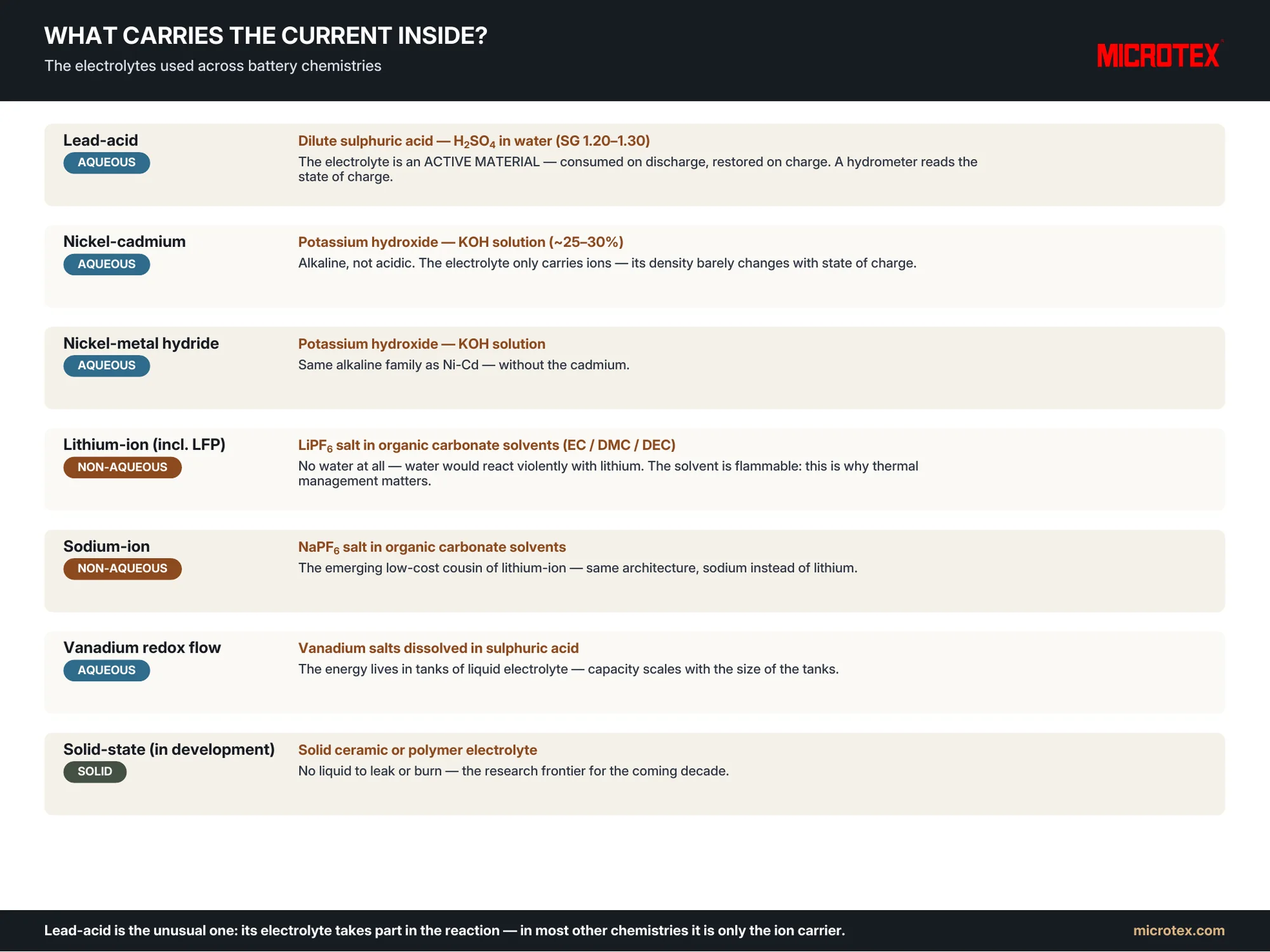
Every battery needs an electrolyte, but they differ profoundly — and lead-acid is the unusual one: its electrolyte is an active material, consumed on discharge and regenerated on charge. In most other chemistries the electrolyte only ferries ions between the electrodes.
Where to buy battery acid
Battery-grade acid is not a retail item: buy from an authorised chemical dealer or a battery-acid supplier, who can deliver it at the specific gravity you need — worth it for small quantities, since it removes the dilution step entirely.
Microtex has been filling, forming and shipping lead-acid batteries since 1969 — stationary OPzS, traction and sealed gel alike. If your question is about the acid in a specific battery, ask us — and for every other term you’ll meet in a datasheet, our battery glossary is open.