
C-rate measures how fast a battery is charged or discharged, compared to its own size. A rate of 1C means a current numerically equal to the battery’s full capacity — nominally an hour’s worth of battery every hour. C/10 means ten times gentler — about ten hours. 2C means twice as hard. That is the whole idea. The interesting part is what speed does to a battery — so let us build it up from something everyone has seen.
Start with a water tank
Imagine a 100-litre water tank on your roof. How long the water lasts depends on the tap. Open a small tap that draws 10 litres an hour, and the tank runs for 10 hours. Open a big tap drawing 100 litres an hour, and it is empty in one hour. Same tank — the only thing that changed is the speed of emptying.
A battery is a tank of electricity. Its size is measured in ampere-hours (Ah) instead of litres — a 100 Ah battery notionally holds 100 amperes for one hour, or 10 amperes for 10 hours, or 1 ampere for 100 hours. The current you draw is the tap.
So what is “C”?
Batteries come in thousands of sizes, so engineers needed one word for “emptying speed” that works for every size. That word is the C-rate: the current expressed as a fraction (or multiple) of the battery’s capacity.
Current (A) = C-rate × Capacity (Ah)
For our 100 Ah battery: 1C is 100 A. C/10 — also written 0.1C — is 10 A. C/5 is 20 A. C/2 is 50 A. 2C is 200 A. For a small 7 Ah alarm battery, the same 1C is just 7 A. The C-rate lets a tiny battery and a forklift battery describe their workload in the same language: “how many hours’ worth of me are you taking per hour?” This is pure arithmetic — it is true for every battery, every chemistry, always.
The catch: a battery is a runner, not a tank
Here the tank picture breaks — usefully. A tank gives you all 100 litres no matter how fast you drain it. A battery does not. A battery is more like a runner. A person who can comfortably walk 20 kilometres in a day cannot sprint 20 kilometres — sprinting burns energy faster than the body can supply it, and the runner stops early. Batteries behave the same way: the faster you discharge, the less total energy you get out.
The reason, in one sentence: at high currents the chemical reaction cannot reach deep into the plates, and voltage collapses to the cut-off before all the active material has done its work. A German scientist, Wilhelm Peukert, measured this in 1897 and wrote it as a formula:
Iⁿ × t = constant (for lead-acid, n is typically between about 1.1 and 1.4)
If n were exactly 1, batteries would be perfect tanks. Because n is bigger than 1, speed always costs capacity.
Two kinds of number — keep them apart
This is the point most comparisons get wrong, so it deserves its own heading. There are two different questions, and they produce two different tables.
Question 1 — the definition: what current is C/5, or 1C, for my battery? Multiply. Nothing more:
| C-rate | Current (100 Ah battery) |
|---|---|
| C/20 | 5 A |
| C/10 | 10 A |
| C/5 | 20 A |
| C/2 | 50 A |
| 1C | 100 A |
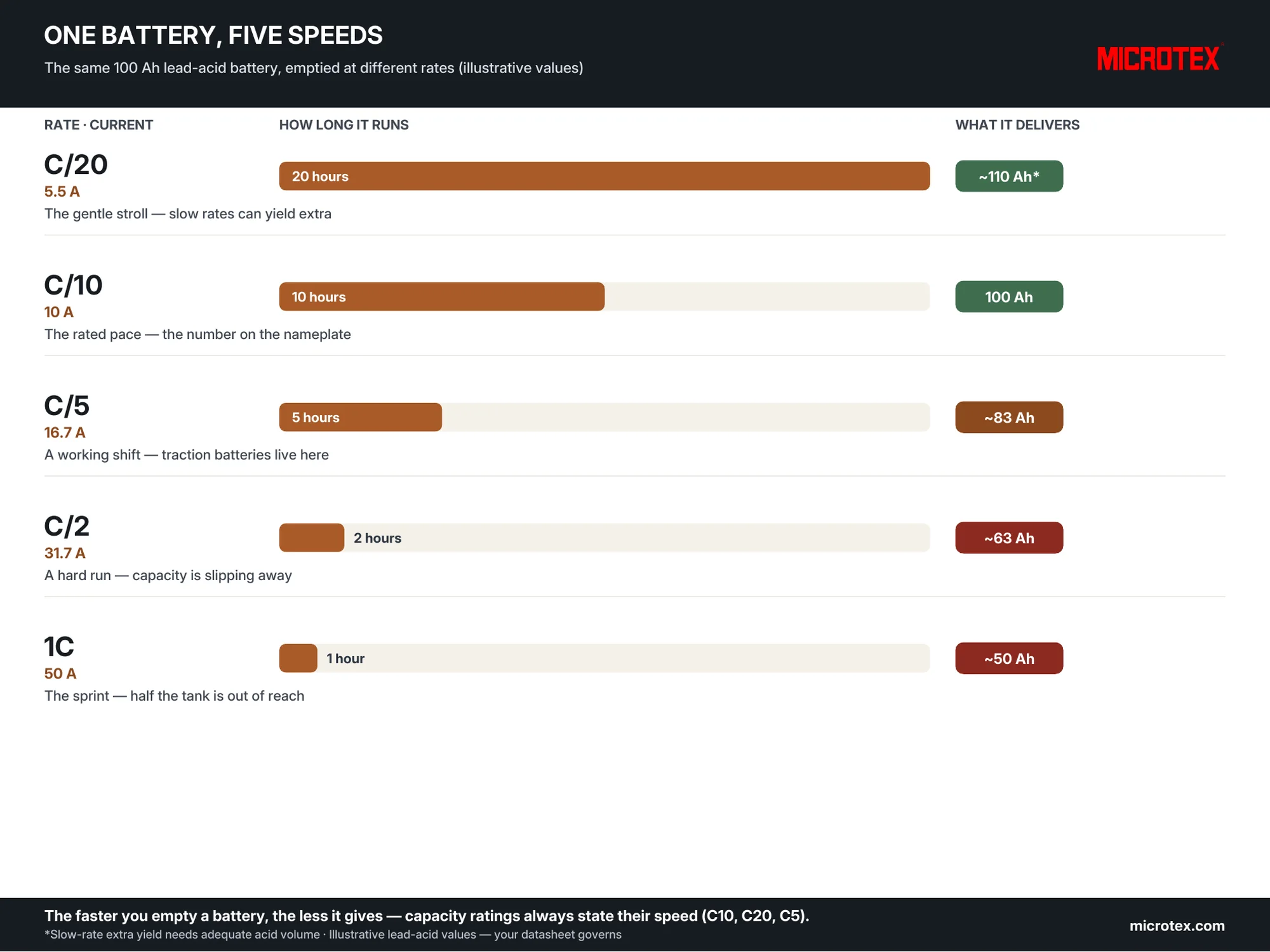
Question 2 — the measurement: what current can this battery sustain for exactly t hours, and how much does it deliver? That is what the datasheet’s endurance table answers, and because of Peukert it is not the same numbers:
| Discharge duration | Sustainable current (typical 100 Ah, 10 h-rated) | Capacity delivered |
|---|---|---|
| 20 hours | 5.5 A | ~110%* |
| 10 hours (rated) | 10 A | 100% |
| 8 hours | 11.7 A | ~94% |
| 5 hours | 16.7 A | ~83% |
| 3 hours | 23.9 A | ~72% |
| 2 hours | 31.7 A | ~63% |
| 1 hour | 50 A | ~50% |
*Illustrative values for a typical flooded lead-acid battery — your battery’s datasheet table governs. The slow-rate bonus appears only where the cell carries enough acid volume.
Now put the two tables side by side and read carefully. The 1C current of this battery is 100 A — and discharged at 100 A, the battery is finished in roughly half an hour, having delivered perhaps 50–58 Ah. The current that lasts exactly one hour is only about 50 A — datasheets call it I₁, the 1-hour-rate current. I₁ is not 1C. Confusing the two is how a battery gets blamed for a sizing mistake: someone reads “50 A for one hour” and calls it 1C, someone else applies the definition and expects 100 A for an hour, and the battery cannot satisfy both. When a figure matters, say which kind it is: “C/5 current” (arithmetic) or “5-hour-rate current, I₅” (measured endurance).
Why datasheets say C10, C20 or C5
Because the capacity depends on speed, an honest capacity figure must state the speed it was measured at. That is the little subscript: C₁₀ = capacity at the 10-hour rate; C₂₀ = at the 20-hour rate; C₅ = at the 5-hour rate — measured at 27 °C, down to a cut-off of 1.75 V per cell (10.5 V for a 12 V battery). The same physical battery might honestly be “100 Ah at C₁₀” and “110 Ah at C₂₀”. Neither number is a lie; they are two speedometer readings of one machine.
Convention follows the application. In India, inverter and solar batteries are rated at C₁₀ (per IS 13369); stationary standby cells are usually specified at C₁₀; traction batteries at C₅, because forklifts work a hard shift; automotive batteries at C₂₀ — a habit from the days when a car battery’s whole job was one start and a couple of hours of headlamps. Today’s start-stop cars restart at every signal while running lights, air-conditioning fans and electronics, which is why the tougher EFB design exists.
Datasheets also write currents this way: I₁₀ is the 10-hour-rate current — for a 100 Ah (C₁₀) battery, I₁₀ = 10 A. You may also meet Cᵣ (rated capacity), CRC (reserve capacity) and Icc, the cold-cranking current — better known as CCA.
C-rate works for charging too
Your phone already taught you this. A 5,000 mAh phone charged at 5 A is charging at 1C — “fast charging” — and it gets warm doing it. Charge overnight at 0.1C and it stays cool. Lead-acid batteries prefer the cool way: the classic starting rate is 0.1 × C₁₀ — 10 A for a 100 Ah battery — tapering as the battery fills. How much current a lead-acid battery can really take, and where the excess goes when a charger pushes harder, is a big enough subject that we have given it its own article. An EV “30-minute fast charge” is roughly 2C — and managing the heat from that is one of the central engineering problems of every battery chemistry.
Try it yourself
1. A 60 Ah battery is discharged at C/5. What current, and roughly how long? Answer: 60 ÷ 5 = 12 A. Nominally 5 hours — in practice a little over 4, because C/5 working delivers roughly 83% of rated capacity.
2. A 150 Ah battery must run a 30 A load. What C-rate is that? Answer: 30/150 = 0.2C, i.e. C/5 — expect roughly 83% of rated capacity, about 4 hours, not 5.
3. Which is working harder: 20 A drawn from a 40 Ah battery, or 20 A from a 200 Ah battery? Answer: the first (0.5C) is sprinting; the second (0.1C) is strolling — same amperes, very different lives.
What this means when you choose a battery
Never compare a C₂₀ number against a C₁₀ number — that is comparing a stroll against a jog. State your real load and running time, and size the battery at that rate. It is exactly how we specify at Microtex, whether it is a stationary OPzS bank rated at C₁₀ or a traction battery built for the C₅ working day. Send us your duty cycle and we will do the arithmetic with you — and for every other datasheet term, the battery glossary is open.
Reviewed and updated 19 August 2026.