
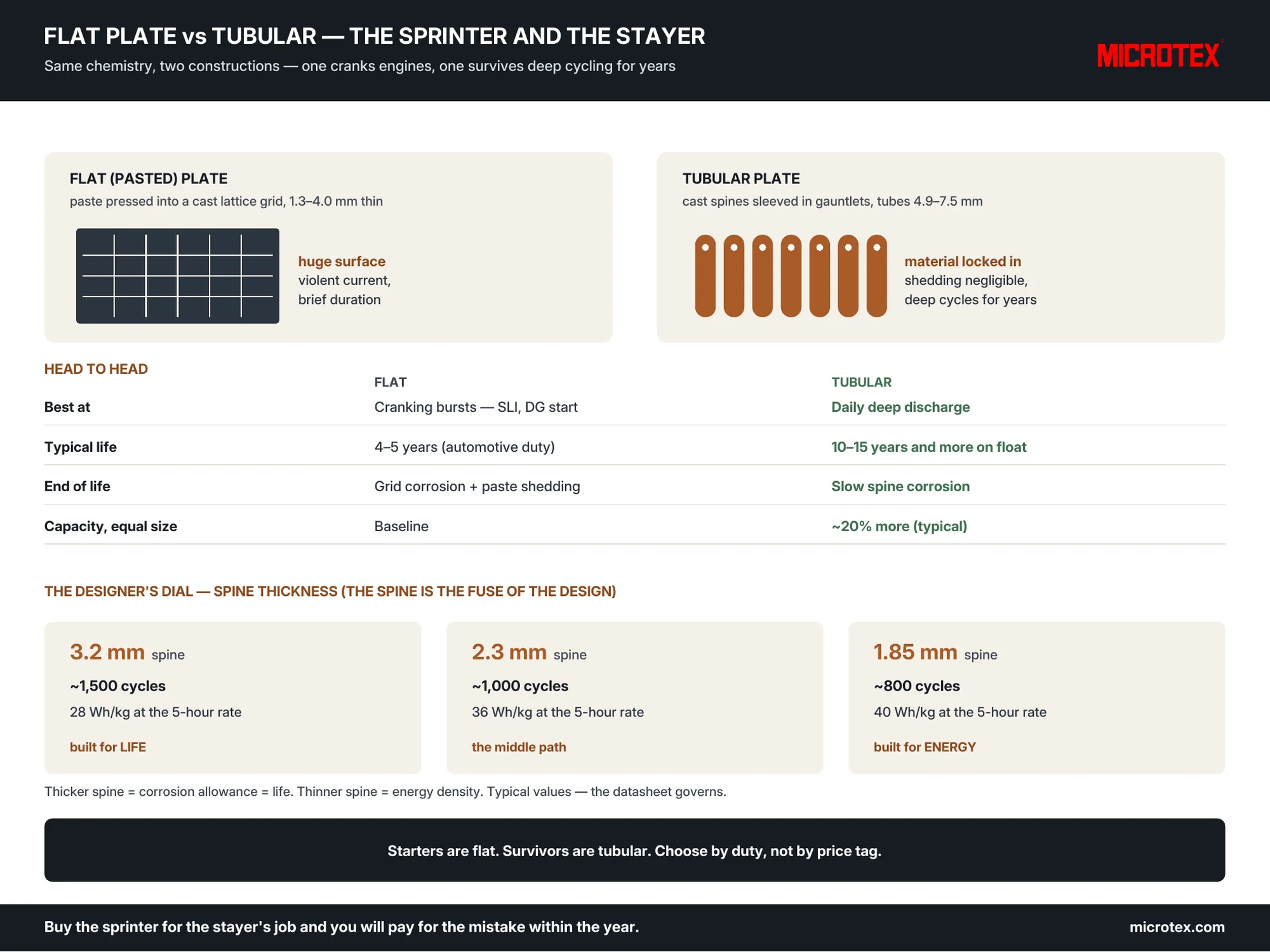
Every lead-acid battery quote hides one construction choice: flat plates or tubular. The flat, pasted plate is a sprinter — enormous surface, brief violent current, the construction inside every car battery. The tubular plate is a stayer — active material locked around cast spines, built to survive deep discharge daily for years. Neither is “better”; they are answers to different questions. Buy the sprinter for the stayer’s job though, and you will pay for the mistake within the year.
The two constructions
A flat plate (also called a pasted, grid or Faure plate) is a cast lattice of lead alloy, typically 1.3–4.0 mm thick, with active-material paste pressed into its windows. Thin plates in large numbers give a starter battery its huge working surface — and its ability to hurl hundreds of amperes at a cold engine. A tubular plate replaces the lattice with a row of cast alloy spines, each sleeved in a fabric gauntlet packed with active material, tube diameters running about 4.9–7.5 mm. Other constructions exist for special duties — Planté, conical, jelly-roll, bipolar — but flat and tubular between them power nearly everything that rolls, lifts or waits for a power cut. The chemistry inside is identical either way: the double-sulphate reaction, PbO₂ + Pb + 2H₂SO₄ ⇌ 2PbSO₄ + 2H₂O.
What each does best
The flat plate’s gift is rate. Maximum surface, minimum path: nothing in lead-acid delivers a cold-cranking burst better, which is why starter and DG-set batteries are flat-plate without exception, serving 4 to 5 years in automotive duty. Its weakness is endurance. Each deep cycle swells and shrinks the paste, and with nothing holding it, material sheds to the cell floor; meanwhile the positive grid corrodes in service until contact is lost — the classic flat-plate end of life. Asked to run an inverter through daily power cuts, a flat-plate battery lasts a fraction of a tubular’s life; the low purchase price buys the shortest path to the next purchase.
The tubular plate’s gift is survival. The active material sits in the annular space between spine and gauntlet — swelling has nowhere to go, so shedding stays negligible and the plate cycles deeply for years: 10 to 15 years and more on float, and the highest cycle life in lead-acid. For equal size and weight, the tube geometry also yields around 20% more usable capacity (typical figures — the datasheet governs). Honesty requires the limitation too: spine-to-material contact area is smaller than a lattice’s, so under very heavy current the local heating runs higher — sustained cranking duty stays with flat plates for good reason. And the same construction scales to the extreme: submarine cells over a metre tall, 5,000–22,000 Ah, fitted with air-lift pumps to defeat the electrolyte stratification that tall cells invite.
Why the gauntlet changes everything
The tube — the trade calls it a PT bag or gauntlet — is woven from high-tenacity polyester multifilament yarn set with an acrylic resin, and it earns its keep four ways. Its pores are sized to let electrolyte move freely while holding active material in, taking shedding to a negligible amount. Its elasticity absorbs the pressure of the material’s cyclic expansion while pressing it firmly against the spine — stable contact, stable performance. It resists abrasion during assembly. And it quietly acts as a filter, slowing the release of antimony from the positive spines into the electrolyte — the migration that, in an ageing battery, erodes the safety margin at the negative plate. A flat plate offers none of this: between grid wire and electrolyte there is essentially no barrier at all. How the plate is built, spine by spine, is on the tubular plate technology page.
The designer’s dial: spine thickness
| Tube diameter | Spine thickness | Specific energy (C5) | Typical cycle life |
|---|---|---|---|
| 7.5 mm | 3.2 mm | 28 Wh/kg | ~1,500 cycles |
| 6.1 mm | 2.3 mm | 36 Wh/kg | ~1,000 cycles |
| 4.9 mm | 1.85 mm | 40 Wh/kg | ~800 cycles |
Tubular end of life is spine corrosion — the spine is the fuse of the design — so its thickness is the designer’s dial. A thick 3.2 mm spine carries years of corrosion allowance and repays with the longest cycle life; a slender spine packs more energy into each kilogram and surrenders life for it. When two tubular batteries quote different weights for the same ampere-hours, this table is usually the reason: one of them is carrying more future.
Choosing for your duty
Starting engines — car, truck, DG set — is flat-plate country, full stop. Daily deep cycling is tubular country: home inverters and UPS duty, forklifts and motive power, mining machines, and the stationary banks that wait years between power cuts on the OPzS page. Once you have chosen tubular, a second question follows — free acid or gel around those same plates — and that one is answered honestly in tubular gel vs flooded. Strange terms live in the glossary; strange duties deserve an engineer — describe yours to us and the recommendation comes back with the arithmetic shown.