
AGM and gel are the two ways to seal a lead-acid battery. Both belong to the VRLA family — valve-regulated, non-spillable, never topped up — and buyers meet them as rivals on the same quotation. The real difference is a single engineering decision: what holds the acid still. Absorb it into a glass-fibre mat and you get AGM; immobilise it in silica gel and you get a gel battery. Everything else — the strengths, the failure modes, the right duty for each — cascades from that one choice, and choosing wrongly is the commonest specification mistake in sealed batteries.
First, what they share: the VRLA principle
In any flooded battery, charging past a certain point splits water into hydrogen and oxygen, which bubble away — that is why flooded cells need watering. A VRLA cell closes that loop with the oxygen-recombination cycle: oxygen evolved at the positive plate travels through gas passages to the negative plate and is converted back to water there, while the design suppresses hydrogen evolution almost entirely. A one-way valve — the V and R in VRLA — vents only if internal pressure ever demands it. The result, for both AGM and gel: no topping up, no acid handling, no watering round, and cells classified as non-spillable, accepted for transport under the applicable exemptions (verify current carrier rules per shipment). The full mechanism is unpacked in our VRLA guide.
The difference: mat versus gel
The gelled battery came first — pioneered in Germany in the 1950s by stiffening the acid with fumed silica. AGM followed in the 1970s and matured through the 1980s in military and UPS service. The two constructions read almost identically on a brochure and behave quite differently in a battery room.
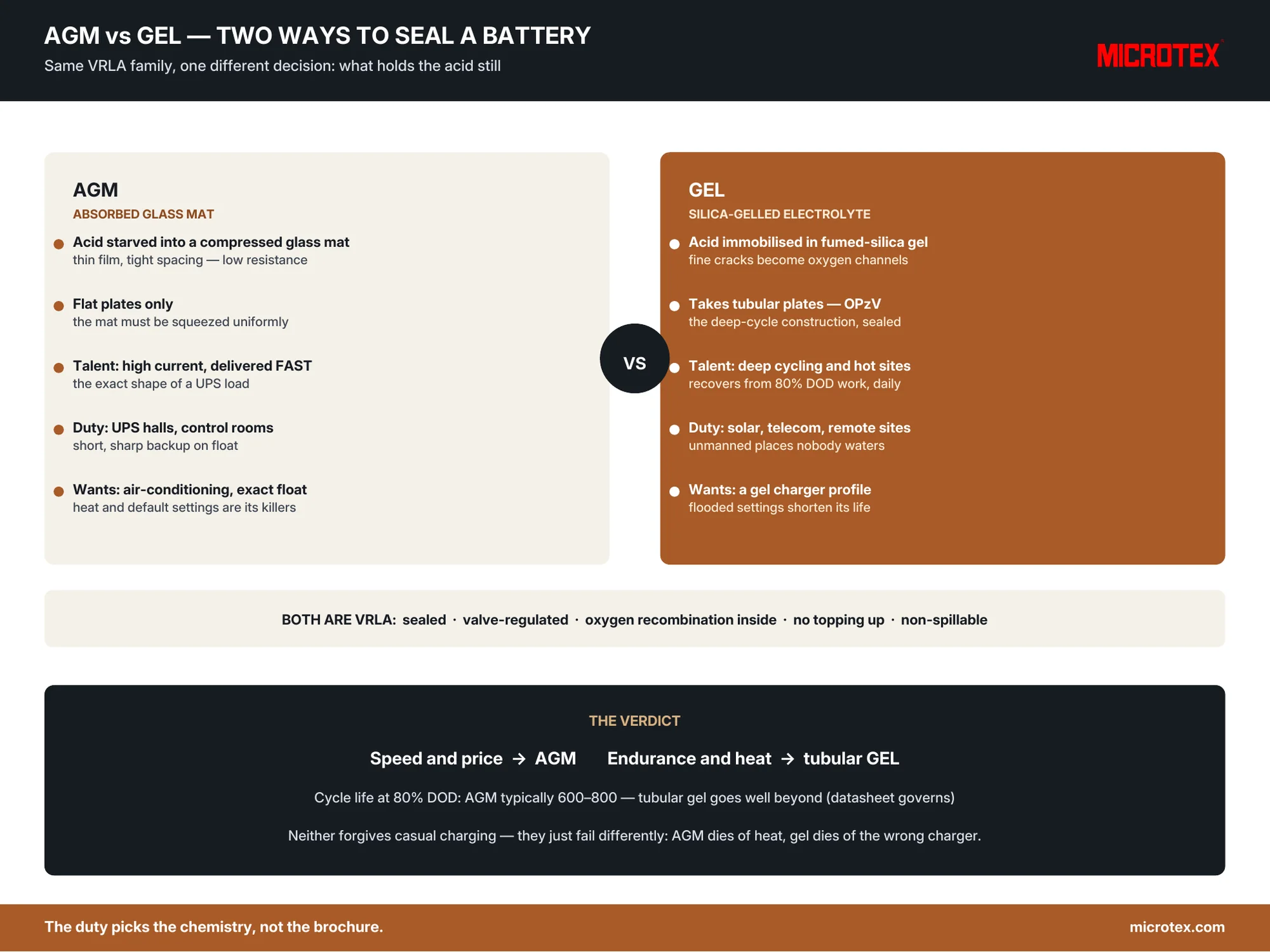
AGM holds a deliberately starved quantity of acid inside compressed glass-fibre mats pressed hard against the plates. The thin acid film and tight plate spacing give AGM very low internal resistance — its defining talent is delivering high current, fast, which is exactly the shape of a UPS load. The compression requirement is also why AGM batteries only ever use flat plates: a tubular plate cannot squeeze a mat uniformly. AGM cells run compact for the job, and their sealed construction permits horizontal rack mounting.
Gel mixes the acid with fumed silica into a substance the consistency of petroleum jelly, filling the whole cell. Early in life the gel shrinks slightly and develops fine cracks — and those cracks become the permanent oxygen channels that make the recombination cycle work (the mechanism is described in Pavlov’s standard reference on lead-acid batteries). Because nothing needs compressing, gel cells can carry tubular plates — the deep-cycle construction — which is precisely what an OPzV battery is. The larger acid volume also gives gel more thermal mass, and an immobilised electrolyte cannot stratify: the slow layering of acid that troubles tall cells simply cannot happen.
Where each one wins
| AGM | Gel | |
|---|---|---|
| Electrolyte | Starved — absorbed in glass mat | Immobilised in silica gel |
| Plates | Flat only (mat needs compression) | Flat or tubular (OPzV) |
| High-rate delivery | Excellent — the UPS shape | Modest — not a sprinter |
| Deep cycling | Typically 600–800 cycles at 80% DOD | The deep-cycle VRLA — well beyond AGM |
| Heat | Wants air-conditioning | Tolerates hot sites better |
| Stratification | Resisted | Impossible |
| Up-front cost | Lower | Higher — repaid in cycling duty |
| Best duty | UPS halls, control rooms, short sharp backup | Solar, telecom, remote and unmanned sites |
Why gel is not a starter battery
Ask a gel cell for a violent burst of current and its higher internal resistance answers slowly — that is the physics, not a defect. Capacity always depends on how fast you draw it (the Peukert effect, explained with schoolroom examples in what C-rate means), and gel gives up more than AGM at punishing rates. Turn the question around and gel’s virtue appears: it recovers well from genuine deep-cycle work, day after day at up to 80% depth of discharge — the duty that ages an AGM battery early. Sprinter and marathon runner, from the same chemistry.
The failure modes to respect
AGM dies of heat and float error. A starved electrolyte means little thermal mass; in a hot room, high float voltage and temperature feed each other, dry the cell, and in the worst case walk it into thermal runaway. The air-conditioning is part of the battery system, and the float voltage must match the cell’s specification with temperature compensation — a UPS left on factory defaults is the commonest early killer.
Gel dies of the wrong charger. A flooded-battery charge profile overdrives a gel cell and shortens its life; gel needs its own voltage settings, temperature-compensated. Its other enemy is chronic undercharge — the undersized solar array that never quite finishes the job, feeding the slow crystallisation described in our sulfation guide. Neither battery forgives casual charging; they just fail differently. And the old wisdom holds for both in cold climates: a charged battery resists freezing — keep them charged.
So which should you buy?
Read your duty, not the brochures. An air-conditioned room, sharp high-rate loads, float service with occasional discharge — that is AGM country, and our 2V AGM VRLA range is built and type-tested for exactly it. A hot, remote or unmanned site with real daily cycling — solar, telecom, outstations — belongs to tubular gel, on the OPzV battery page. And where trained maintenance exists and maximum verifiable life is the goal, flooded OPzS still sets the standard. We manufacture all three, which is why we can afford to be honest: the duty picks the chemistry, not the catalogue.
Terms that puzzled you live in the glossary. A duty that straddles the boundary — cycling in an air-conditioned room, or high-rate loads in the heat — is worth an engineer’s opinion rather than a guess: describe the site to us and the recommendation comes back with the reasoning attached.
Gel vs AGM — the honest comparison, on film
Where AGM wins, where gel wins — and where the CTO would refuse to sell either.