
Sulfation is what kills neglected lead-acid batteries. Every discharge normally coats the plates with soft, finely divided lead sulphate — that is the chemistry working as designed, and charging converts it straight back. But leave a battery discharged, undercharged or idle in the heat, and those soft crystals slowly ripen into large, hard, white crystals that refuse to take part in charging. Capacity quietly disappears. The good news: sulfation is almost entirely preventable, and in its early stages, reversible.
The chemistry: soft sulphate versus hard sulphate
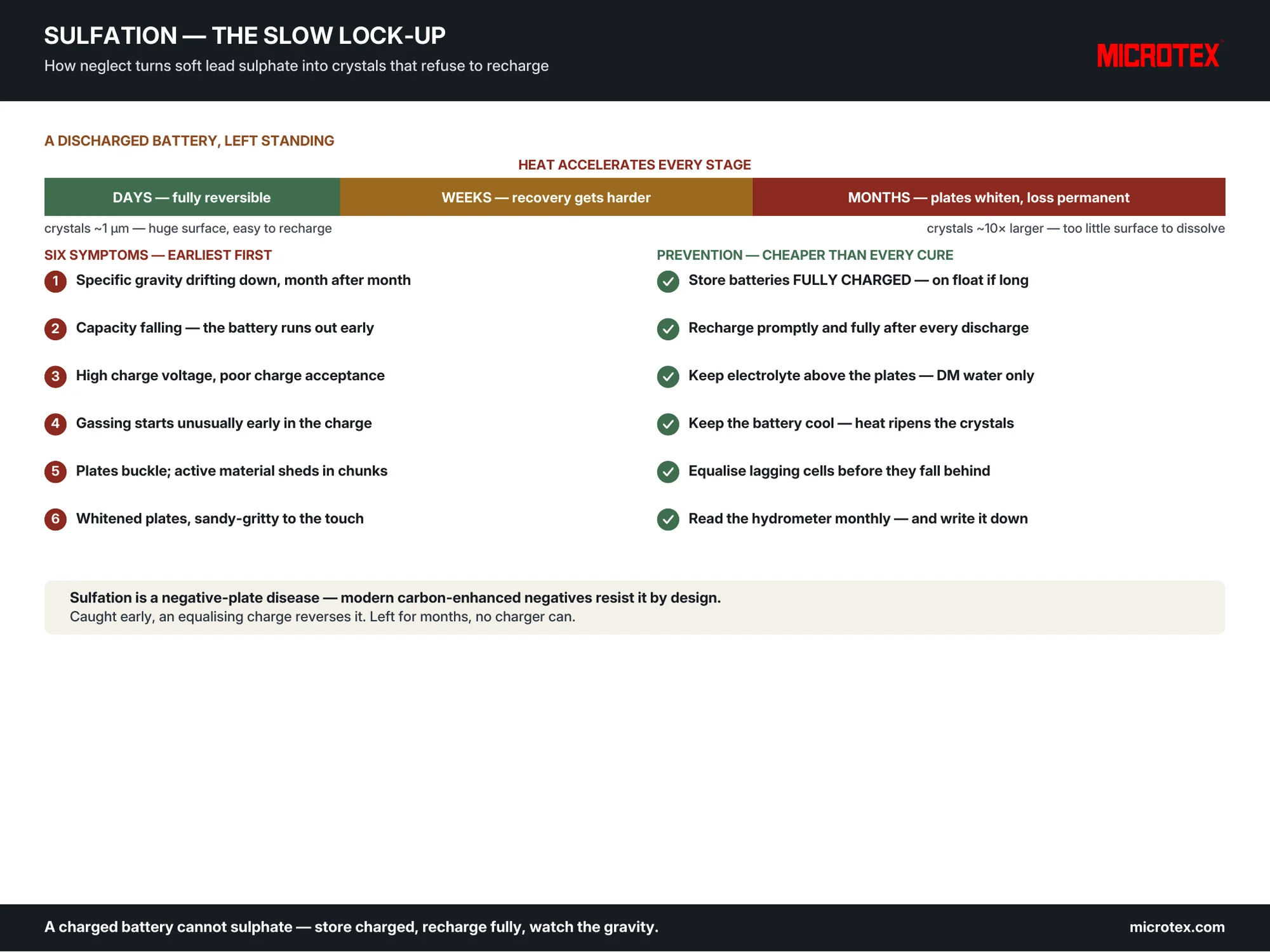
Recharging works by dissolution and precipitation: lead sulphate dissolves slightly into the electrolyte, and the dissolved lead ions are converted back to active material at the plates. The word “slightly” carries the whole story. Lead sulphate dissolves at only about 45 mg per litre in pure water, and far less — a few milligrams per litre — in battery-strength acid. Fresh, fine crystals expose enormous surface area, so this trickle of dissolution is enough to recharge them. But crystals in storage keep slowly dissolving and re-precipitating, and the process favours the big crystals at the expense of the small ones. Reported storage studies show crystals growing from roughly a micrometre when freshly discharged to around ten times that size over months of idle storage — and a large, dense crystal presents so little surface that the charger simply cannot dissolve it fast enough. That locked-up sulphate is what the trade calls hard sulfation. It also raises the battery’s internal resistance, which is why sulphated batteries show high charging voltage and poor charge acceptance.
Why the negative plate suffers first
Sulfation is a disease. The negative self-discharges faster; in partial-state-of-charge duty it is the plate that stays chronically undercharged; and if the electrolyte level falls, the exposed top of the negative plate sulphates in air. A badly sulphated negative turns visibly white and feels sandy or gritty. Independent testing confirms the operating pattern behind it: batteries cycled at partial charge without a periodic full recharge steadily lose capacity to stratification and sulphate build-up — recoverable only by an occasional full, equalising charge. This is also why modern designs mix specialty carbon into the negative paste: carbon keeps charge acceptance high at partial state-of-charge and measurably slows sulfation — one of the quiet revolutions in current lead-acid technology.
The symptoms
Falling capacity — the battery runs out early. Falling electrolyte density that charging no longer restores. High charging voltage with poor charge acceptance. Gassing that starts unusually early in the charge. Plate buckling and chunky shedding in advanced cases. And the visual signature: whitened plates with a sandy, gritty feel. On a maintained battery, the earliest warning is in the logbook before it is visible anywhere else: specific gravity drifting down month after month while voltage looks normal.
What causes it
Every cause is a variation on one theme — sulphate left unconverted, given time and warmth to harden: leaving the battery discharged for weeks or months; frequent undercharging or a float voltage set too low; electrolyte level falling below the plate tops; storage or operation at high temperature (heat accelerates the crystal ripening); electrolyte stratification, where dense acid at the bottom sulphates the lower plate; topping up with acid instead of demineralised water; and ignoring lagging cells until they fall too far behind the string.
Reversible or permanent?
Caught early — days or weeks of undercharge — sulfation is reversible: a controlled overcharge applied to an already fully-charged battery (an equalising charge) breaks up the young crystals. Left for months, the crystals grow past the point of practical recovery: the plates whiten, and no ordinary charge will bring the capacity back. Between those extremes sit the workshop recovery procedures below — worth attempting on valuable batteries, honestly framed: recovery is partial and never guaranteed.
Workshop recovery procedures
For trained battery technicians, with full PPE and continuous temperature watch — pause any of these if the electrolyte approaches 50 °C.
1. Long, gentle charge (early sulfation). Top up with distilled water. Charge at normal current until noticeable gassing; rest 30 minutes; recharge at one-tenth of normal current until profuse gassing; rest again; repeat the low-rate charge until specific gravity and charging voltage hold steady near normal. Adjust final density if needed.
2. Deep-discharge cycling (long-neglected cells). Charge at 0.2C until 2.4 V per cell, then drop to 0.05C until voltage and gravity plateau with strong gassing. Rest an hour; resume at 0.05C to steady state; rest again. Repeat charge-and-rest until gassing begins immediately on charging, then discharge at 0.02C to 1.75 V per cell, rest two hours, and repeat the whole sequence. Full restoration, where possible at all, typically takes seven to eight cycles.
White powder, blue powder — what’s on my terminals?
Two different chemicals, one message. The white crust is lead sulphate from acid mist meeting the terminal. The blue-green one appears where terminals carry copper inserts: sulphuric acid attacks the copper to form copper sulphate, whose hydrated crystals are the familiar blue. Wash either away with baking soda and water (It must never enter the cell: only for external cleaning), dry, and coat the terminals with a thin film of petroleum jelly — not grease. Corroded terminals add resistance, and resistance is how good batteries get blamed for bad connections.
Prevention — cheaper than every cure
Store batteries fully charged, and on a float or smart maintenance charger if the storage runs long — a charged battery cannot sulphate, and (bonus in cold climates) a charged battery resists freezing too. Recharge promptly and fully after every discharge; shallow, hurried charges are how sulfation compounds. Keep electrolyte above the plates, top up with demineralised water only, keep the battery cool, and act on lagging cells early with an equalising charge. Your hydrometer is the early-warning instrument: read it, correct the reading to 27 °C as shown in our battery acid guide, and write it down.
Sulfation rewards exactly the discipline this whole series teaches: charge fully, store charged, watch the gravity. For how charging speed interacts with all of this, see what C-rate means; for the carbon-enhanced negatives that resist PSOC sulfation, see the VRLA guide; and for any term that puzzles you, the glossary is open. Batteries in a duty where sulfation keeps winning? Describe the duty to us — the fix is usually in the charging regime, not the battery.