
Behind every reactor’s safety case sits a room full of batteries. When the grid disappears and the diesel generators are still cranking, the station’s DC system — its battery banks — holds up the instrumentation, the protection relays, the switchgear and the emergency lights, without being asked. Nuclear plants are the most conservative battery buyers on earth, and they have spent some seventy years deciding what to trust. That story, told honestly, is the best explanation of stationary battery engineering we know.
What the batteries actually do
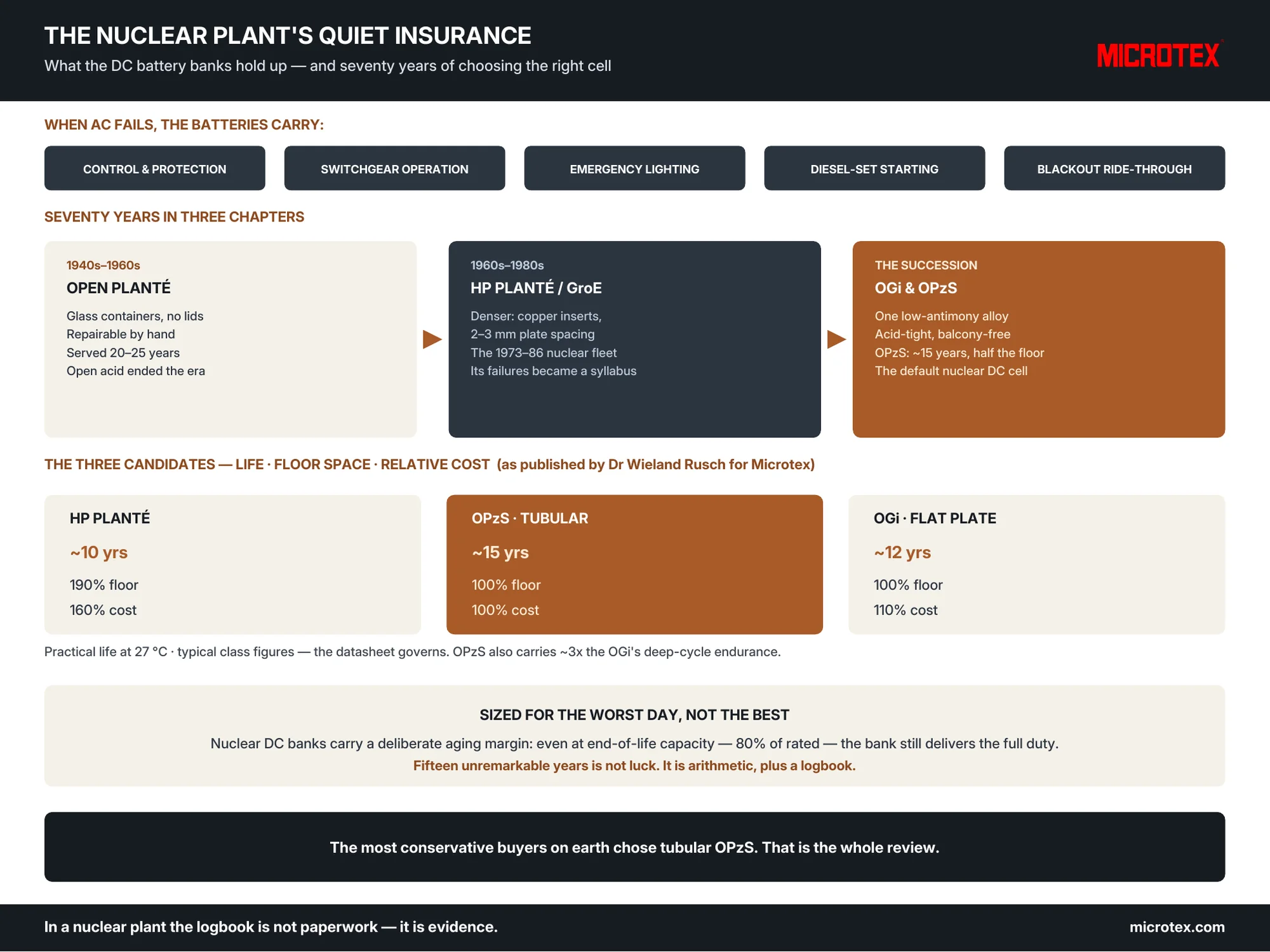
A power station runs on AC but survives on DC. The battery banks float across the DC buses and carry, the instant supply fails: control and protection systems — the relays that measure, decide and trip; switchgear operation — the stored energy that opens and closes breakers on command; emergency lighting for the operating staff; the starting duty for standby diesel sets; and the station-blackout ride-through, the defined minutes-to-hours window the plant must survive on batteries alone while backup generation comes up. Some of these duties are safety-classified and carry the strictest qualification demands; others are conventional plant services. All of them assume one thing: the bank delivers its full duty on the worst day of its life, not its best.
That assumption is engineered, not hoped for. Stationary banks are sized with a deliberate aging margin — the design must still carry the complete duty cycle when the battery has faded to its end-of-life capacity, conventionally 80% of rated. Sizing this way is why a well-kept bank gives fifteen years of unremarkable service: the margin absorbs the aging, and the logbook proves it.
Seventy years in three chapters
The history that follows draws on the article Dr Wieland Rusch wrote for Microtex — his biography closes this post.
Chapter one: the open Planté cell. From the Second World War into the 1960s, utilities ran open Planté cells — glass containers without lids, Planté positive plates, antimony-free negatives, pure lead connectors. Crude, but honest: a technician could reach in and repair a bulged plate or clear a short, and the cells served 20 to 25 years. Open acid in an open room ended the design; development moved on.
Chapter two: the High-Performance Planté. In the 1960s, British manufacturers introduced a denser successor — called GroE in Germany — keeping the Planté positive but adding a lead-antimony flat negative, tight plate spacing with microporous separators, copper-inserted pillars and bolted, lead-coated copper connectors. Energy density improved, and this is the battery that went into the nuclear plants built from 1973 to 1986. It never reached its ancestor’s 20-to-25-year life — and its failure modes became a syllabus in themselves. Container “balconies” carrying the positive plates cracked at their ends on large cells. Mixed alloys in one cell shed conductive flakes that grew into short circuits. Pillar bushings that were not acid-tight let corrosion in — failures that ruined at least one German maker. Chromate residue from the Planté forming process, if not washed out completely, quietly shortened plate life. And plates spaced only 2–3 mm apart turned every bit of positive-plate growth into a potential short, while plate friction lifted poles and opened leaks. Nearly twice the weight and floor space of what followed, at a premium price.
Chapter three: the succession. The OGi — a flat-plate flooded stationary design — and the tubular-plate OPzS, both built on a single low-antimony alloy system (around 1.6% Sb), in balcony-free containers with acid-tight seals, displaced the High-Performance Planté across replacement programmes. As Dr Rusch estimated at the time, Europe’s nuclear fleet still carried about 20% legacy Planté banks, with OGi and OPzS at roughly 40% each.
The three candidates, compared
| HP Planté | OPzS (tubular) | OGi (flat plate) | |
|---|---|---|---|
| Cycles (75% DOD, C4 basis) | — | ~1,500 | ~500 |
| Practical life at 27 °C | ~10 years | ~15 years | ~12 years |
| Pillar bushings | Systematic failures persist | Acid-tight | Acid-tight |
| Footprint | 190% | 100% | 100% |
| Weight | 190% | 100% | 100% |
| Relative cost | 160% | 100% | 110% |
The table explains the succession without a single adjective. The tubular OPzS carries triple the OGi’s cycle endurance — the construction argument is unpacked in flat plate vs tubular — while the OGi class keeps its place where high-rate discharge duty dominates, on the 2V flooded battery page. For the long-duty banks that define nuclear DC service, the OPzS became the default: longest practical life, half the Planté’s floor space, and nothing about its seals or alloys waiting to surprise anyone.
What a nuclear buyer demands
Nuclear procurement does not buy brochures; it buys evidence against named standards, and any vendor should be fluent in the terrain. Type testing of stationary cells to the IEC 60896 series. Maintenance, testing and replacement practice per IEEE 450 for vented lead-acid. For safety-classified duties, qualification concepts along the lines of IEEE 535 for Class-1E batteries. Seismic qualification — a regime we know from the inside: in May 2026 our 2V HDP stationary cells, mounted in their double-tier station stand, underwent Resonance Search and Seismic Qualification testing to IEC/IEEE 60980-344:2020, the current nuclear seismic standard, on the triaxial shake table at CPRI’s Earthquake Engineering and Vibration Research Centre, with NPCIL quality assurance witnessing the test (report CPRIBLREVRC26T0049). Beyond that: sizing calculations with the aging margin shown, not asserted; documentation and material traceability that survive a licensing audit; and a supplier expected to hold records — and spares — for decades. Every requirement is project- and site-specific: treat this list as the map, and verify the exact demands per tender.
The maintenance religion
Flooded stationary banks reward ritual: specific gravity readings corrected to 27 °C and written down, as the battery acid guide shows; float voltage held to the datasheet with temperature compensation; periodic capacity tests that turn faith into data; and ventilation discipline, because charging makes hydrogen and hydrogen forgives nothing — the full safety canon is in why batteries explode. In a nuclear plant the logbook is not paperwork; it is evidence that the quiet insurance in the battery room is real. The same DC discipline, one fence further out, runs the grid itself — see the substation battery page.
Talking to us about critical-infrastructure duty
Microtex builds the OPzS, HDP and flooded stationary classes this post describes, with CPRI type-test evidence — including the nuclear-standard seismic testing above — quoted on the product pages, and engineers who answer sizing questions with the calculation attached. If your duty is critical — utility, industrial or otherwise — describe it to us: loads, autonomy, room, and the standards your tender names. Strange terms live in the glossary.
About the historical source: Dr Wieland Rusch, the German battery scientist and inventor of the copper stretch-metal submarine battery, was associated with Microtex from 2008 to 2011, designing several of our battery ranges and installing manufacturing processes and methods that remain in use on our line today. The historical chapters and comparison table above are drawn from the article he wrote for Microtex.