
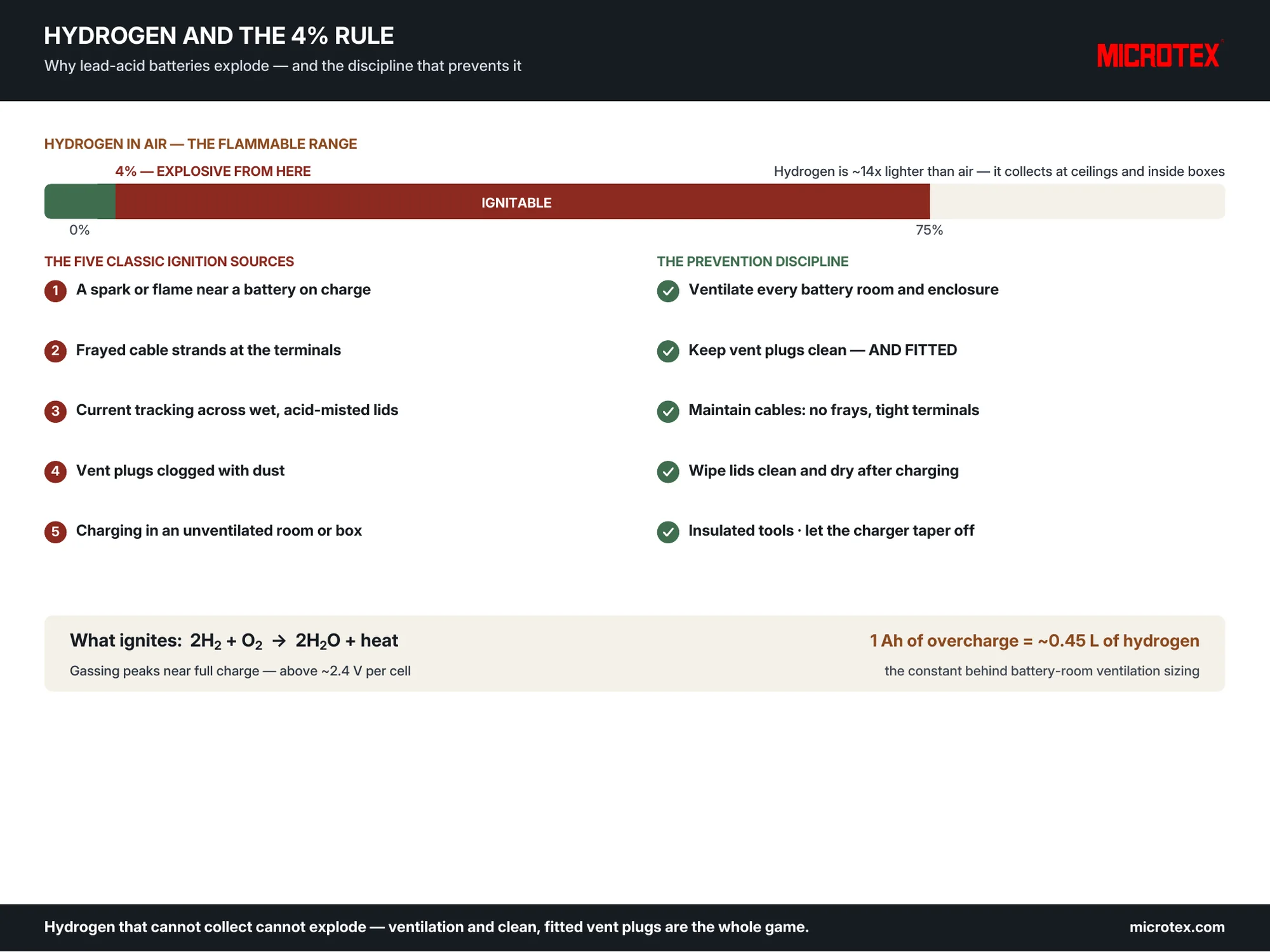
Batteries explode when hydrogen gas from charging accumulates and meets a spark. Every lead-acid battery produces hydrogen and oxygen towards the end of charge, as some of the water in the electrolyte is split by electrolysis. Hydrogen becomes explosive at just 4% concentration in air — and it stays ignitable all the way up to about 75%. Almost every battery explosion traces back to the same two-step failure: the gas was allowed to collect, and something made a spark. Both steps are preventable.
Where the gas comes from
For most of the charge, current goes into converting lead sulphate back to active material. But as the cell approaches full charge — a growing share of the current splits water instead: oxygen evolves at the positive plate, hydrogen at the negative. Overcharging, charging too fast, or a poorly regulated charger all make the gassing heavier. A flooded battery breathes these gases out through its vent plugs, which is exactly why what surrounds the battery matters so much.
If that escaping hydrogen ignites, the flame can flash back through an open path into the cell, ignite the gas mixture inside, and the pressure bursts the container:
2H₂ + O₂ → 2H₂O + heat
How much gas are we talking about? The physics is exact: every ampere-hour of overcharge splits about a third of a gram of water into roughly 0.45 litres of hydrogen (plus 0.22 litres of oxygen) at room conditions — this constant is the very basis on which battery-room ventilation standards are sized. A 500 Ah bank drifting 10 A into overcharge makes over four litres of hydrogen an hour. In a sealed cabinet, the 4% threshold arrives far sooner than intuition suggests.
Two things quietly raise the gassing over a battery’s life. Heat is one: a hotter cell gasses more at the same charger voltage, which is one more reason temperature-compensated charging matters. Age is the other: in antimonial batteries, antimony slowly migrates to the negative plates over the years and lowers the voltage at which hydrogen evolves — so an old battery gasses earlier and harder than it did when new. Design your ventilation for the fleet’s old age, not its youth.
Sealed (SMF/VRLA) batteries are safer on this particular count: in a healthy, correctly charged cell there is no open vent path, the great majority of the gas recombines internally, and the valve releases very little. But none of that is an absolute — the valve exists precisely because cells sometimes must vent, and what they vent is the same ignitable hydrogen, which is why the ventilation standards include VRLA batteries in their calculation rather than exempting them. “Healthy” and “correctly charged” are doing real work in this paragraph: an abused VRLA battery gasses too.
Why hydrogen is sneaky
Hydrogen is the lightest gas there is — about 0.09 g/L, roughly 14 times lighter than air (oxygen, at 1.43 g/L, is about 16 times denser than hydrogen). In the open, it rises and disperses within moments, which is why outdoor battery work is rarely the problem. The danger is anywhere with a ceiling and no draught: a battery box, a golf cart’s enclosed compartment, a battery room with the windows shut. There the gas quietly collects at the highest point until it crosses 4% — and then a single spark is enough. Golf cart battery explosions are a textbook case: eight batteries in a closed box, a brushed motor sparking inches away.
The five classic ignition scenarios
1. A spark near a charging battery. Charging is when gassing peaks — any naked flame, cigarette, grinder or contactor spark near a battery on charge is the classic trigger.
2. Frayed cable ends. Broken strands at the crimp make intermittent contact — a spark generator bolted directly to the gas source. Check where cables enter metal battery boxes, too: a sharp entry angle chafes insulation.
3. Wet, acid-misted lids. End-of-charge bubbling leaves an acid film on the lid; current tracking across that film heats, sparks and corrodes. Wipe lids clean and dry after charging.
4. Clogged vent plugs. Dust-blocked plugs trap gas inside the cell until pressure and concentration build. The remedy is to keep them clean — never to remove them.
5. Unventilated rooms. Poor ventilation lets hydrogen build at ceiling level until the whole room is a trigger waiting for a switch contact.
How to prevent it — the discipline
Ventilate. A battery room or enclosure must exchange air — hydrogen that cannot collect cannot explode. Battery-room ventilation requirements are formalised in standards such as IEC 62485-2; if in doubt, more airflow.
Keep vent plugs clean — and fitted. Wash dusty plugs with soap and water. Never charge with the plugs removed: an open well sprays acid mist and gives a flame a straight path into the cell. Quality vent plugs carry a microporous ceramic flame-arrestor disc inside — look into the vent hole and you should see the small white disc.
Maintain the cables. No frayed strands, tight terminals, no sharp bends where cables enter boxes, and keep sparking devices such as brushed motors well separated from the battery compartment.
Wipe the lids. Clean, dry cell tops after every charge — no tracking paths.
Use insulated tools. A spanner dropped across terminals is a spark and a short in one motion; a taped spanner is not a rated insulated tool. Use only VDE/1000V-rated tools for your safety.
Switch the charger off before connecting or disconnecting leads. The make-and-break spark at a live clamp, centimetres above a gassing cell, is the commonest self-inflicted trigger there is.
Let the charger taper. Gassing is worst when full charge meets full current. Modern chargers reduce current towards the end automatically — one more reason the charger determines the battery’s fate.
Why does my battery smell like rotten eggs?
That smell is hydrogen sulphide (H₂S) — a colourless, highly toxic, flammable gas that severe overcharging can generate in a lead-acid battery. It is the same smell as decaying organic matter, and it is a warning, not a curiosity: switch the charger off, ventilate the area, and stay away until the smell has completely cleared. Then find out why the battery was being overcharged — H₂S does not appear during normal, correctly-set charging.
A battery that is charged correctly, ventilated properly and maintained on a schedule is a remarkably safe machine — millions work quietly in homes, plants and vehicles for decades. The discipline in this article is the whole difference. For the charging side of that discipline, read our guide to C-rate and charging speeds and the battery acid handbook; for terminology, the battery glossary. And if you are designing a battery room or an enclosure, ask us — ventilation questions are exactly the kind we like answering before commissioning, not after.