
🌎 Lea esta página en español
🇷🇺 Читать на русском
/ RESERVE POWER · TUBULAR GEL (VRLA)
OPzV battery — tubular gel for places nobody visits
Solar fields, telecom towers, oil-and-gas outstations — sites where no one tops up a battery, and the afternoon is hot. The OPzV cell answers that duty: the same long-life tubular plates as our flooded OPzS, sealed into a gel electrolyte that asks for no watering. Microtex has manufactured gel batteries in Bengaluru since 2007 — sold under our Eternia gel range.
CPRI type-tested — 2V 1200 Ah OPzV · 2V 1000 Ah T-Gel — Gel manufacture since 2007 — Maintenance-free VRLA
Why gel — the honest version
In a gel cell the electrolyte is immobilised in silica gel. Two consequences do the selling. First, stratification — the slow layering of acid that quietly kills tall flooded cells between equalise charges — cannot happen; the acid cannot move. Second, the gel’s water loss is self-limiting by design: early in life the gel shrinks and forms fine cracks that become permanent oxygen channels, the recombination cycle takes over, and water loss effectively stops. That is the science behind “no topping up” — a mechanism, not a slogan (it is described in the standard reference, Pavlov, Lead-Acid Batteries, 2011).
The honesty that keeps the promise: heat is still the enemy. Every lead-acid chemistry ages faster when hot — which is exactly why the low-maintenance battery matters most in hot, remote places: nobody is there to compensate for neglect. Shade the battery room, and the gel does the rest.
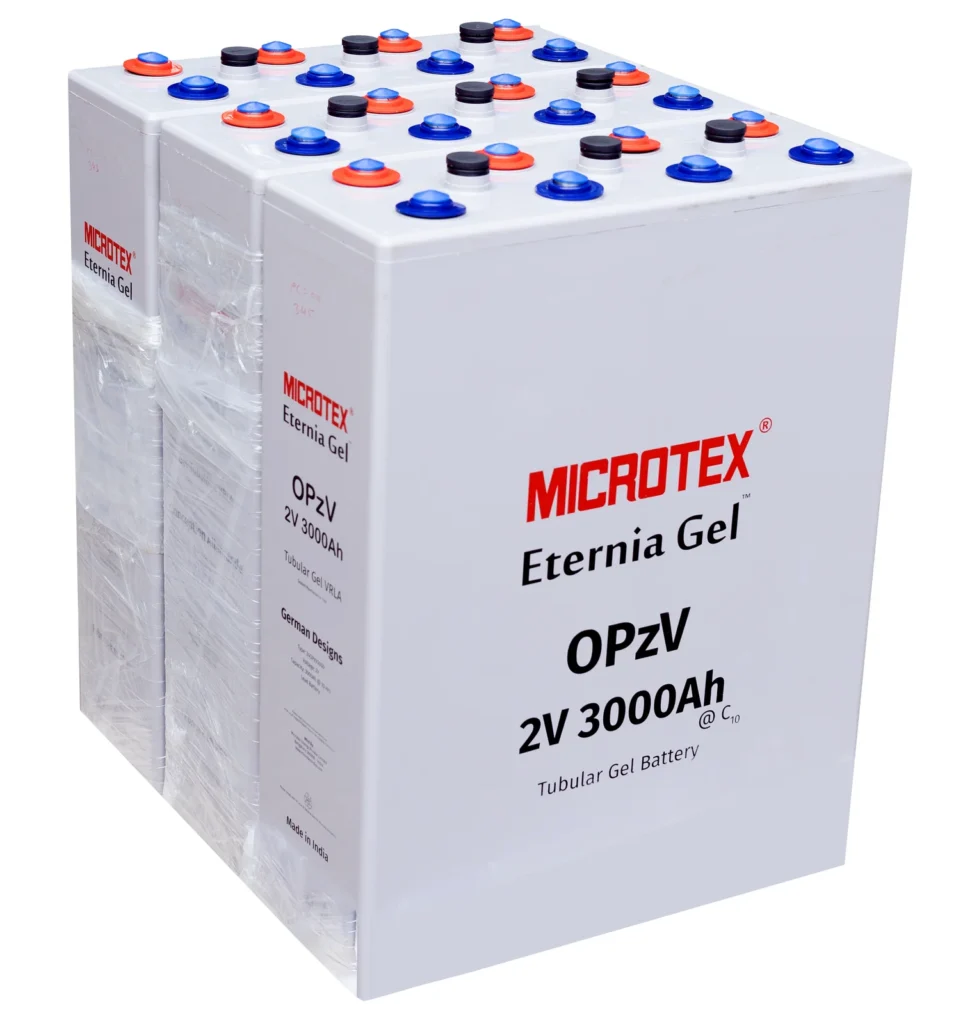
FIG. 1 — 2V OPzV TUBULAR GEL CELLS
Where OPzV earns its keep
Solar & hybrid power
Daily cycling, remote sites, no maintenance crew — the classic OPzV duty, in cells and 48 V bank configurations.
Telecom & instrumentation
Towers and outstations visited quarterly at best — sealed cells that hold their charge and their silence.
Oil & gas outstations
Pipeline and wellhead backup in hard climates, where a maintenance visit costs more than the battery.
Unmanned infrastructure
Where OPzS would demand a watering round, OPzV holds the fort — the trade explained on the OPzS page.
Evidence, not adjectives
| Product | Test | Where & when |
|---|---|---|
| 2V 1200 Ah OPzV (12OPzV 1200) | Marking, rated capacity, Ah/Wh efficiency — type-tested against customer specification | CPRI Bengaluru · Jan 2025 |
| 2V 1000 Ah T-Gel (2VT 1000PP) | Type-tested against customer specification | CPRI Bengaluru · Jan 2025 |
Report numbers and ULR references travel with our tender documentation. The plates inside are the same in-house tubular construction — spines, gauntlets, oxide — described on the technology page.
Questions buyers ask us
Gel or AGM — which VRLA should I buy?
Honestly: AGM delivers current faster and costs less up front — it suits UPS rooms and short high-rate duty. Gel resists stratification completely, tolerates deep daily cycling better, and its water loss is self-limiting — it suits solar, telecom and remote sites, especially hot ones. For a UPS room we will quote you our 2V AGM range instead — the right answer depends on the duty, not the catalogue.
Does an OPzV battery really never need topping up?
Correct — there is nothing to top up and no way in. The oxygen-recombination cycle restores the water that charging would otherwise consume. What it does need: a charger with the correct gel voltage settings and temperature compensation. A flooded-battery charger profile will shorten its life.
What is the difference between OPzV and T-Gel?
Both are Microtex tubular gel cells. OPzV follows the DIN cell sizes and designations that international tenders specify; the T-Gel range serves the same electrochemistry in alternative capacities and formats. Tell us the specification you must meet and we will quote the right family.
What kills gel batteries in the field?
Almost always the charger, not the battery: wrong voltage settings, no temperature compensation, or chronic undercharging in under-sized solar arrays. Heat is the other thief — shade and ventilation repay themselves in years of life. Buy the battery and the charging advice together.
Can you build complete 48 V bank solutions?
Yes — cells and assembled 48 V configurations for solar and telecom duty. Send the load profile, autonomy and site conditions through the enquiry form and an engineer replies the same working day.
A 288 kWh case study — on film
A 288 kWh solar installation in North Africa reported two faults. Both investigations ended somewhere unexpected — and neither was the battery. Dr. McDonagh tells the story.
Specify the battery that thrives on neglect.
Send the duty — loads, autonomy, site temperature, visit frequency — and the proposal comes back sized and evidenced.