
Every battery factory has the same quiet enemy under its feet. Formation and charging areas live with dilute sulphuric acid — a splash here, a weep there, year after year. Whatever the floor is made of, the acid is patient. This is the story of how we solved it at our Bengaluru plant, and we are publishing the method because we would like other battery makers to copy it. The ground under a factory belongs to everyone who comes after us.
What failed first
We did what the industry does: acid-resistant chemical tiles, laid in resin. The tiles themselves were excellent — they never failed. The joints failed. Resin jointing compounds age, shrink and crack, and once a joint opens, acid finds the ground beneath and the tile above it is just a lid on the problem. The lesson was blunt: in chemical flooring, the joint is the floor.
The idea, found in a temple courtyard
The answer did not come from a flooring catalogue. Visiting a temple in South India, I noticed the courtyard paving — great granite slabs, centuries old, with grass growing decoratively in the gaps between them. The stone was untouched by time; the joints were alive. Standing there, the thought arrived complete: granite is one of the most acid-resistant floors nature makes, and the only weakness is the joint — so fill the joint with the one material a battery plant trusts completely. Pour lead into it.
Why lead is the right joint for an acid floor
Lead’s behaviour in sulphuric acid is the founding fact of our whole industry: it passivates. On contact, the surface forms a dense layer of lead sulphate that seals the metal beneath — the same electrochemistry that lets a battery grid live for twenty years in acid lets a poured joint live indefinitely under a formation floor. Chemical plants of an earlier era knew this well; lead lining was how acid vessels were built before exotic polymers existed. Lead is also soft and ductile, so it accommodates the thermal movement of large stone slabs without cracking — the exact failure that kills rigid resin. And at the end of the floor’s life, the joints go to the same recycler as our batteries do. The floor itself is recyclable.

The build, layer by layer
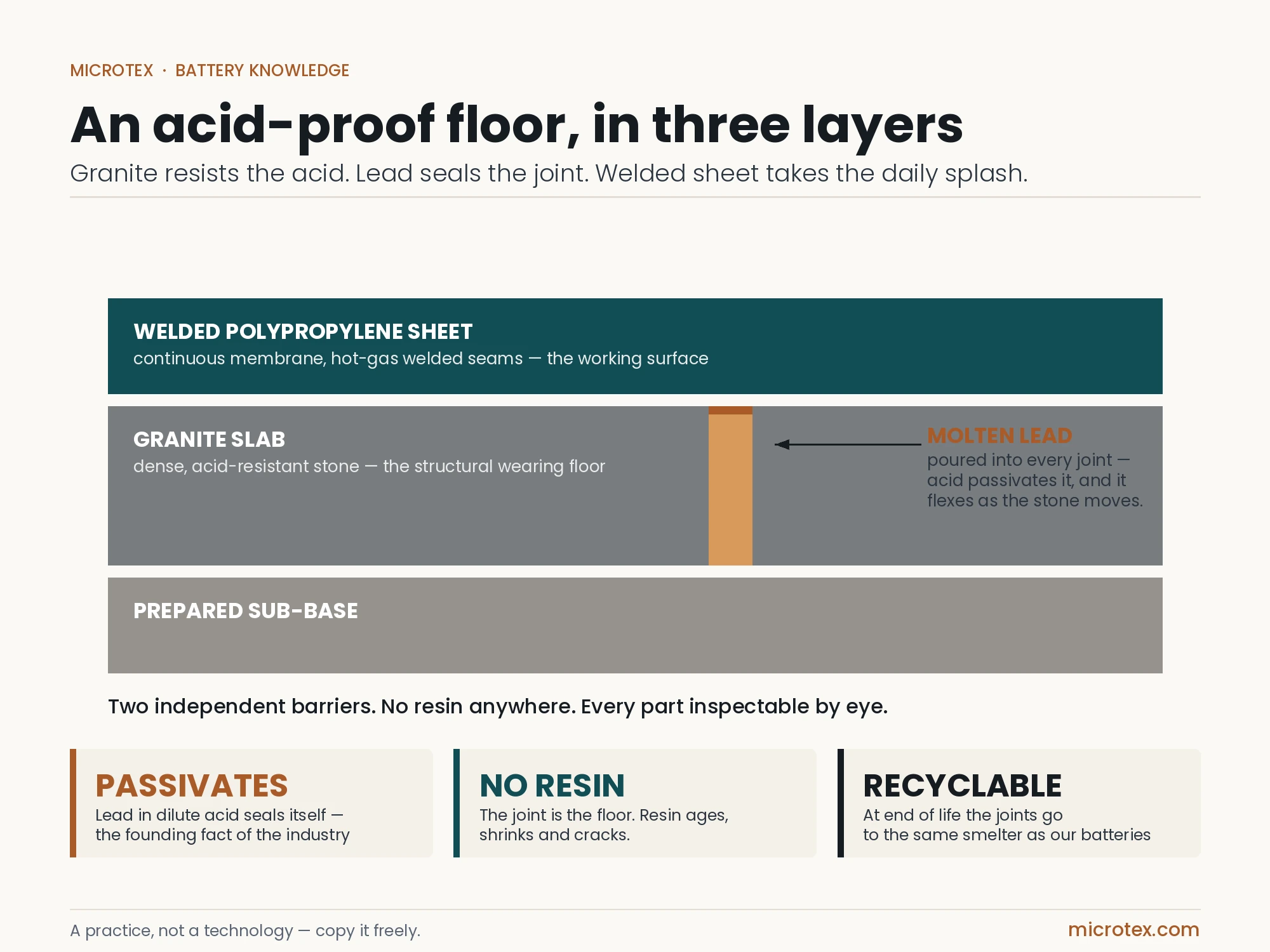
The construction, across the whole of our formation and charging floors, is three honest layers:
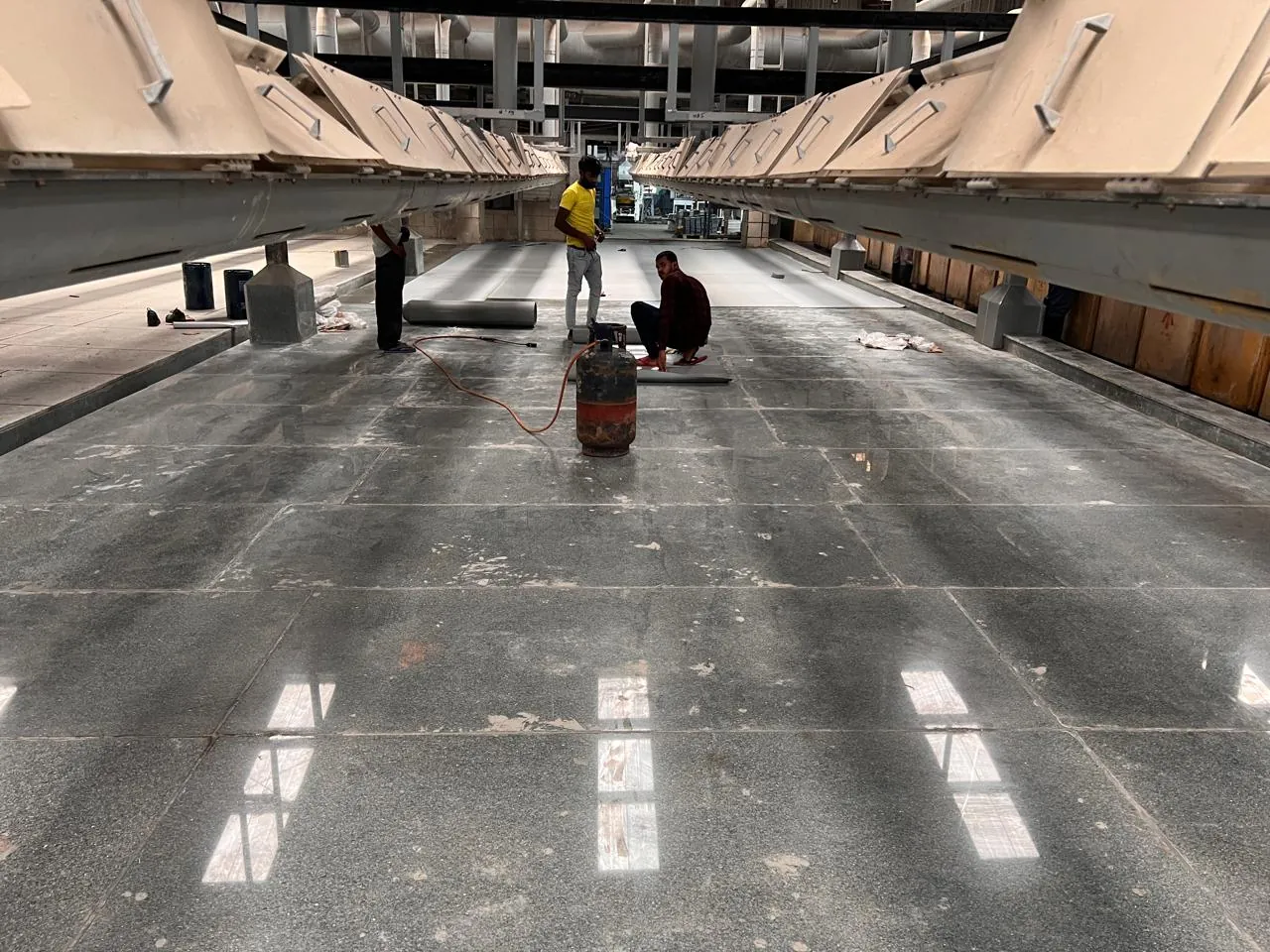
1. Granite slabs — thick, dense, polished stone, laid as the structural wearing floor. Granite shrugs off dilute sulphuric acid, takes point loads from tanks and trucks, and cleans easily.
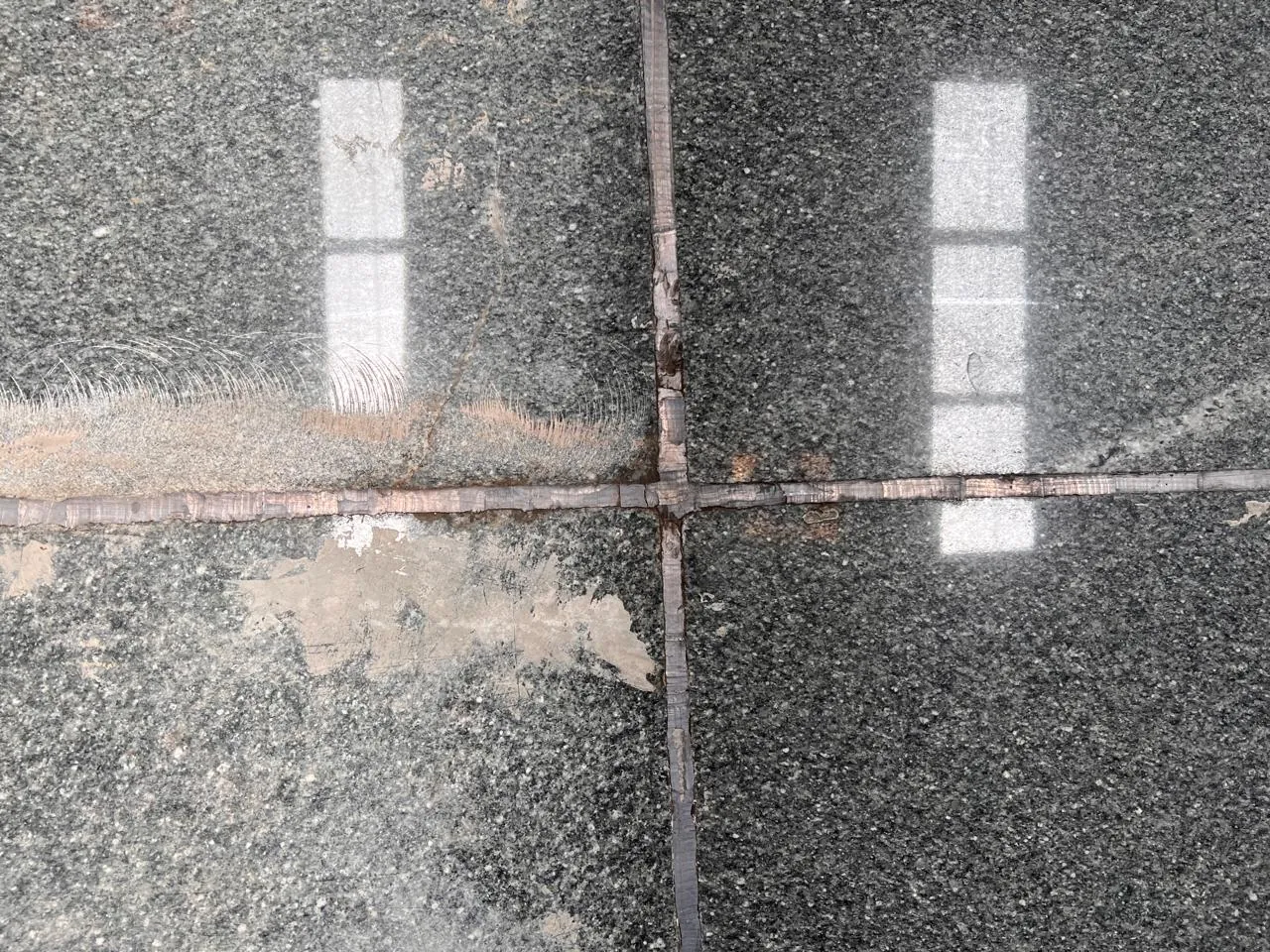
2. Lead-filled joints — molten lead poured into every joint between slabs, then dressed flush. No resin anywhere. Where the slabs meet, the floor is sealed by a metal that acid passivates rather than attacks. The photographs show the joints after years in service — the tooling marks still visible, the seal intact.
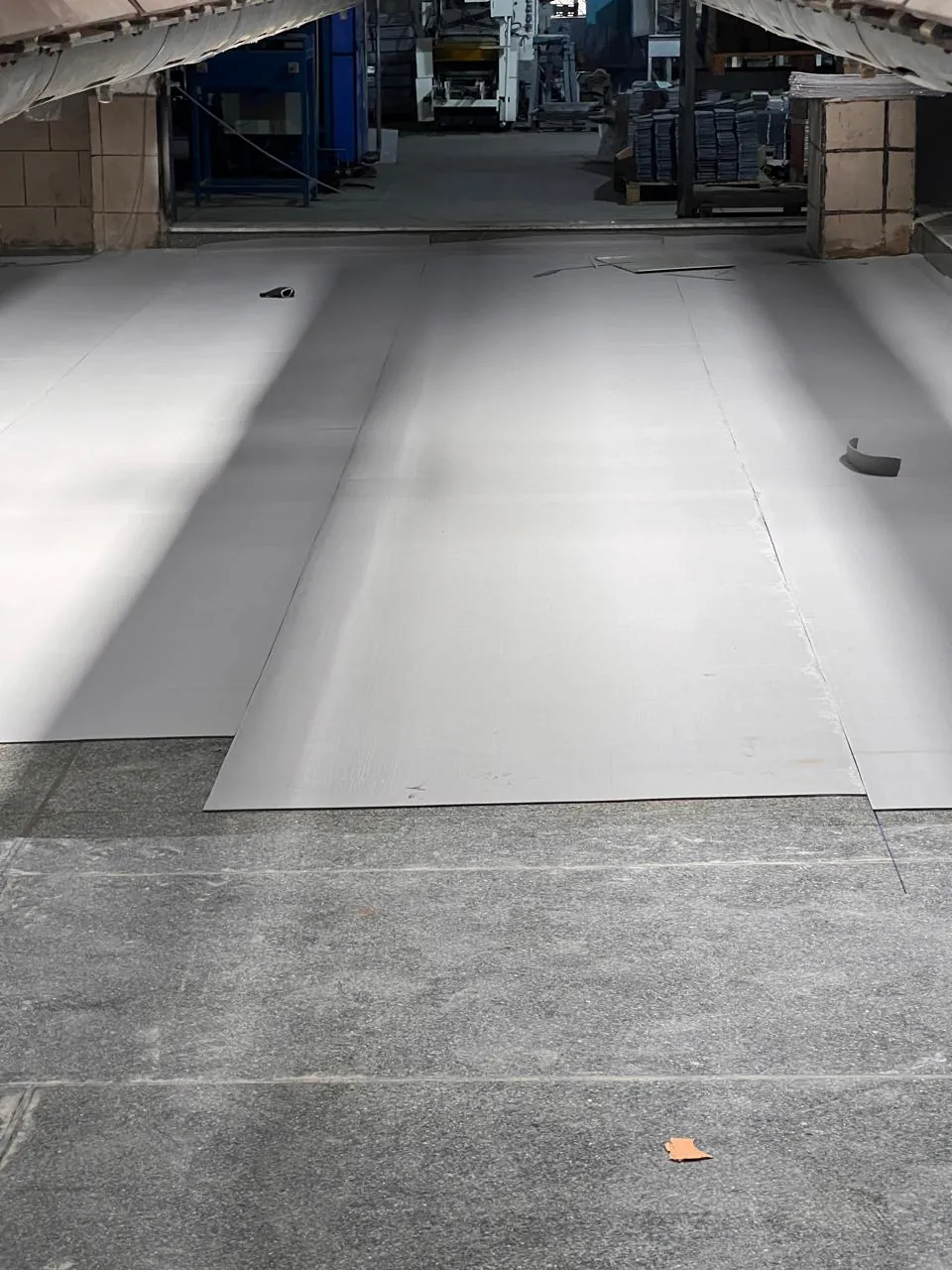
3. A welded thermoplastic overlay — sheets of polypropylene laid over the granite with welded seams, hot-gas jointed so the overlay is one continuous acid-proof membrane. This is the working surface that takes the daily splash and wash-down, and any panel can be re-welded or replaced without touching the stone below.
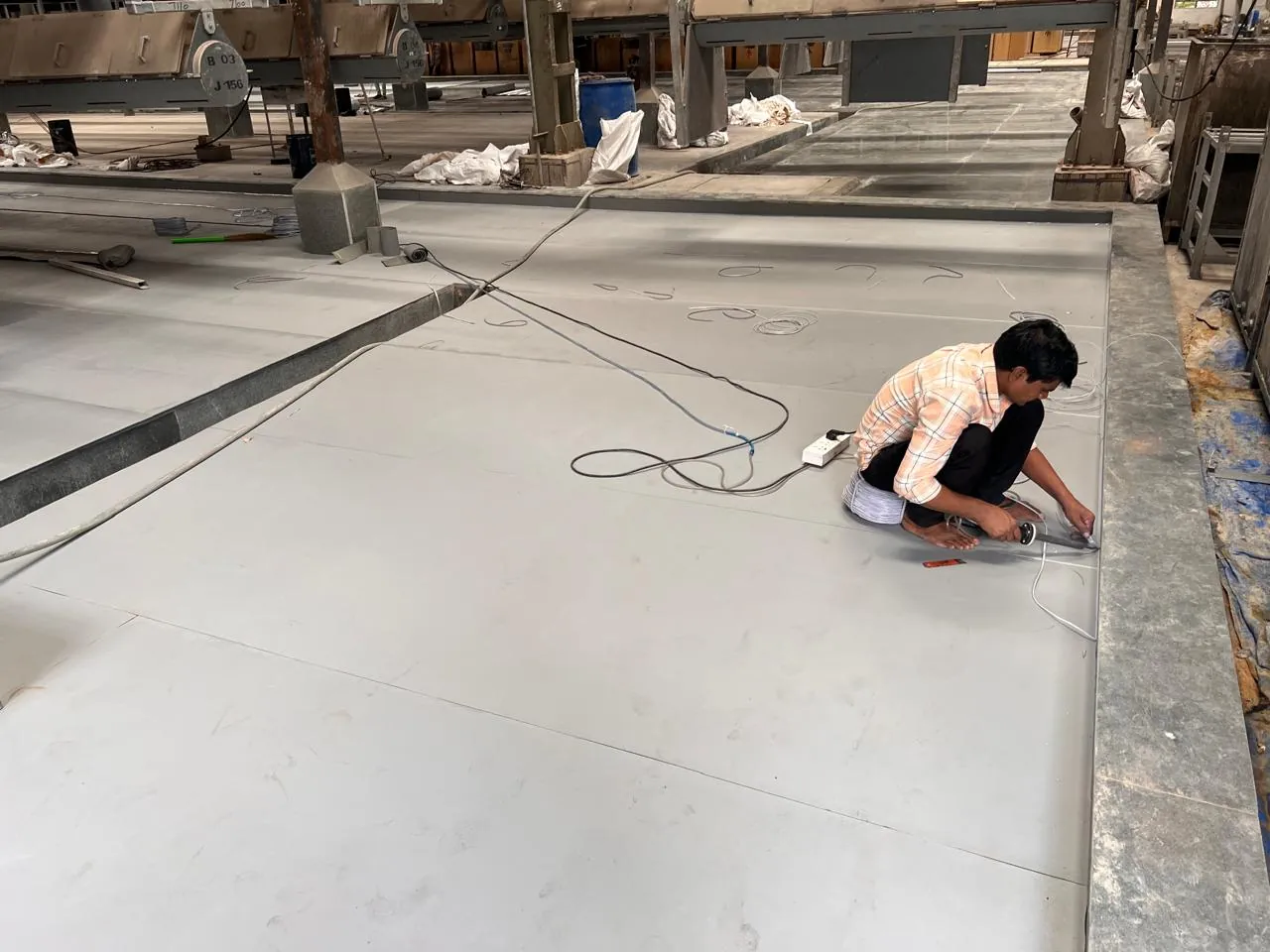
Two independent barriers, each complete in itself, over ground that the first barrier alone would already protect. The chance of acid reaching soil is as close to nil as engineering can make it — and every part of the system is inspectable by eye.
What it costs and what it saves
Granite and lead are not the cheapest floor on day one. They are close to the cheapest floor per decade. There are no joint renewals every few years, no hidden seepage repairs, no remediation risk sitting under the plant — and remediation of acid-contaminated ground, wherever it has happened in industry, costs more than a hundred floors. For a battery maker, the floor is also an audit asset: when a customer, a pollution control board, or a certification auditor asks how we guarantee nothing reaches the ground, we do not show them a procedure. We show them the floor.
Take the idea
None of this is patented, and none of it should be. It is a practice, not a technology: stone that resists acid, a metal joint that acid passivates, and a welded membrane above both. If you make batteries — or run any plant that lives with electrolyte — you are welcome to copy it exactly. If a detail would help, write to us and we will share it. The industry is better when its ground water is clean under every factory, not just ours.
Questions plant engineers ask us
Why not epoxy or acid-proof tile alone?
The tile is rarely the failure; the jointing is. Rigid resins crack with thermal movement and age. A ductile, passivating metal joint removes the floor’s weakest element.
Does the lead joint react with the acid?
Only to seal itself. Lead in dilute sulphuric acid forms an adherent lead-sulphate layer that stops further attack — the same passivation our industry is built on.
Is a welded plastic overlay necessary if the granite-and-lead floor is already sealed?
Necessary, no. Wise, yes. It takes the daily working abuse, it is cheap to renew panel by panel, and it turns one barrier into two.
Any safety notes for the lead pouring itself?
Standard lead-melting discipline: ventilation, dry joints (moisture and molten metal must never meet), PPE, and hygiene practice identical to a battery plant’s normal lead handling.
See how the same thinking runs through the plant: our engineering philosophy · how our batteries are built · write to us for details of the floor