
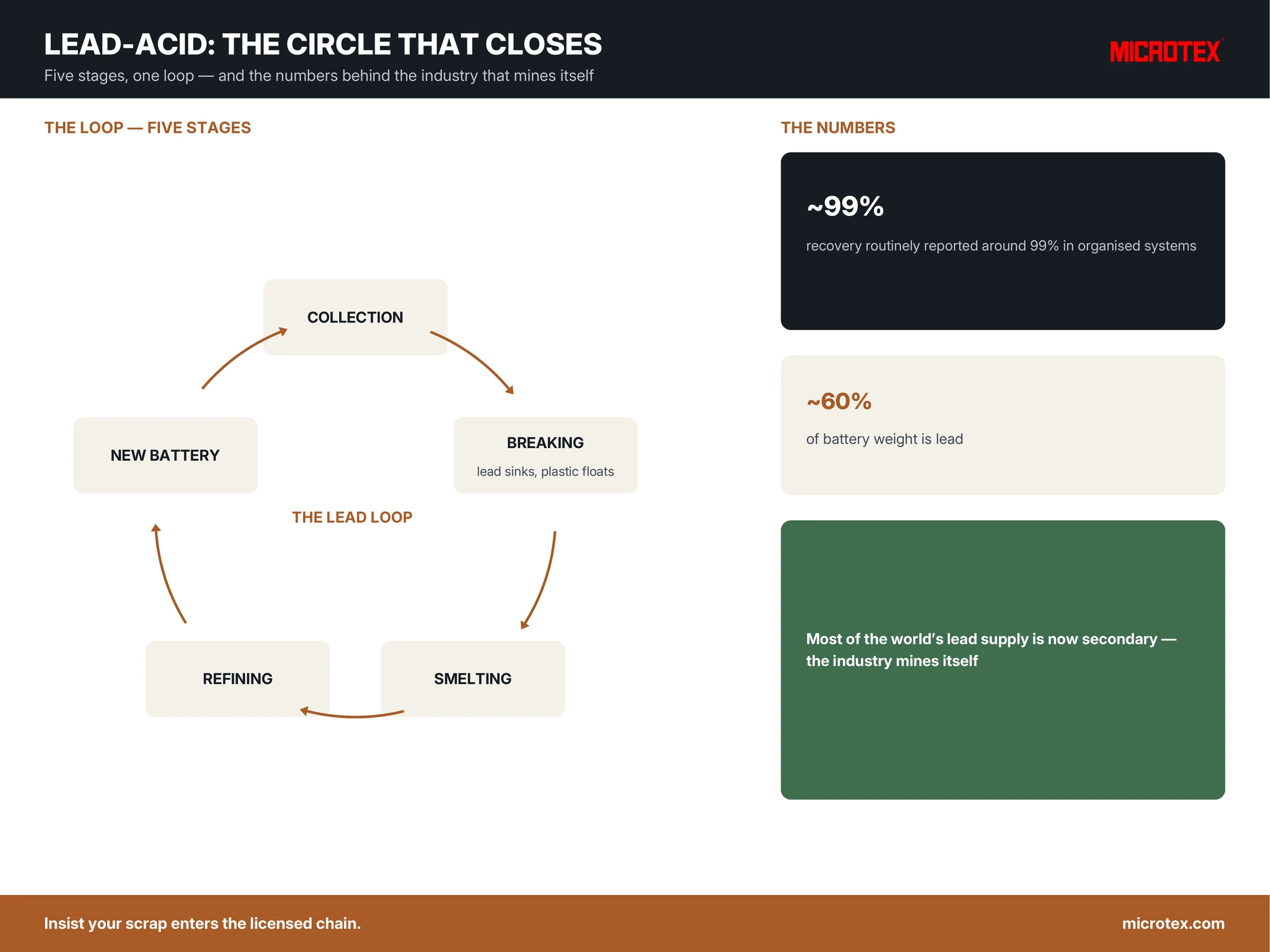
The lead-acid battery has one environmental credential no newer chemistry can yet match: its circle closes. In organised recycling systems, recovery rates for lead-acid batteries are routinely reported around 99% — a figure that has made it, by many accounts, the most successfully recycled manufactured product in the world. The lead in a new battery has usually lived several lives already. This article explains how that circle works, what happens at each stage, and — because honesty is a Microtex habit — where the industry still fails.
Why lead recycles so well
Three properties conspire. Lead is DENSE in the battery — around 60% of the battery’s weight is lead or lead compounds, so a scrap battery is a rich ore, richer than most mined ore bodies. Lead is SIMPLE to reclaim — it melts at a low temperature for a metal, separates cleanly from the other materials, and remelting scrap consumes a fraction of the energy that smelting virgin ore does, which is why the economics never needed a subsidy. And the battery is STANDARDISED — a recycler can break any maker’s battery with the same process, because the anatomy is universal: lead and its oxides, sulphuric acid, polypropylene or hard-rubber containers, and separators. The consequence is remarkable and well documented in the industry’s lifecycle literature: batteries dominate world lead demand, and the majority of the world’s lead supply is now SECONDARY — dug from old batteries, not from the ground. The lead-acid industry is, in effect, already mining itself. Compare that with chemistries whose recycling is still far behind, and you see why the lead circle closed decades ago while others are still being engineered.
The journey of a dead battery
An organised recycler runs the battery through five stages. Collection — scrap batteries flow back through dealers, service networks and buy-back schemes; the old battery you exchange at purchase is the first link. Breaking — machines crush the batteries and the pieces separate in water by density: lead sinks, plastic floats, acid drains for treatment. Desulphurisation and smelting — the lead fractions are processed and smelted back to metallic lead. Refining — the crude lead is refined and alloyed to specification; recovered lead re-enters battery production as oxide and grid metal. The rest — polypropylene is washed, pelletised and returns as new battery containers; the acid is neutralised or converted into useful sulphates rather than dumped. Nothing of consequence needs to leave the loop.
The honest paragraph: where the industry fails
Everything above describes ORGANISED recycling. The industry’s shame is the unorganised kind: backyard smelting that recovers the lead and releases everything else — lead fumes into neighbourhoods, acid into drains. It persists because scrap batteries are valuable and informal channels pay cash. The remedy is structural, and it is arriving: producer-responsibility rules now bind manufacturers in India and much of the world to collect and channel scrap into licensed recyclers, and buyers can help by insisting their scrap goes to the formal chain — the few rupees more from an informal buyer purchase someone else’s poisoned soil. When your bank reaches end of life, ask the recycler one question: are you licensed? A serious battery supplier will help route the scrap properly; it is part of the job, not a favour.
What recycling means for a battery buyer
Three practical consequences. First, residual value: a dead lead-acid bank is not waste, it is metal with a market price — factor the scrap credit into lifetime cost when comparing chemistries. Second, supply resilience: recycled lead feeding back into production is one reason the technology’s material chain is stable. Third, end-of-life duty: a battery is only as green as its disposal, so the last decision you make about a bank — where it goes — matters as much as the first. A battery that served fifteen years in a substation and then returns as next decade’s grids has completed the only lifecycle in the battery world that genuinely deserves the word circular.
Our own position in this circle is described on the Microtex environment page — and if a bank near you is approaching the end of its life, talk to us about the replacement and the responsible exit of the old one in the same conversation.
There is no grave — on film
“Every single part of that battery can and is recycled.” The CTO on lead-acid’s closed recycling loop — and why it matters when chemistries are compared.