
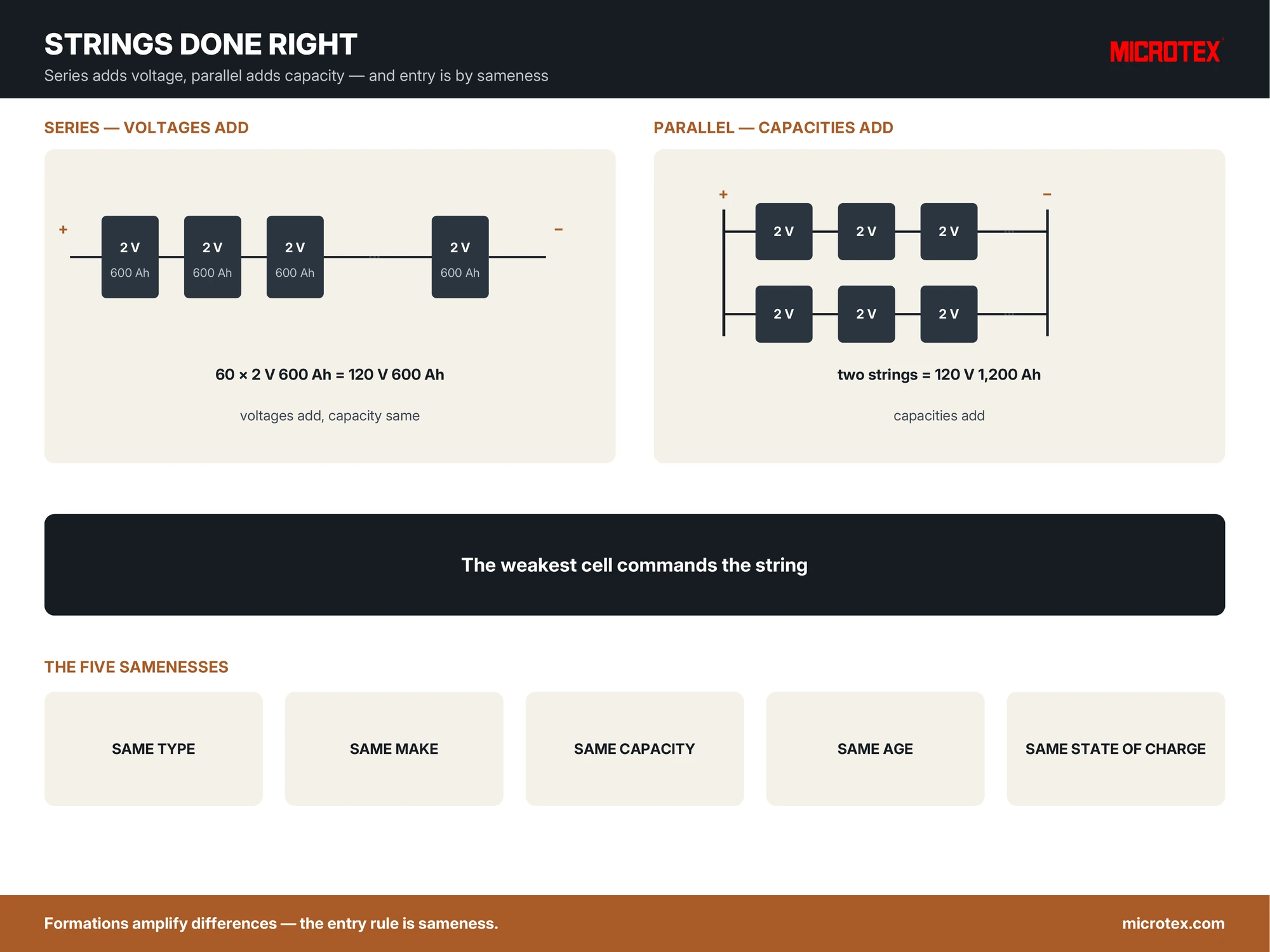
No battery of consequence works alone. A 2-volt cell is the atom of the lead-acid world; everything bigger — the 48 V telecom bank, the 110 V substation battery, the 80 V forklift tray — is cells in formation. Two formations exist. In series, positive to negative, voltages add and capacity stays: sixty 2 V, 600 Ah cells make a 120 V, 600 Ah battery. In parallel, positive to positive, capacities add and voltage stays: two such strings side by side make 120 V, 1,200 Ah. The definitions take one paragraph. The reason this article exists is what the definitions hide: formations fail differently than cells do, and the rules below are the difference between a bank that ages gracefully and one that eats itself.
The series law: the weakest cell commands the string
Series cells carry identical current — the string has no choice. So the cell with the least capacity empties first, and from that moment every further ampere-hour drives it deeper than its companions, ratcheting it weaker with each cycle. One lagging cell in a 55-cell substation string sets the performance of all 55. This is why cell matching at assembly matters, why single-cell replacements into old strings are done thoughtfully or not at all, and why the periodic equalising charge exists: it is the maintenance act that pulls lagging cells back level before divergence becomes destiny. It is also why per-cell readings — voltage and, in flooded cells, specific gravity — are the health record of a series bank: averages hide exactly the cell you need to see.
The parallel law: equal paths or circulating trouble
Parallel strings share the load in proportion to how easy each path is. If one string has longer cables, an extra joint, or a slightly higher internal resistance, it quietly does less work while its twin does more — and ages faster for the privilege. Worse, mismatched strings at rest push current into each other. The disciplines that prevent this are physical and boring, which is why they get skipped: identical cable lengths and cross-sections to each string, the same number of joints in each path, connections torqued to specification, and a per-string means of measurement so imbalance can be SEEN. Battery makers also cap how many strings may sit in parallel — follow the datasheet’s limit, because beyond it the balancing problem outgrows the discipline.
The never-mix laws
Formations amplify differences, so the entry rule is sameness. Never mix capacities in series — the small cell is overdriven every cycle. Never mix ages — an old battery’s higher internal resistance and lower capacity drag a new partner down to its level; pairing a fresh battery with a tired one mostly buys you two tired ones. Never mix chemistries or types — flooded, AGM and gel want different charge behaviour, and a shared charger serves one of them badly. And never mix makes casually, even at the same rating, because two makers’ “600 Ah” can behave differently enough to unbalance a formation. Same type, same make, same capacity, same age, same state of charge: five samenesses, cheap on day one, unaffordable to retrofit.
Series-parallel, and who should decide
Real installations combine both: series strings to reach the voltage, paralleled to reach the capacity. The design questions stack accordingly — string count versus cell size, fault behaviour, protection, and the end-of-discharge voltage check at full load. Our bias, where the cell range allows it: fewer, larger cells in a single series string beat many small strings in parallel, because one string has no sharing problem at all. That trade-off — and the cable, joint and layout drawings that make a formation honest — is design work we do as part of sizing. Tell us the voltage, the duty and the room, and the bank comes back drawn, not described.