
Ask around and you will hear that lead-acid batteries “give off hydrogen,” as if a battery sat in the corner quietly emitting gas all day. It does not. Hydrogen evolution is an end-of-charge event — bounded in time, predictable in place, and governed by the charger. Understanding when the gas comes is the key to understanding why this is the most thoroughly solved hazard in the battery world.
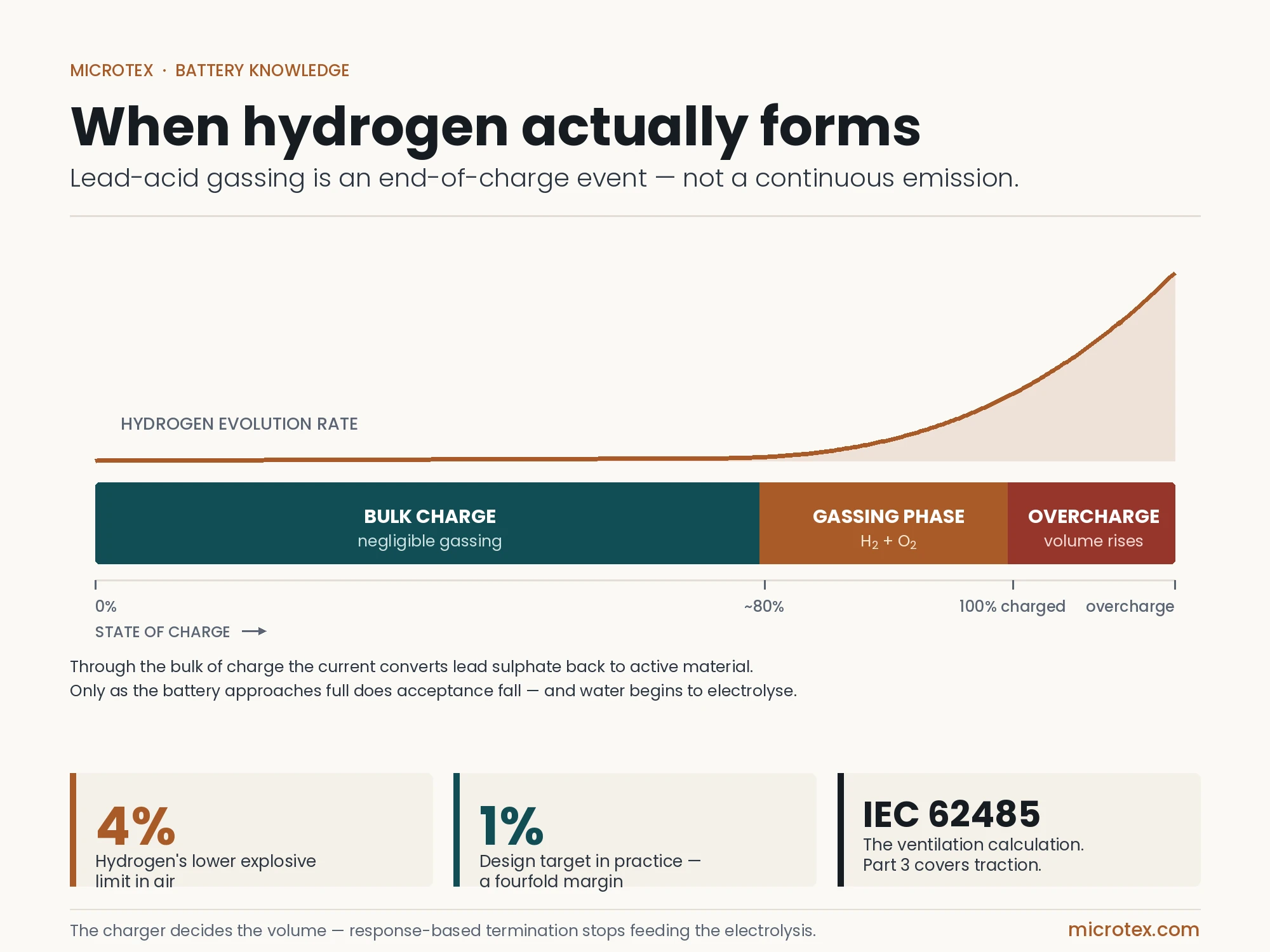
When hydrogen actually forms
Through the bulk of a charge, a lead-acid battery accepts current gratefully: nearly all of it goes into converting lead sulphate back into active material, and gassing is negligible. During discharge, none at all. Only as the battery approaches full charge does its acceptance fall — and the current that the plates can no longer use begins to electrolyse water instead. That is the gassing phase: oxygen at the positive, hydrogen at the negative, in the final stage of charge and above all in overcharge, where gassing rises steeply.
So the hydrogen question is not “does the battery gas?” but “what happens at the end of charge?” — one activity, in one known place, in one known window of time. Hazards do not come better behaved than that.
The charger is the hydrogen policy
Because the gas comes from the end of charge, the charger profile decides how much of it there is. Old timer-based chargers ploughed on past full charge and paid for it in water and hydrogen. A modern profile — response-based termination that reads the battery instead of the clock, temperature compensation, and a correct finishing rate — takes the battery to full and then stops feeding the electrolysis. The difference is not marginal: overcharge is where the volume lives, and a well-designed charger simply declines to go there. We design our own chargers around exactly this principle, because the cheapest hydrogen to ventilate is the hydrogen never made.
The numbers that govern the room
Hydrogen becomes ignitable at 4% concentration in air — the lower explosive limit. Design practice does not flirt with that number: installations are ventilated to hold concentration around 1%, a fourfold margin below the explosive limit, with alarms as the backstop rather than the plan — and the standard’s ventilation formula applies its own further safety factor of five to the gas evolution it assumes. The governing standard, IEC 62485 (Part 2 stationary, Part 3 traction — the traction part names battery locomotives in its own scope), provides the ventilation calculation: cell count, charging current and gassing behaviour in, required airflow out. Indian underground practice runs tighter still: traction battery enclosures are held below 1% by measured ventilation, enforced through the mines regulator’s framework for decades. And because the standards size the airflow for the worst case — the equalising charge — everyday operation runs far inside the margin.
What mature practice looks like
A well-run charging bay is ordinary engineering: hydrogen rises, so lids slope and vents sit high with no stagnant pockets; airflow is measured, not assumed; the charger is interlocked with the ventilation so that if the fan stops, charging stops; flame-arresting vent plugs sit on every cell as a passive barrier needing no power and no software. All of it auditable with an anemometer and a gas meter — and Indian underground installations run this discipline as routine compliance today.
One honest footnote: batteries on continuous float — substation banks, standby duty — evolve a small trickle of gas from the float current itself, which is why standards keep battery rooms ventilated at all times and not only at charge-end. The trickle is tiny; the same calculation covers it without effort. The design case, always, is the end of charge.
Gas management is universal — ours is just the codified one
Every electrochemical system manages gas. Vanadium flow batteries fit hydrogen sensors and venting systems. Lithium cells in fault conditions vent gas mixtures that are themselves hydrogen-rich and flammable, with toxic components — which is why off-gas detection is now specified for lithium installations. The difference is maturity and timing: lead-acid’s gas arrives on a schedule, at the end of charge, in quantities the IEC 62485 calculation sizes the fans for, against limits Indian mine practice has enforced for decades. A hazard with a timetable, a written standard and a measurable margin is a hazard a plant already controls.
Questions engineers ask us
Does a lead-acid battery give off hydrogen all the time?
No. Evolution is negligible during discharge and through most of the charge; it concentrates in the final gassing phase as the battery approaches full, and rises steeply only in overcharge. Batteries on float evolve a small continuous trickle, which is why rooms stay ventilated — but the design case is end of charge.
How much ventilation does my battery room need?
IEC 62485 gives the formula from cell count and charging current. Send us the bank size and charger rating and we will run it for your room — it is a ten-minute calculation.
What single change most reduces hydrogen?
The charger. Response-based termination instead of timers keeps the battery out of overcharge — and overcharge is where the volume lives. Match the profile to the battery and the gas problem shrinks at the source.
Do sealed (VRLA/gel) batteries gas?
Far less — internal recombination returns most of it — but standards still require ventilation sizing for fault conditions. “Sealed” shrinks the calculation; it does not abolish it.
Related reading: our mining battery chargers — profiled to finish, not overcharge · locomotive batteries · what actually burns in a battery fire