
Ask what happens to a battery at the end of its life and you learn more about its economics — and its ethics — than any datasheet tells you. For lead batteries the answer has been settled for decades: they come back as batteries.
The most recycled industrial product there is
A lead-acid battery is close to a closed materials loop: the lead, the plastic case, even the acid are recoverable, with overall recovery rates above 95% in regulated systems — figures that make it, by common account, the most recycled manufactured product in the world. This is not a pilot programme or a promise about 2035. It is the existing industry, and India regulates it: the Battery Waste Management Rules, 2022 place extended producer responsibility on manufacturers, with registered recyclers and a documented chain of custody.
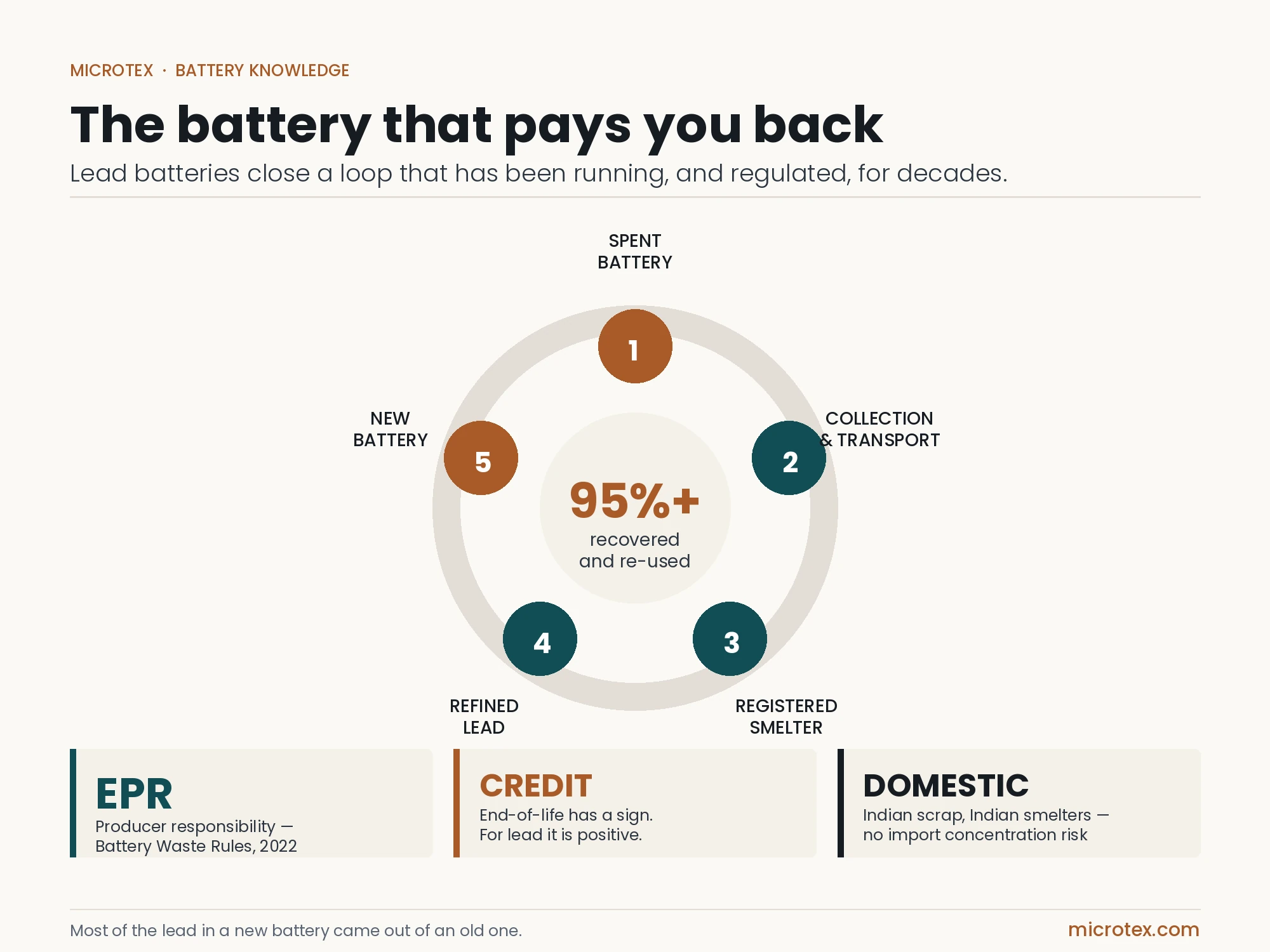
End-of-life value has a sign
Here is the line most total-cost comparisons miss: at end of life, a lead battery is an asset. Its scrap commands real value against the next purchase, because the smelter wants the lead. For newer chemistries the sign today is usually reversed — recycling capacity is still being built, the processes are young, and iron-phosphate cells in particular contain little of the cobalt or nickel value that funds recovery, so end-of-life is commonly a cost. That will improve with time, and it should. But a procurement decision is made at today’s prices, and today one chemistry’s end-of-life line is a credit while the other’s is a debit.
The supply-chain dividend
A closed loop has a second consequence: independence. Because most of a new lead battery’s lead comes from old lead batteries, the supply chain is substantially domestic — Indian scrap, Indian smelters, Indian plants. Energy-transition minerals tell a different story: international agency assessments project heavy geographic concentration in refined lithium, cobalt and battery-grade graphite for years to come. That is not an argument against any chemistry. It is an argument that supply-chain exposure belongs in the procurement file, next to price.
Questions buyers ask us
How do I dispose of a spent industrial bank compliantly?
Through registered recyclers under the 2022 Rules, against documentation. As the producer we carry EPR obligations — ask us and we will point you to the compliant route and the paperwork.
Does recycled lead make a worse battery?
No. Secondary lead refined to specification is electrochemically the same metal — the loop has fed the industry for generations.
Should end-of-life value appear in a tender comparison?
Yes — as a line item with a sign. Omitting it silently favours whichever technology has the larger disposal cost.
Related reading: reading cycle-life numbers correctly · OPzV gel batteries · motive power range