
An earthquake is the one moment a standby battery is guaranteed to be needed and the one moment nobody can go and check on it. When the ground moves, grids trip, generators shed and substations go dark — and the tripping, the protection, the emergency lighting and the safe-shutdown sequence all run on DC. The battery is not merely expected to survive the shaking; it is expected to be mid-discharge, carrying the plant’s most important minutes, while the rack it stands on is being rattled through every frequency the site can produce. Ordinary type tests say nothing about this. A separate discipline exists to prove it, with its own standards, its own vocabulary and its own brutal pass line — and if you buy batteries for a nuclear station, a substation in a seismic zone, or any plant that must ride out the ground’s bad day, you should know how to read it. This guide decodes seismic qualification the way our battery testing guide decodes the everyday hierarchy of proof.
The vocabulary: OBE, SSE and the spectrum on the wall
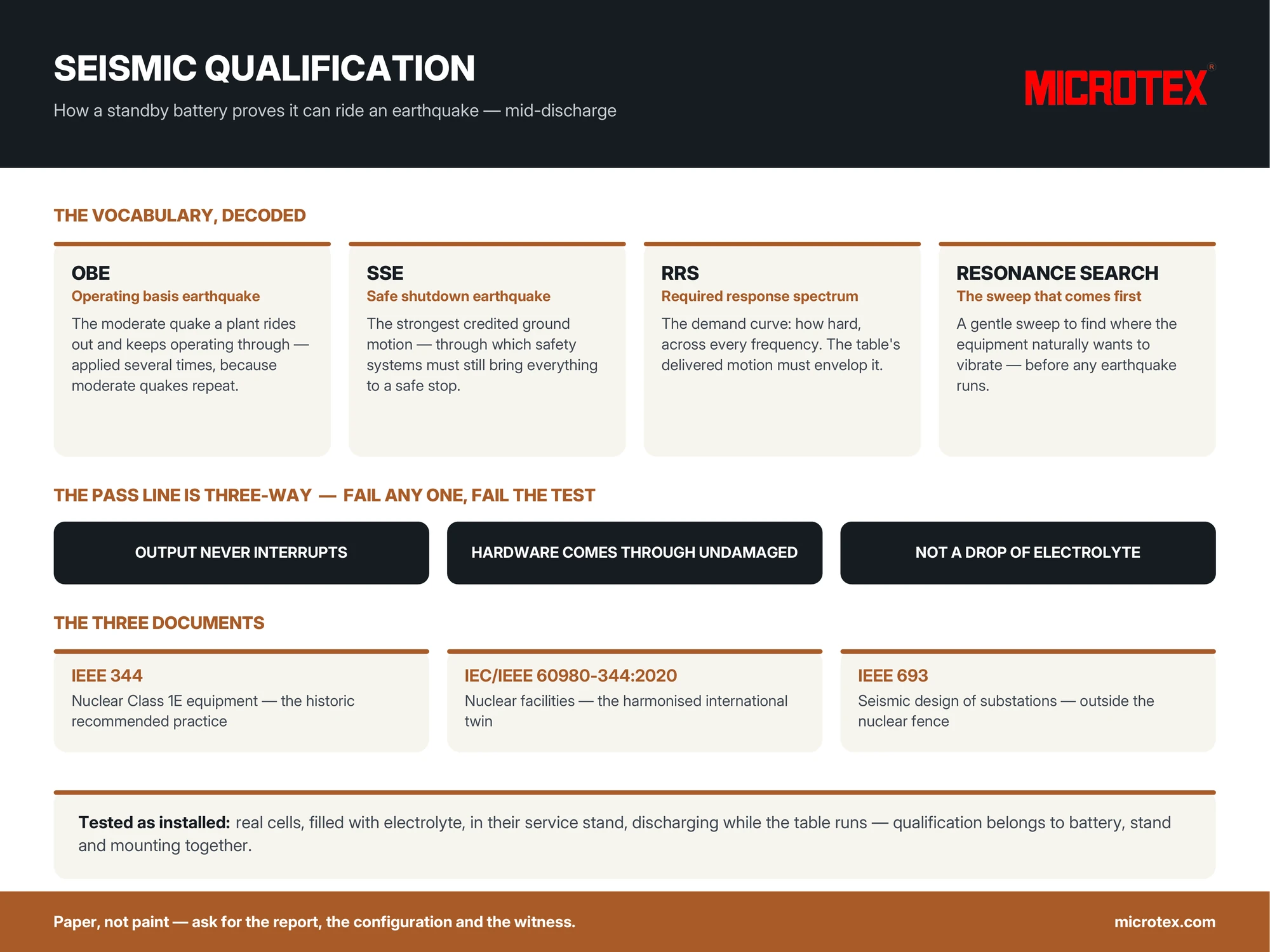
Seismic qualification speaks in a handful of terms worth learning once. The OBE — operating basis earthquake — is the moderate quake the plant should shrug off and keep operating through; a qualification campaign typically applies several of them, because moderate quakes repeat. The SSE — safe shutdown earthquake — is the big one: the strongest ground motion the site is credited with, through which the safety systems must still do their job of bringing everything to a safe stop. The demand itself arrives as a curve, not a number: the required response spectrum, or RRS, plots how hard the equipment must be shaken across the whole range of frequencies the site and building can deliver. The shake table’s job is to produce a motion whose measured spectrum — the test response spectrum — envelops that requirement, so nobody can say the test was softer than the demand. And before any earthquake is simulated at all, a resonance search sweeps gently through the frequencies to find where the equipment naturally wants to vibrate — because a stand that resonates at a frequency the site produces will amplify the quake instead of merely carrying it.
The standards map: three documents, three worlds
Three families of paper govern this discipline. For nuclear stations, the historic reference is IEEE 344 — the recommended practice for seismic qualification of Class 1E equipment (the electrical equipment credited with safety duty) in nuclear power generating stations, a document that has evolved since the 1970s. Its modern international twin is IEC/IEEE 60980-344:2020 — “Nuclear facilities — Equipment important to safety — Seismic qualification” — a joint IEC and IEEE publication that harmonises the same discipline for use worldwide. Outside the nuclear fence, IEEE 693 — the recommended practice for seismic design of substations — covers the switchyard world. The three differ in scope and paperwork, but the logic is shared: state the demand as a spectrum, prove the equipment meets it, and document everything. Qualification under these documents can be earned by analysis, by test, or by documented experience — and for a battery, the argument that convinces an engineer is the test, because a battery is not a bracket: it is a heavy, liquid-filled, electrically live assembly whose failure modes (cracked containers, spilled electrolyte, broken intercell joints, interrupted output) are exactly the kind that calculation is least trusted to exclude. Where our battery standards guide explains what the everyday product standards fix, the seismic documents fix something narrower and harder: behaviour during the worst minute of the plant’s life.
What actually happens on the table
A proper battery campaign tests the battery as installed: real cells, filled with electrolyte, mounted in their actual stand with their actual clamping, connected and — this is the heart of it — discharging while the table runs. Qualification belongs to the whole system, battery plus stand plus mounting; a certificate earned by a lone cell bolted to a fixture says little about a double-tier bank on a welded frame. The sequence usually runs: resonance search first, then the repeated OBE runs, then the SSE, with the cells under load throughout. The pass line is unforgiving in three directions at once — the electrical output must continue without interruption, the hardware must come through undamaged, and not a drop of electrolyte may leave the cells. A battery that survives but stops discharging has failed. A battery that keeps discharging but weeps acid onto the stand has failed. This is also why the room around the bank matters: seismic zones are one of the four duties our battery room design guide says a room owes its battery, because the best-qualified cell is only as good as the stand and anchoring it lives on.
Where we stand — tested, witnessed, on film
We publish this guide from experience, not theory, and the proof lives on the product pages that own it. Our flooded tubular OPzS cells — the construction utilities specify for switchgear duty — carry seismic qualification per IEEE Std 344, tested at CPRI and witnessed by NPCIL QA; the specification-side story is on our substation battery page. And in May 2026 our 2 V HDP cells went through Resonance Search and seismic qualification testing per IEC/IEEE 60980-344:2020 — in their double-tier stand, on CPRI Bengaluru’s triaxial shake table, witnessed by NPCIL QA: five OBE runs and one SSE at ten per cent above the required response spectrum, discharging without interruption throughout, with zero damage and zero electrolyte spillage. The report number travels with our tenders, and the test footage — used with CPRI’s permission — plays on the 2V HDP battery page. Each line carries its own standard and its own report; when a duty needs one or the other, we quote the document your specification speaks.
How to read a seismic claim — the buyer’s checklist
When a datasheet says “seismically qualified”, make the phrase prove itself with five questions. To which document? — a standard number and edition, not the bare word “seismic”. By what route? — test, analysis or experience; if test, ask to see the report, not the certificate summary. In what configuration? — cells in their service stand, filled and on discharge, or a bare cell on a fixture? Did the delivered motion envelop the demand? — the test spectrum must cover the required spectrum, and the report’s plots show it. Who witnessed it? — an independent laboratory’s name and a customer inspectorate’s signature are worth more than any adjective. These are the same instincts our nuclear plant battery guide applies to the wider qualification world, where paper, not paint, is what a battery is really made of. If your site sits in a seismic zone and your DC system’s paperwork has never been asked these questions, send us the specification — we will tell you plainly which of our lines carries the qualification your duty needs, and show the reports before you commit.