
A stationary battery spends twenty years in one room — and the room decides how those years go. We have seen premium cells age beautifully in modest buildings and identical cells suffer in expensive ones, and the difference was never the battery. It was ventilation, temperature, layout and housekeeping: the four duties a room owes its battery. This guide is for anyone specifying a battery room for a substation, plant DC system or UPS installation — and for the consultant who must defend the drawing.
Duty 1 — ventilation: engineered, not assumed
Charging lead-acid batteries evolve hydrogen, and hydrogen accumulating under a ceiling is the one hazard in this subject with no forgiving failure mode — our explosion guide carries the arithmetic: evolution is predictable per ampere-hour of overcharge, and the flammability threshold it must never approach is known. The design consequence is simple to state and routinely botched: ventilation must be CALCULATED from the bank’s size and charging regime — the international battery-installation standards (the IEC 62485 family) exist precisely to turn that into required airflow — not assumed from a window. Practical corollaries follow. Air must move at ceiling level, where hydrogen collects, with inlets low and outlets high. Ventilation must run whenever charging runs, especially during equalising. And nothing that sparks — switches, sockets, unrated fittings — belongs in the exhaust path. A room that gets ventilation right has retired most of its risk before the battery arrives.
Duty 2 — temperature: the room is the calendar
The Arrhenius law makes the battery room’s thermostat a financial instrument: sustained heat above the rated room temperature trades battery life away at exponential speed, and the operating-temperature guide carries that arithmetic. Design for it: keep the room out of the afternoon sun where the site allows, insulate the roof before buying air-conditioning, keep batteries away from heat-dumping equipment (chargers included — give them their own wall or room), and above all keep the TEMPERATURE UNIFORM across the bank, because a string whose end cells run warmer than its middle cells ages unevenly, and uneven strings punish everyone. A modest, steady room beats a cold room with hot corners.
Duty 3 — layout: built for the maintainer
Every reading our testing guide recommends assumes a human can REACH the cell. So: racks and tiers arranged with working access to every cell — voltage points, vent plugs, level indicators all visible and touchable without gymnastics; aisle widths that admit a person, a trolley and a hydrometer tray; cells arranged so numbering follows a walkable sequence (log sheets that match the walk get filled; ones that don’t get faked). Racks themselves must carry the weight honestly — a large bank is tonnes — with acid-resistant finish and, where the site demands it, seismic-qualified construction: our own cells and stands have been shake-table tested at CPRI, and the HDP battery page carries that evidence. Floors: acid-resistant finish with containment appropriate to flooded banks, because a room that fears a spill has already half-managed one. And lighting bright enough to read a meniscus — dim battery rooms breed skipped readings.
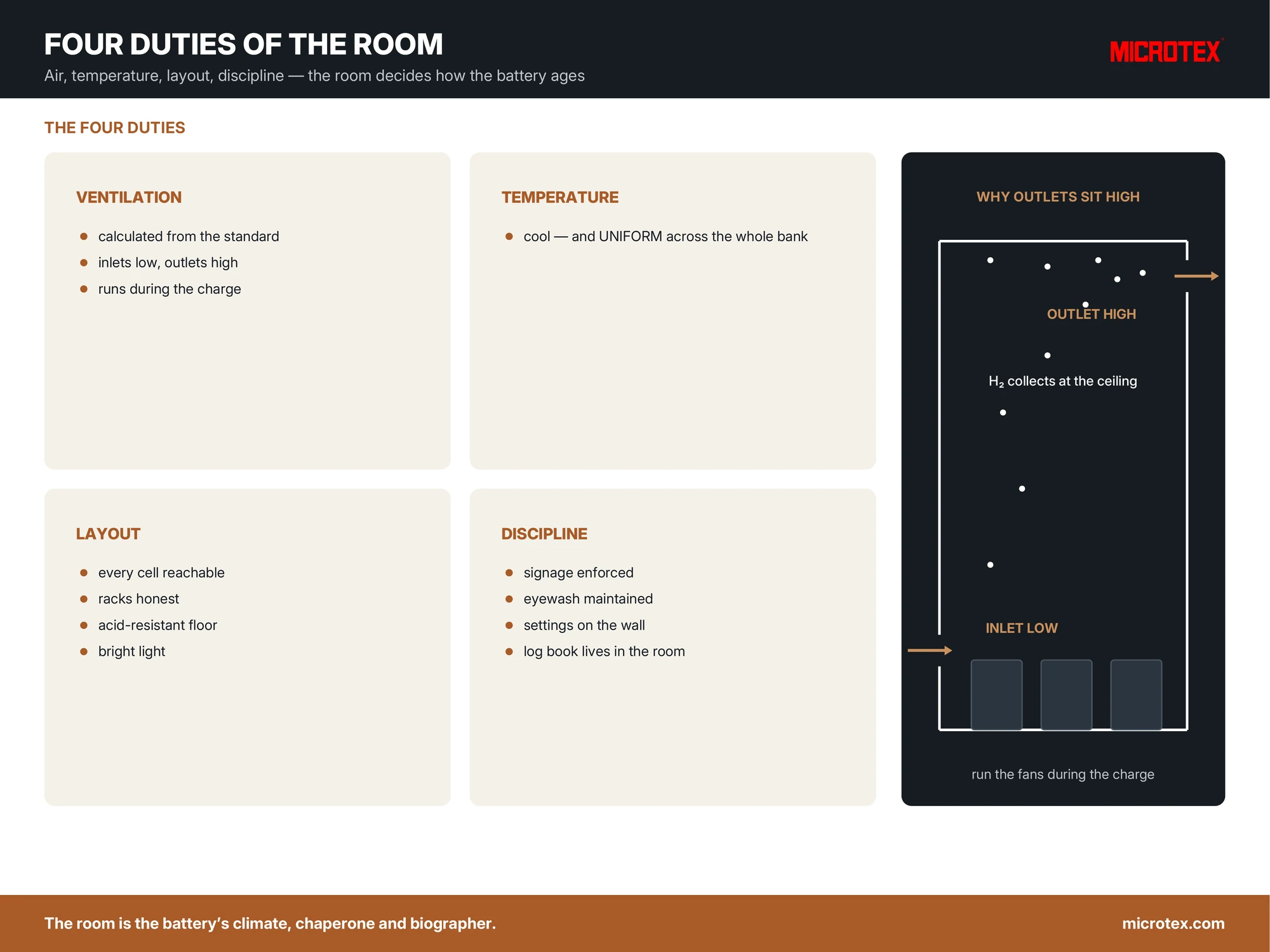
Duty 4 — discipline: the room as a system
The remaining duties are organisational, and they are the ones that decay first. Signage that means something: no-smoking and no-naked-flame enforced, not decorative. Safety provisions per the battery-safety guide — eyewash, PPE, spill neutralisation — present AND maintained, because a dry eyewash bottle is a lie in a green box. Cabling dressed and sized so the DC run doesn’t quietly eat the voltage the battery worked to deliver. Charger settings documented ON THE WALL, not in a retired engineer’s memory. And a log book that lives in the room: per-cell readings on schedule, every topping-up recorded, every deviation dated. When we commission a bank, the room walk-through is part of the job — and when a customer asks us to review a battery-room drawing before construction, we do it without charge, for the same reason we design charging areas for mines: the room is not the battery’s container. It is the battery’s climate, chaperone and biographer. Send us the drawing; concrete is much harder to change than a PDF.