
A battery bank is only as strong as its weakest cell, and that is not a proverb — it is exactly how a series string behaves electrically. Every cell in a series-connected bank carries the same current, whether it is charging or discharging, whatever its own individual health. A cell with slightly less capacity, or slightly higher internal resistance than its neighbours, reaches its own full discharge first while the healthier majority still has energy left to give. If the load keeps pulling current past that point, the weak cell has nowhere left to go but into reversal — driven through zero volts and out the other side, its polarity flipped by the very current the rest of the string is still happy to supply. David Linden’s Handbook of Batteries describes this “weak cell or weak module” effect for large multi-cell packs in exactly those terms: the phenomenon is statistically predictable — in any large enough population of cells, some will always sit at the tail end of the capacity, power and resistance distribution — and the string does not protect them from the string’s own current. It happens in a stationary OPzS bank the same way it happens in any other series-connected battery; the physics does not care which chemistry is involved.
Why the string voltage lies to you
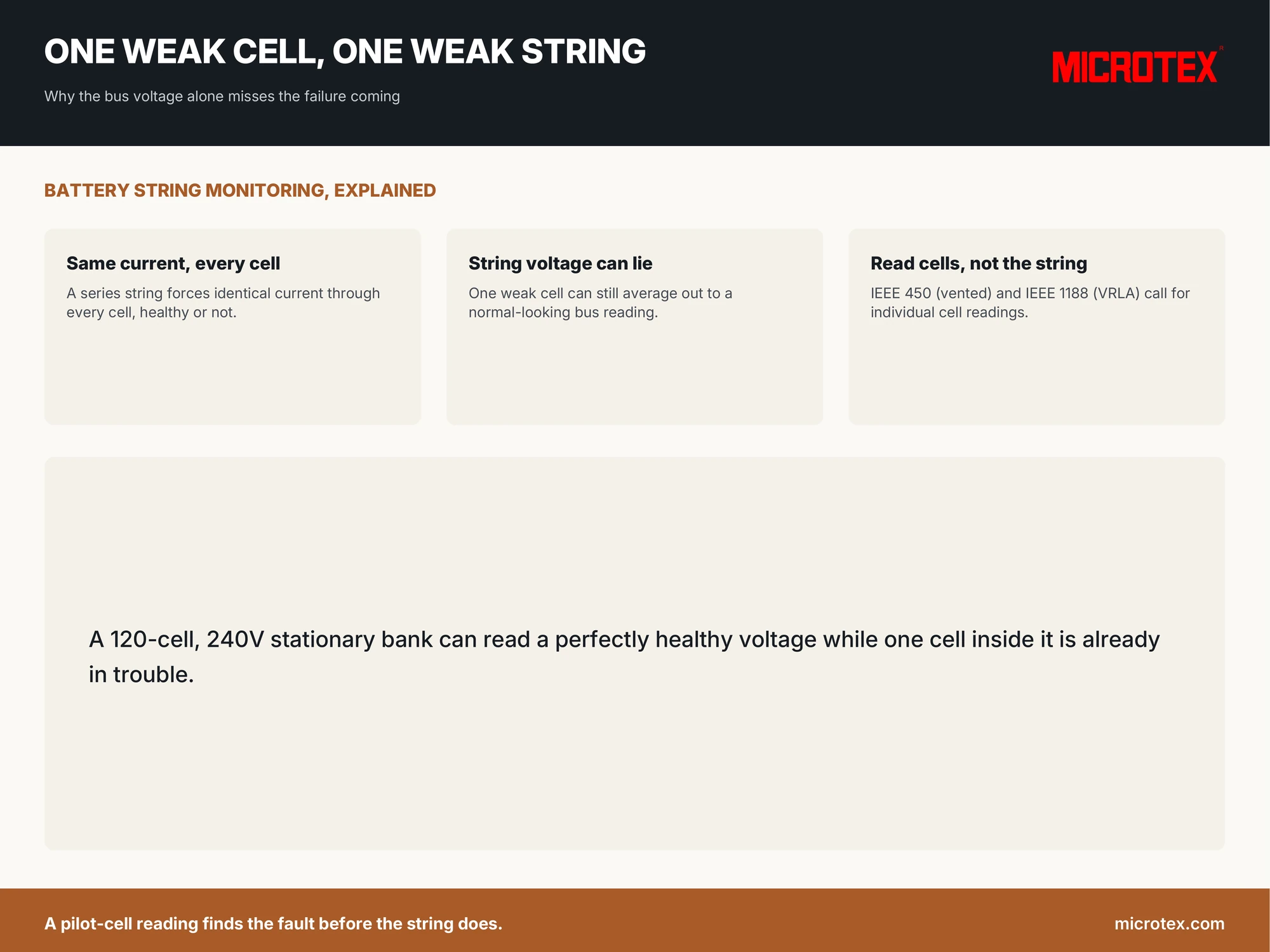
A 120-cell, 240 V stationary bank can read a perfectly healthy 246 V on the DC panel meter while one cell inside it is already in trouble — because 119 cells reading a fraction above average and one reading badly below it can still average out to a normal-looking string voltage. This is the single most repeated warning in stationary-battery maintenance literature, and it is why the recognised maintenance standards do not stop at a string reading. The American IEEE’s recommended practice for vented lead-acid stationary batteries (IEEE 450, most recently revised in 2020) and its valve-regulated counterpart (IEEE 1188 — check the current status of the edition before you cite it, as VRLA guidance has moved between standards over the years) both call for individual cell voltage and specific-gravity readings on a schedule, not just a once-a-year full-string check. A designated “pilot cell” or small sample gets read more often as an early-warning trip wire; the whole string gets read on a longer cycle specifically to catch the cell that the pilot sample missed. The point of both is the same: find the cell that is drifting away from the others before it drags the healthy majority through a repeated cycle of reversal and recovery.
What actually makes one cell go weak
Rarely is it one single dramatic fault. Our guide to positive grid corrosion covers the slow chemical process that eventually limits every cell’s capacity at a slightly different rate, so a spread across a bank’s cells is normal — the standards exist because a spread becomes a problem only once one cell falls far enough behind. Acid stratification can make one cell in a rack read low simply because it has had a different duty cycle or cooling than its neighbours. Rising internal resistance in a single cell is often the clearest early flag, well before capacity loss shows up on a discharge test. And sometimes the cell itself is fine and the fault is outside it entirely: a loose or corroded intercell connection adds resistance in exactly the same place in the circuit, which is why our guide to terminal corrosion is a companion check to every “weak cell” investigation, not a separate one — replacing a healthy cell because a dirty connector made it look sick is a real and avoidable mistake.
What to do once you find it
Linden’s own account of stationary practice describes the traditional remedy for a string that has drifted apart: a full equalising charge, taken to completion, which brings the whole string back to a common state of charge — though he notes plainly that this option narrows on newer, semi-sealed maintenance-free designs, where differential watering and deliberate overcharge are neither possible nor wanted. Where an equalising charge is not the right tool, the honest choice is between monitoring the weak cell closely (logging its individual trend, not just noting it once) and replacing it before it forces the rest of the string through repeated reversal events, each of which does its own damage. Replacing one cell in an ageing string is a real decision with its own trade-offs — a new cell paired with old neighbours ages differently again — and it deserves to be made from a trend, not a single bad reading.
Read the cells, not just the string
If your maintenance programme only ever reads the bus voltage, it will not tell you which cell is quietly falling behind until it fails on the day you need the bank most. Our guide to stationary battery monitoring systems covers the instrumentation that automates individual-cell reading; if you would rather start with a manual reading schedule and a form to log it against, ask us for the individual-cell test plan we give our own stationary customers.
Sources quoted: T. B. Reddy (ed.), Linden’s Handbook of Batteries, 4th ed. (McGraw-Hill, 2011).