
A battery monitoring system watches; a battery management system controls — and a lead-acid bank needs the first, not the second. The confusion is expensive. Our guide to the battery management system describes the electronic guardian a lithium pack cannot live without, the circuit that balances cells and cuts the current when limits are crossed. A flooded or valve-regulated lead-acid bank on a substation, telecom or railway DC bus needs nothing of the kind; it needs a witness. The US Bureau of Reclamation, which runs its own power stations, defines the job by way of IEEE: battery monitoring equipment is “a permanently installed system for measuring, storing, and reporting battery operating parameters”. It measures, it stores, it reports. It does not decide. This guide sets out what a stationary battery monitor should measure, how to read what it records, and — from the same institutions that recommend it — what it cannot do.
Why a witness is worth paying for
The Bureau’s manual is candid about how stationary batteries die: “Typically, failure is due to a lack of maintenance. Batteries usually show signs they are beginning to degrade, which are observable through visual inspections and testing parameters.” The signs are there; nobody is looking, because the bank is in an unmanned substation, a hilltop telecom shelter or a room visited quarterly. A monitor looks continuously, and its value is the trend — the same quiet number our guide to internal resistance calls a finder rather than a prophet, now recorded every hour instead of every quarter. The manual’s own framing is worth keeping: monitoring “can be performed manually or by an automated battery monitoring system. If performed correctly, both will yield quality results”. The monitor is not a different kind of maintenance; it is the walk-round done by a machine that never skips a month.
What it should measure
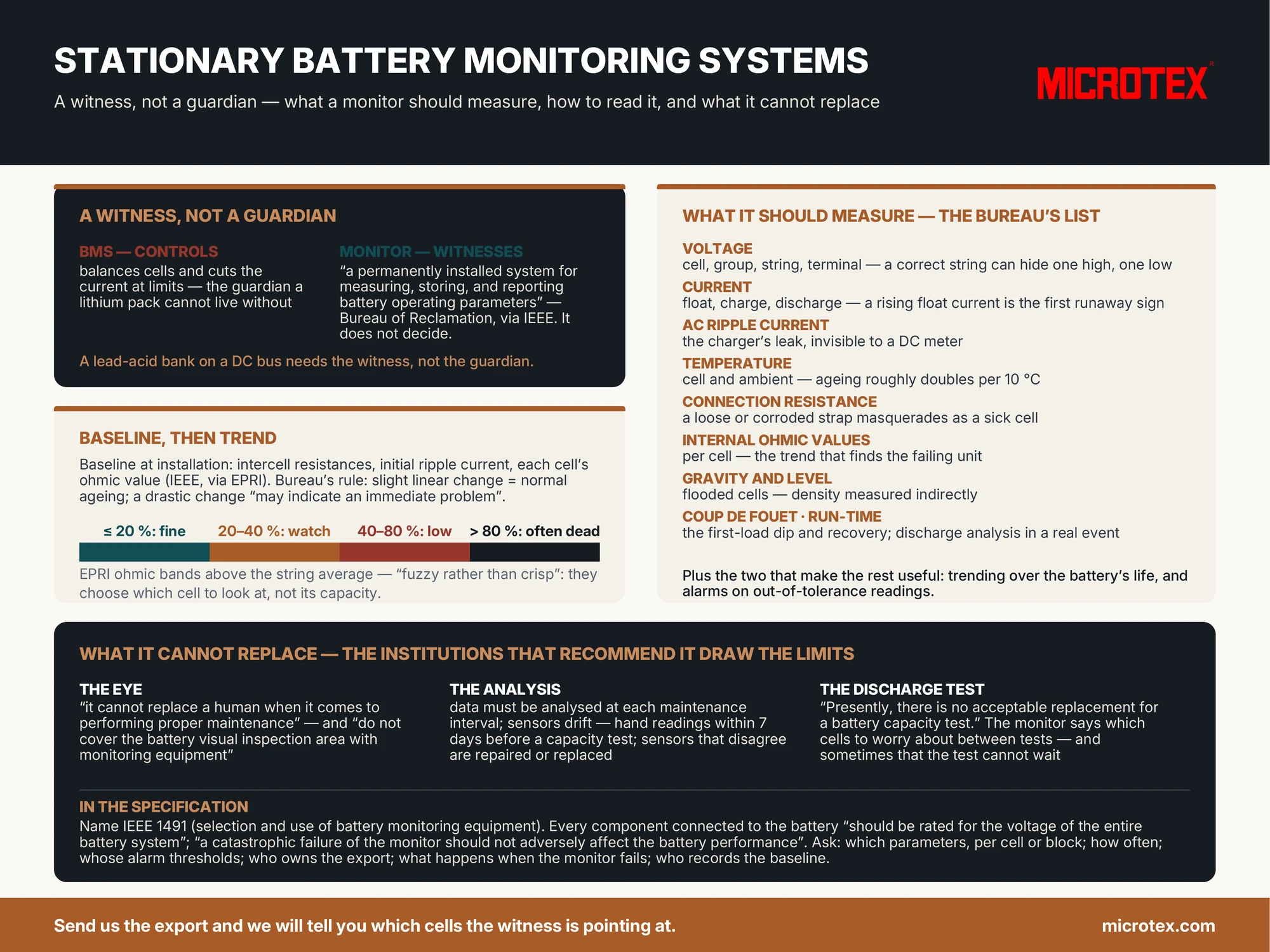
The Bureau’s parameter list is the specification a buyer should start from. Voltage — cell, group, string and terminal — because a string voltage that reads correctly can hide one cell high and one low. Current — float, charge and discharge — because the float current is the bank’s resting pulse and a rising one is the first sign of the runaway staircase our float-charging guide describes. AC ripple current, which the manual lists separately for good reason: it is the charger’s leak, invisible to a DC meter, and our guide to AC ripple explains what it costs. Temperature, cell and ambient, because ageing roughly doubles for every ten degrees, the loan our Arrhenius guide describes, and because a single warm cell in a cool row is a cell telling you something. Interconnection resistance, the micro-ohm reading our guide to terminal corrosion treats as doctrine, because a loose or corroded strap will masquerade as a sick cell. Internal ohmic values per cell, the trend that finds the failing unit. For flooded cells, specific gravity — which the manual notes is “typically measured indirectly by determining the density of the electrolyte” — and electrolyte level. Then two the buyer often forgets: the coup de fouet, the initial voltage dip and recovery when load is first applied, and discharge run-time analysis during an actual event. And the two that make the rest useful: trending over the life of the battery, and alarms on out-of-tolerance readings so that a problem is seen the day it starts, not the quarter after.
How to read what it records
A monitor without a baseline is a diary with no first page. The Electric Power Research Institute’s report on ohmic monitoring notes that IEEE’s installation practice for valve-regulated banks calls for recording, at installation, the initial intercell connection resistances, the initial ripple current and each cell’s internal ohmic value, “to establish a baseline against which to compare future measurements” — the same first-day record our guide to battery commissioning puts on the checklist. Against that baseline, the Bureau gives the reading rule in two sentences: “A slight linear increase or decrease in values is typically a sign of normal aging. A drastic change, either linear or non-linear, may indicate an immediate problem.” For the ohmic numbers specifically, the EPRI report offers a traffic-light method that compares each cell with the string’s nominal or adjusted average: for resistance and impedance, cells within about 20 percent above the average were, in its data, almost always of acceptable capacity; 20 to 40 percent was its “watch” band; 40 to 80 percent usually meant a low-capacity cell; and beyond 80 percent, often a dead one. The report is honest about the limits in the same breath — “the boundaries between Green, Yellow, and Red are fuzzy rather than crisp” and “the data scatter makes precise predictions impractical” — which is why our guide to testing ranks ohmic readers as brilliant finders and poor prophets. Use the bands to decide which cell to look at, not to declare capacity.
Then the unglamorous part. The EPRI project found that users’ data was “commonly stored in numerous directory locations, with widely varying file names, which made it very difficult to compare recent data to previously recorded data” — a monitor whose exports nobody can find is a monitor that was never bought. Its advice is simple: one place, one naming convention, battery name and date, so that this year’s readings sit beside last year’s. A monitoring contract that does not say who reads the data, how often and against what baseline has bought the sensors and forgotten the witness.
What it cannot replace
The institutions that recommend monitors are the same ones that draw its limits, and a tender should copy them. The Bureau: a monitoring system “can provide excellent information pertaining to the state-of-health of a battery, but it cannot replace a human when it comes to performing proper maintenance”. The visual inspection still happens, and the manual adds a rule installers break constantly: “Do not cover the battery visual inspection area with monitoring equipment” — a flooded cell’s plates and sediment must stay visible. The data must actually be analysed at each maintenance interval, or the monitor has merely recorded the failure in detail. Sensors drift: the manual has the crew take all readings by hand “within 7 days prior to the battery capacity test” and compare them with the monitor’s, repairing or replacing sensors that disagree. And the last line is the one that matters most, because it is the one a monitor salesman will not say: “Presently, there is no acceptable replacement for a battery capacity test.” The discharge test remains the only proof, as our testing guide insists; the monitor tells you which cells to worry about between tests and, sometimes, that the test cannot wait. Two safety points from the same manual belong in the specification: every component connected to the battery, directly or indirectly, “should be rated for the voltage of the entire battery system”, and “a catastrophic failure of the monitor should not adversely affect the battery performance”. A monitor that can short a cell or drain a string when it fails is a hazard bolted to the thing it was bought to protect.
Putting it in the specification
IEEE publishes a guide for exactly this purchase — IEEE 1491, Guide for Selection and Use of Battery Monitoring Equipment in Stationary Applications — and naming it in the tender is cheaper than describing it. Beyond that, six questions sort the offers: which of the Bureau’s parameters are measured, and per cell or per block; how often, and whether the interval is programmable; what the alarm thresholds are and whether they are taken from the battery’s own datasheet rather than the monitor’s defaults; how the data is exported, in what format, and who owns it; how the monitor is isolated from the string and what happens to the battery when the monitor fails; and whether the baseline is recorded at commissioning by the same instrument that will trend it. Our guide to writing a battery specification shows where the clause sits. We do not make monitors; we make the OPzS cells and VRLA banks they sit on, and we read their exports for customers who send them. If your bank is monitored and nobody has looked at the trend since commissioning, send us the export and we will tell you which cells the witness is pointing at.
Sources quoted: U.S. Bureau of Reclamation, FIST Volume 3-6: Storage Battery Maintenance and Principles (April 2020); EPRI, Stationary Battery Monitoring by Internal Ohmic Measurements, Report 1002925 (EPRI, Palo Alto, 2002).