
The fastest way to charge a battery is to not charge it at all. Hand over the empty one, take a full one, drive off: battery swapping turns an hours-long chemistry problem into a two-minute logistics problem, and every few years the idea is announced as the future of electric transport. As of 2026 the announcement is, for once, backed by serious hardware in China and serious business models in India. But here is what the coverage always misses: swapping is not a new idea on trial — it is an old idea with a fifty-year service record, running three shifts a day in the world’s forklift fleets, on lead-acid batteries, in rooms we know intimately. This guide covers both stories, and the catch that decides where swapping works.
The revival, as of 2026
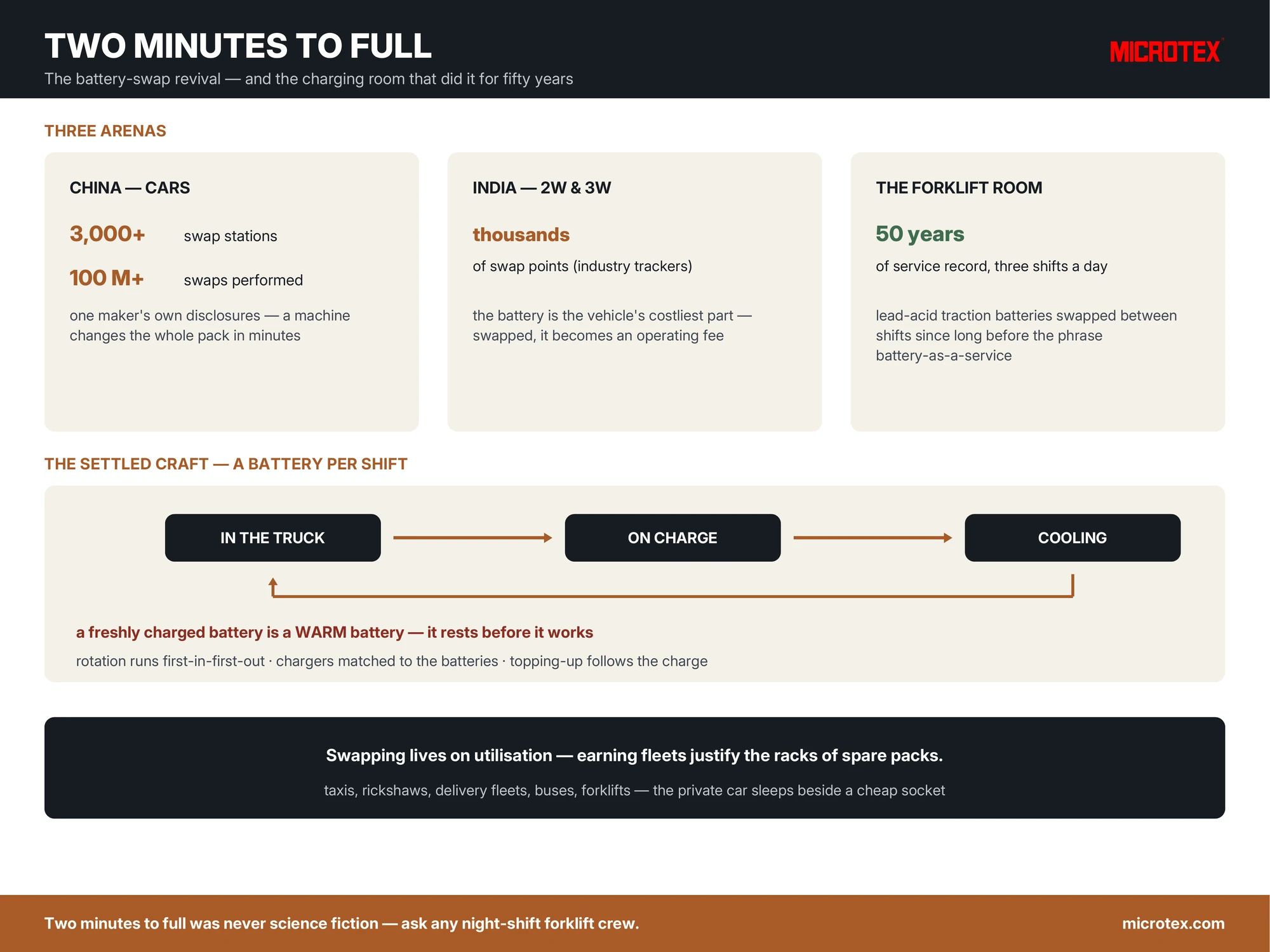
In China, swapping has escaped the pilot stage. One premium carmaker has built a network of more than three thousand swap stations and reports over a hundred million swaps performed — its own disclosures, but disclosures backed by stations you can drive to, where a machine exchanges the car’s entire underfloor pack in a few minutes, untouched by human hands. A leading Chinese cell maker, meanwhile, has announced a standardised swappable pack and a station network planned with a state oil company’s fuel-station estate — significant because standardisation across carmakers, not any single network, is the model’s real frontier. India’s revival runs on smaller wheels and arguably sounder economics: for electric rickshaws and delivery scooters, the battery is the costliest part of the vehicle, and swap networks turn that capital cost into an operating fee — industry trackers count thousands of swap points serving two- and three-wheeler fleets, with the Bureau of Indian Standards progressing standards for swappable packs and NITI Aayog having circulated a draft national swapping policy. (Policy in this space is still settling; verify the current framework before building a business on it.)
Where swapping quietly worked all along: the forklift charging room
Now the story we can tell with authority, because we have equipped it for decades. A forklift on three-shift duty cannot stop for the long, gentle charge its traction battery wants — so materials-handling fleets have swapped batteries between shifts since long before anyone coined “battery-as-a-service”. The discipline is settled craft. The classic planning rule: one battery in the truck, one on charge, one cooling — a battery per shift — because a freshly charged battery is a WARM battery, and sending it straight back to work stacks charging heat on working heat, the temperature arithmetic that quietly halves battery life. So charged batteries REST before duty, rotation runs first-in-first-out so every battery works and rests equally, chargers are matched to the batteries rather than shared indiscriminately, topping-up follows the charge, and the room itself — ventilation, spacing, handling gear for packs weighing as much as a small car — is engineered like the piece of process infrastructure it is. Every element of the modern swap station’s playbook is here, decades early, in unglamorous form.
The eternal obstacle: standardisation
Why, then, doesn’t every car swap? Because swapping only scales when packs interchange, and pack design is precisely where carmakers believe their advantage lives — shape, chemistry, cooling and software are competitive weapons nobody wants standardised into a commodity. A swap network must also FINANCE what it standardises: every station holds an inventory of the vehicle’s most expensive component, idle on racks, waiting. And there is the handover problem the brochures skip: you hand in YOUR battery — perhaps young and pampered — and receive a stranger’s, so the network must guarantee state-of-health equivalence, which takes telemetry, grading and contract language that the industry is still writing. The forklift world solved all three obstacles the blunt way: ONE OWNER holds the trucks, the batteries and the charging room, so standardisation happens by fiat inside the factory fence and nobody argues about whose battery is whose. That is the deep lesson: swapping thrives where a fleet is managed as one estate, and struggles where ownership fragments.
The honest economics — and the verdict
The arithmetic is unforgiving and worth stating plainly. A swap station earns only when vehicles keep arriving empty, so the model lives on UTILISATION: taxis, rickshaws, delivery fleets, buses, forklifts — vehicles that earn all day and cannot afford to stand still — justify the station’s capital and its rack of spare packs. The privately owned car, which sleeps at home beside a cheap socket for ten hours every night, mostly does not; slow overnight charging is simply too convenient a rival. So the honest verdict, as of 2026: swapping is not the future of all charging — it is the present of high-utilisation fleets, exactly as it has been on factory floors for fifty years. Two minutes to full was never science fiction; ask any night-shift forklift crew. If you run a multi-shift fleet and want the battery fleet, chargers and room engineered as one system — the version of this idea with five decades of proof — talk to us.