
Batteries rarely die of work; they die of charging. Every guide in this series has ended at the same door — sulfation from undercharge, explosions from bad charging-room habits, gel cells killed by flooded-battery settings — so this post walks through the door: how to charge a lead-acid battery correctly, how to read its state of charge honestly, and the five sins that shorten battery life more than any amount of honest work.
What charging actually does
Discharge runs the double-sulphate reaction forward — PbO₂ + Pb + 2H₂SO₄ ⇌ 2PbSO₄ + 2H₂O — turning both plates partly to lead sulphate and diluting the acid. Charging pushes it back: current converts the sulphate to active material and the acid re-concentrates. Two useful gauges fall straight out of that chemistry: as the battery fills, the electrolyte’s specific gravity rises and so does the battery’s voltage. Push charging past what the plates can absorb, though, and the surplus current splits water into hydrogen and oxygen instead — the gassing that costs water and, unmanaged, builds the hazard covered in why batteries explode. Charge too little, too casually, and unconverted sulphate hardens into the slow disease of sulfation. Correct charging is simply the narrow road between those two ditches.
The three charging methods
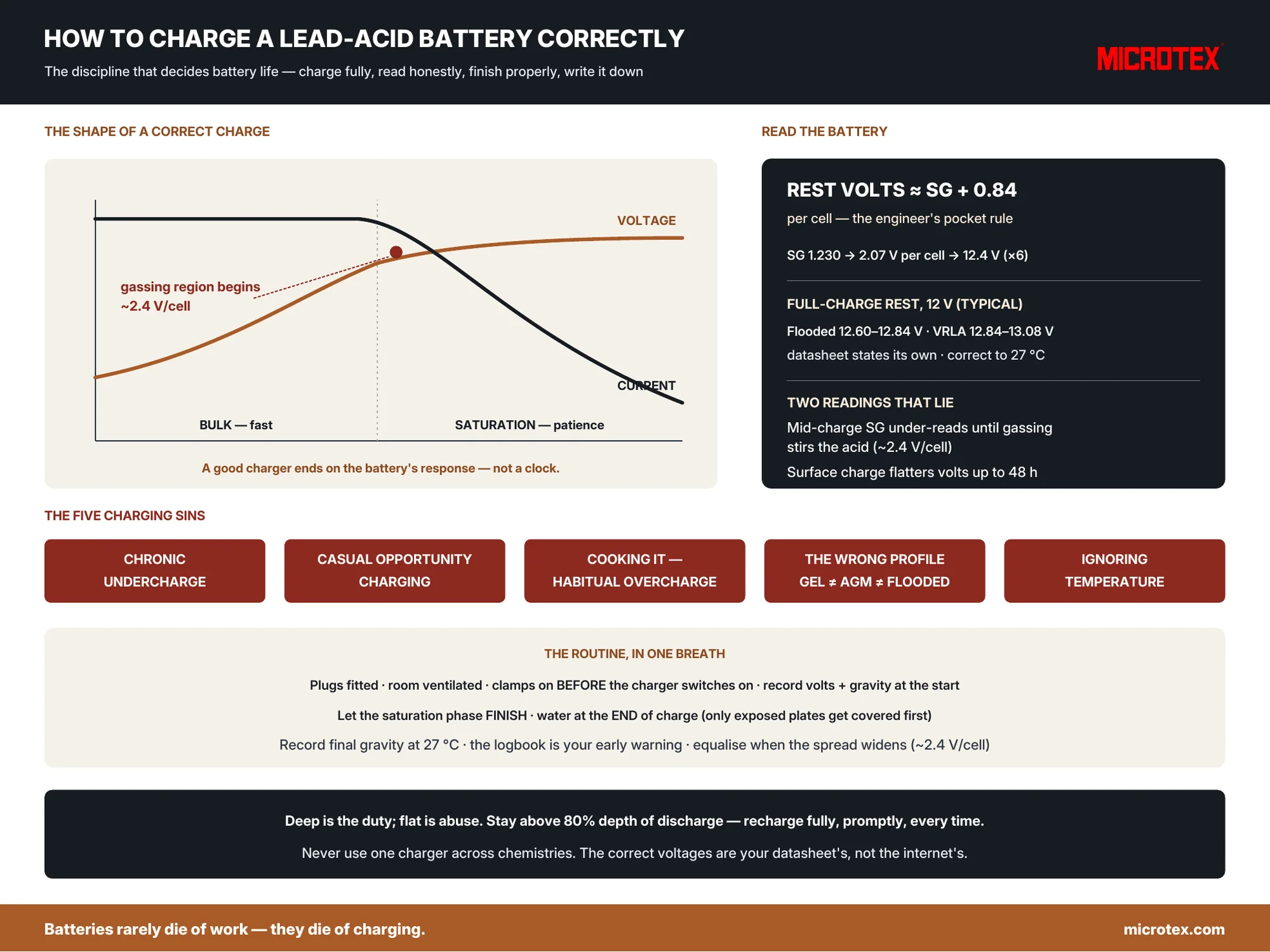
Every charger ever built plays variations on three themes. Constant current pushes a fixed current in and lets the voltage rise — simple, but it must be stopped in time or gassing runs away. Constant voltage holds a set voltage and lets the battery draw what it will — the current starts high and tapers as the battery fills, which is why it suits standby and UPS duty. Taper charging is the old transformer charger: current falls as voltage rises. Modern chargers combine the first two — a constant-current bulk phase that restores most of the charge quickly, then a constant-voltage saturation phase where the current dwindles. The shape to remember: the bulk phase is fast; the saturation phase is patience. Both matter, and skipping the slow half is not a shortcut, it is sin number one below.
| Lead-acid type | Usual charging approach |
|---|---|
| Flooded flat plate | Constant current, CC/CV or constant-voltage taper |
| Flooded tubular (traction, OPzS) | Constant current, CC/CV or constant-voltage taper |
| AGM VRLA | CC/CV or constant voltage — voltage-limited, temperature-compensated |
| Tubular gel VRLA (OPzV) | CC/CV or constant voltage — gel-specific settings, temperature-compensated |
One philosophy above all: a good charger ends the charge on the battery’s response — voltage behaviour, current saturation, temperature — not on a clock. Timers guess; batteries answer. A full charge takes hours, not minutes, and the exact duration belongs to the charger’s judgement and the manufacturer’s manual, not to a rule of thumb. As for charger size, common practice puts the charger’s current at a fraction of the battery’s capacity — broadly between a tenth and a quarter — and the battery’s manual has the final word.
How to read the state of charge
For a flooded battery, the hydrometer is the honest instrument: the acid’s specific gravity tracks the state of charge almost linearly. Take the reading at eye level, correct it to 27 °C exactly as shown in the battery acid guide, and write it down. For sealed batteries — and as a cross-check on flooded ones — use the rest voltage and the old rule every battery engineer carries:
Rest voltage per cell ≈ specific gravity + 0.84. A cell with electrolyte at 1.230 rests near 1.230 + 0.84 = 2.07 volts; six cells make 12.4 volts. Fully charged, a flooded 12 V battery typically rests at 12.60–12.84 V and a VRLA at 12.84–13.08 V — the VRLA sits higher because its acid is stronger (an AGM runs around 1.30 SG where a stationary OPzS cell sits near 1.20; each datasheet states its own).
Two caveats keep those readings honest. First, mid-charge readings lie: the dense acid made at the plates sinks, so the hydrometer under-reads until the charge reaches the gassing region — around 2.4 volts per cell — and the bubbles stir the electrolyte back to uniformity. Second, a freshly charged battery flatters itself: concentrated acid clinging near the plates holds the voltage high for hours — up to two days. Let the battery rest, or take a brief discharge, before trusting a rest-voltage reading. And any reading, hydrometer or voltmeter, needs its temperature correction applied.
The correct routine, step by step
For a flooded battery, the whole discipline fits in seven habits. One: vent plugs stay fitted and the space ventilated — plugs are designed to breathe. Two: connect the clamps first, then switch the charger on; switch off before disconnecting — the make-and-break spark above a gassing cell is the classic self-inflicted accident. Three: record voltage and specific gravity at the start. Four: let the charge finish — the saturation phase is where full charge actually happens, and snatched half-charges are how sulfation compounds. Five: water at the END of charge, never before; the sole exception is plates left exposed, which get just enough demineralised water to cover them before starting. Six: record the final gravity, corrected to 27 °C, and confirm it has returned to its usual full-charge value. Seven: the logbook — the cheapest early-warning system a battery room owns.
Equalising: the corrective charge
Cells in a string never age in perfect step, and stratified or lagging cells drift low in gravity and voltage. The remedy is the equalising charge: a deliberate, controlled overcharge — typically at around 2.4 volts per cell — applied to an already-charged battery so that every cell reaches genuine full charge and the gassing stirs any acid layering away. Equalise when the readings call for it: when the spread between highest and lowest cell voltages or gravities widens beyond what your datasheet allows, or after a deep discharge. How often that is depends on the battery and the duty — the datasheet, not a calendar, sets the interval.
The five charging sins
Chronic undercharge — the battery that never quite finishes, losing a little capacity to hardening sulphate every week. Casual opportunity charging — snatching charge at breaks without engineering for it; acceptable when designed, ruinous when improvised, as the traction battery guide explains. Cooking it — habitual overcharge, which pays out as water loss, positive-grid corrosion and heat. The wrong profile — flooded-battery settings applied to sealed batteries; gel and AGM each need their own catalogue voltages with temperature compensation, the difference unpacked in AGM vs gel. Ignoring temperature — a hot battery on a fixed voltage draws more current, heats further, and spirals; temperature-compensated charging is not a luxury feature, it is the escape from that loop. Beneath all five sits one floor: avoid riding below 80% depth of discharge, and recharge promptly after every deep discharge.
Other chemistries, one honest paragraph
Lithium-ion charges fast on a constant-current, constant-voltage recipe, terminated by its battery management system — necessary, because its volatile electrolyte punishes overcharge severely. Nickel-cadmium and nickel-metal-hydride hold their voltage so flat that chargers watch for the end-of-charge signatures instead: the voltage dip (−dV/dt) and the temperature-rise slope (dT/dt). The practical rule this buys you: never use a charger across chemistries — and for how discharge rate reshapes capacity and run-time in every chemistry, the arithmetic lives in what C-rate means.
Charging discipline is a partnership between the battery and the charger, which is why our proposals ship with the charging specification attached — battery and settings from one hand, so the warranty conversation never starts. Odd terms live in the glossary; a charging regime that isn’t behaving lives in an enquiry — describe the battery, the charger and the shift pattern, and an engineer will find the sin.
The fastest ways to kill a good battery — on film
Dr. Michael McDonagh, our Chief Technical Officer, counts the fastest ways customers destroy perfectly good batteries — the wrong specification, the wrong charger, the fast-charging myth, and the new-cell-in-an-old-bank mistake. A few minutes of factory-floor truth.