
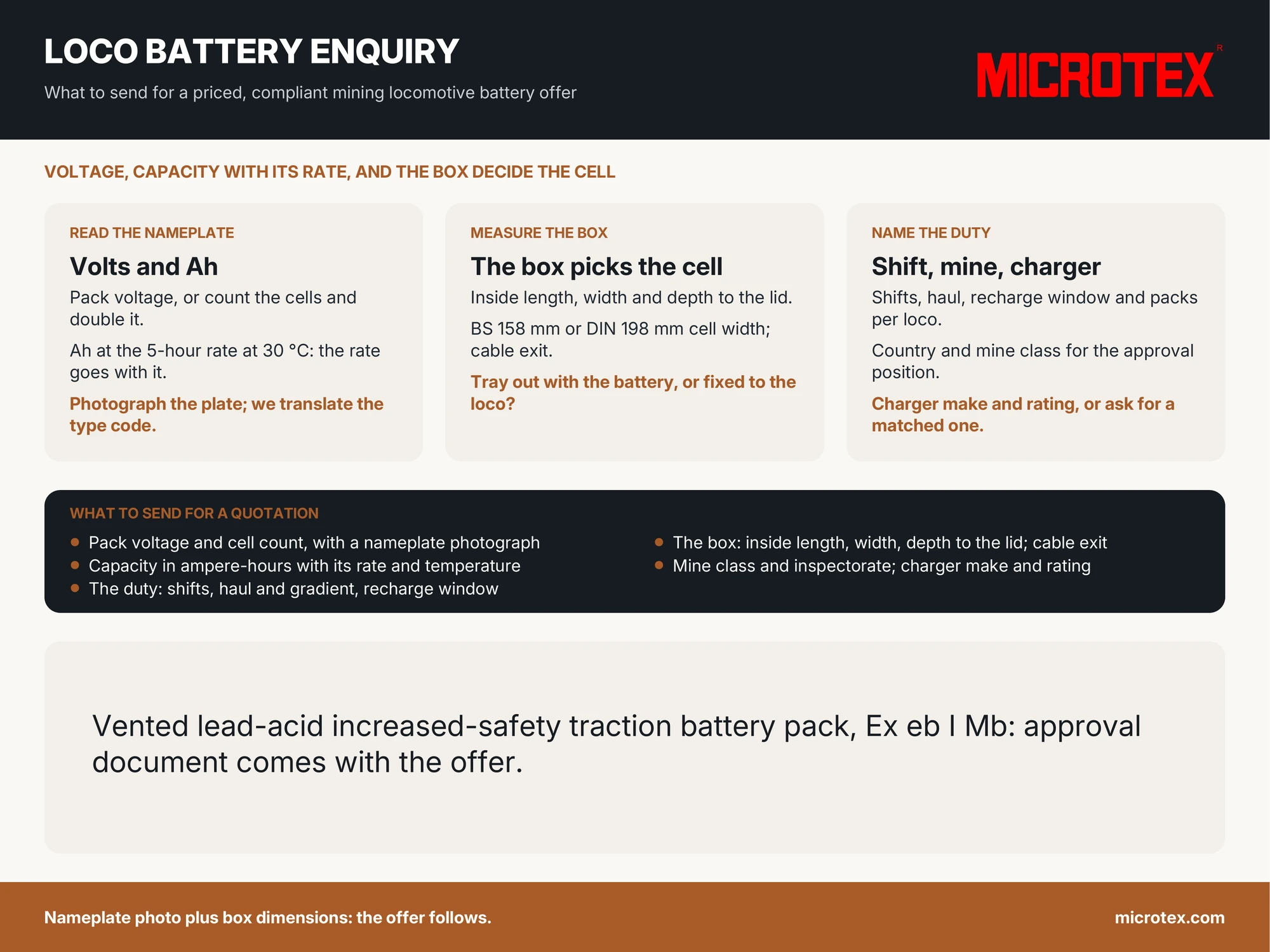
A mining locomotive battery enquiry that carries the pack voltage, the capacity with its rate, the box dimensions, the duty, the mine class and the charger comes back as a priced, compliant offer; one that carries a model name comes back as questions. This is the checklist for the mine engineer or purchase officer with a locomotive standing idle or a fleet renewal to tender.
Pack voltage and the number of cells
Traction packs are 2 V cells in series, so the pack voltage and the cell count say the same thing twice; we ask for both so a misread nameplate shows. Our mining locomotive battery page lists packs from 48 V with 24 cells to 180 V with 90 cells, and any other voltage given the cell count. Photograph the nameplate: a type code such as 7MIPzB 602 gives the positive plates per cell, the cell family and the capacity; other makers’ codes differ and we translate them.
Capacity: the number, its rate and its temperature
An ampere-hour figure on its own is not a specification. Our traction cells are rated at the 5-hour rate at 30 °C, the convention of IS 5154 (Part 1) and IEC 60254-1, and Linden’s Handbook of Batteries shows for traction cells that capacity falls as the discharge rate rises and as the temperature drops, so a 10-hour or 20-hour figure from another plate describes a different duty; tell us which rate is printed and we convert. Behind the number sits the duty; our guide to mine locomotive battery sizing lists the eight items we size from, so send what you have, flagging estimates.
The battery box decides the cell
A traction battery is individual cells in a steel tray made to fit the machine, which is why the box, not the catalogue, usually settles the cell. Give the inside length, width and depth, the cable exit, and whether the tray comes out with the battery or stays with the locomotive. Our BS-dimension cells are 158 mm wide and our DIN-dimension cells 198 mm, and cell heights run from 309 to 745 mm, so box depth chooses the plate size as much as the ampere-hours do. Dell and Rand’s Understanding Batteries notes that traction cells are built to a standard width, so a box drawn for one family rarely accepts the other.
Name the pack correctly, and tell us the mine
The product is a vented lead-acid increased-safety traction battery pack, marked Ex eb I Mb to IS/IEC 60079-7:2015 with IS/IEC 60079-0:2017; the enclosure-based concept of IEC 60079-1, type ‘d’, is different and we do not claim it. Compliance is not certification: the approval position depends on your country and mine class, so the approval document for the exact pack comes with the offer and its number is quoted in writing against your enquiry, never printed in advance. Name the country, the mine class and the inspectorate whose approval you need. Check the current edition of any standard; the mine’s statutory rules take precedence. Our MUV and scoop battery page shows the 240 V pack of the same cell family.
The charger belongs in the same enquiry
Batteries die in the bay more often than on the machine, so tell us the charger you have, or ask for one matched to the pack: our mining battery chargers log ampere-hours returned and time, so the mine can audit every charge. State the recharge window: a charge cut short every day is chronic undercharge. Charging batteries in underground mines has ventilation and layout rules the bay must meet first.
Electrolyte and working temperature
Our mining cells are filled to 1.260 specific gravity rather than the textbook 1.280, chosen for the 35 to 40 °C reality of a working mine, where a weaker acid corrodes the positive more slowly. Tell us the working temperature at the face and in the bay so that we can confirm the gravity and charge profile.
What service life to expect, and what shortens it
Our figure for tubular cells in mining traction duty, as of 2026, is 4 to 5 years: a planning figure, not a warranty. Linden’s handbook defines the end of a traction battery’s cycle life as the point where it no longer delivers 60 to 80 per cent of its rated capacity, so ask which fraction any quoted life is measured to. The usual life-shorteners are chronic undercharge in a hurried bay, watering neglect and heat, and lead-antimony spines make a tubular cell lose water, so the watering round is part of the duty. Our guide to mining battery total cost of ownership turns the life figure into money.
Spares and cell replacement
Because the pack is an assembly of cells, a failure in one or a few is put right by replacing those cells, not the pack. Ask the offer to state its cell replacement policy and whether matching cells, connectors and covers come with a date. Ours are quoted with a date.
Where other chemistries fit
Lithium locomotive packs are offered underground, with makers reporting faster charging and longer life. Where the recharge window is short and one pack must run two shifts without a change-out, lithium may suit better than ours; we cannot verify those figures, so ask for logged data from a reference mine on a similar duty and for the approval position in your mine class. For a shift of haulage, a full recharge and crews who service the battery cell by cell, the tubular lead-acid pack is our honest recommendation. See our record of battery fires in underground mines and our overview of battery-powered underground mining equipment.
The enquiry list
- Pack voltage and cell count, with a nameplate photograph.
- Capacity in ampere-hours with its rate and temperature.
- The duty: shifts per day, haul and gradient, recharge window, packs per locomotive.
- The box: inside length, width and depth to the lid, cable exit, tray fixed or removable, venting.
- Terminal and connector type and cable size.
- Country, mine class and the inspectorate whose approval you need.
- Charger make and rating, or a request for a matched charger.
- Working temperature at the face and in the bay.
- The spares you want quoted: cells, connectors, covers.
- Number of packs, the mine, the locomotive make and model, the date it must run.
Send the list, complete or partial, through our contact page. Our locomotive page says every size is delivered in 21 days once the specification is settled, and that we reply within the working day; the nameplate photograph and the box dimensions settle it fastest.
Sources quoted: T. B. Reddy (ed.), Linden’s Handbook of Batteries, 4th ed. (McGraw-Hill, 2011), chapter 16, sections 16.2, 16.3 and 16.5 on electrolyte gravity and on deep-cycle and traction batteries; R. M. Dell and D. A. J. Rand, Understanding Batteries (Royal Society of Chemistry, 2001), section 8.6 on tubular traction batteries.