
A mine locomotive battery cannot be sized from the locomotive’s model name; it is sized from a duty cycle, and most enquiries reach us without one. We build lead-acid traction batteries for underground machines, so this post sets out the eight things a battery maker needs to know, in the order they usually matter. It is a checklist for the person drafting the enquiry, not a sizing method; the method is in our guide to how a battery bank is sized. Safety approvals differ by country, mine class and regulator, so treat every approval point below as something to verify with the mine and its regulator before relying on it.
Why a locomotive is its own case
The IEC traction-battery standard, IEC 60254-1, covers lead-acid batteries for electric propulsion in road vehicles, locomotives, industrial trucks and material handling equipment, and Linden’s Handbook of Batteries lists mine locomotives among the traction (motive power) applications of lead-acid. The shared design is deep daily cycling; our guide to a traction battery explains it. What differs underground is the track, the heat, the dust and the rules, and each of those changes the answer.
The eight things
1. Voltage and the box. The locomotive’s nominal voltage, the cell count it expects, and the exact internal size and weight limits of the battery box. Measure the box, not the old battery, which may be packed out. The battery is usually one of the heaviest items on a battery locomotive, so ask the locomotive maker whether it counts as adhesive weight; as with a forklift’s counterbalance, a lighter battery is not automatically better.
2. The duty per shift. Trips per shift, cars hauled, distance and the gradient profile are useful, but the best data is a logged discharge: the ampere-hours taken out over a normal shift, from the locomotive’s controller or a clip-on meter. A measured duty beats a calculated one every time.
3. Peak current. Starting a loaded train on a rising gradient draws far more current than cruising, and a battery gives less capacity at a high rate of discharge, as explained in our guide to Peukert’s law. Tell us the heaviest regular pull.
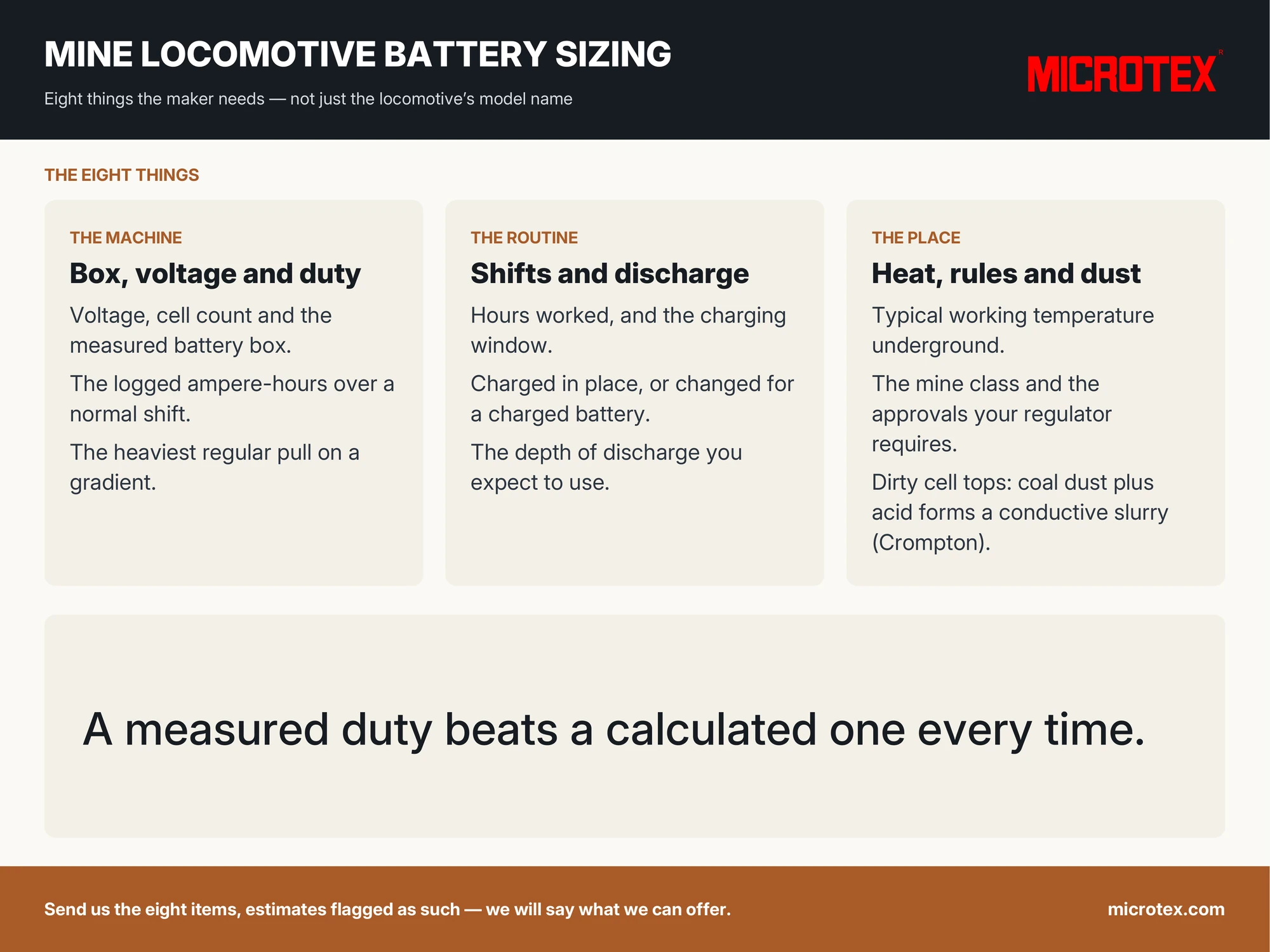
4. Shift pattern and charging window. How many hours the locomotive works, how long it stands, and whether the battery is charged in place or changed for a charged one. The answer decides how many batteries each locomotive needs; our guide to charging batteries in underground mines covers the station below ground.
5. How deep you will discharge. Dell and Rand give 80 per cent depth of discharge as the usual limit for a traction battery. A battery sized to be emptied further than its maker intends is a battery sized to fail early, so state the depth you expect to use.
6. Underground temperature. Deep workings can be warm, and heat shortens life; our guide to operating temperature explains the trade. The maker may adjust the electrolyte density to suit the temperature, so give the typical working temperature at the charging bay and on the track.
7. The mine’s safety class and approvals. Coal and non-coal mines, and gassy and non-gassy workings, are governed differently, and the battery, the charger and the battery box may each need approval. Tell us the country, the mine class and which approvals your regulator or mine owner requires, and ask for the maker’s current approval status in writing; do not assume one country’s approval holds in another.
8. Housekeeping of the cell tops. Crompton, in the Battery Reference Book, singles out coal-mine locomotive batteries: acid spilt on the top, plus coal dust, makes a slurry that conducts well, so current can flow across the cell tops, heat them locally, and in some circumstances start a fire. A clean, dry battery top is therefore a safety measure as well as a maintenance habit, and an unexplained earth leakage reading is a reason to inspect; see our guide to DC earth faults.
Where lithium is better, and where it is not yet proven
Lithium locomotive packs are offered for underground use, and their makers report faster charging and longer life; we cannot verify those figures independently, so ask any supplier for logged data from a reference mine with a similar duty. Lithium is a fair choice where fast charging in the shift change is worth the extra cost and the mine has approved it. Our record of battery fires underground sets out why many mines remain cautious about chemistry choices below ground.
Send us the eight items, even if some are estimates and flagged as such. In return you should expect the proposed battery, the charger it needs, the box drawing, and the assumptions written down, so that anyone at the mine can check them against the real duty. If the first month of logged data differs from the estimate, the sizing should be revisited and not defended. We will say what we can offer and what we still need to measure. Tell us the locomotive, the mine class and the shift pattern.
Sources quoted: IEC 60254-1:2005, Lead-acid traction batteries — Part 1: General requirements and methods of tests, scope (IEC webstore; check the current edition); T. B. Reddy (ed.), Linden’s Handbook of Batteries, 4th ed. (McGraw-Hill, 2011), chapter 16, table of major applications of lead-acid batteries; R. M. Dell and D. A. J. Rand, Understanding Batteries (Royal Society of Chemistry, 2001), chapter 4; T. R. Crompton, Battery Reference Book, 3rd ed. (Newnes, 2000), chapter 1, section on localised heating effects in batteries.