
Every battery fire in an underground mine that has been publicly reported fits on one page — and the page says something different from what either side of the lithium argument wants it to say. The mining press describes battery electric vehicle fires as either a solved problem or a catastrophe waiting to happen. The mine rescue reports, the regulator bulletins and the two peer-reviewed reviews that have counted the incidents say neither. They say the lithium record is short, that nobody has died in it, and that almost every entry was a charging bay, a storage yard or a maintenance error rather than a battery failing on its own. They also say, if you read the older reports, that the lead-acid record contains two of the worst coal-mine disasters of the last fifty years. This is that page, with its sources, and with what the two records have in common — which turns out to matter more than the chemistry.
The lithium record: eleven incidents, no deaths
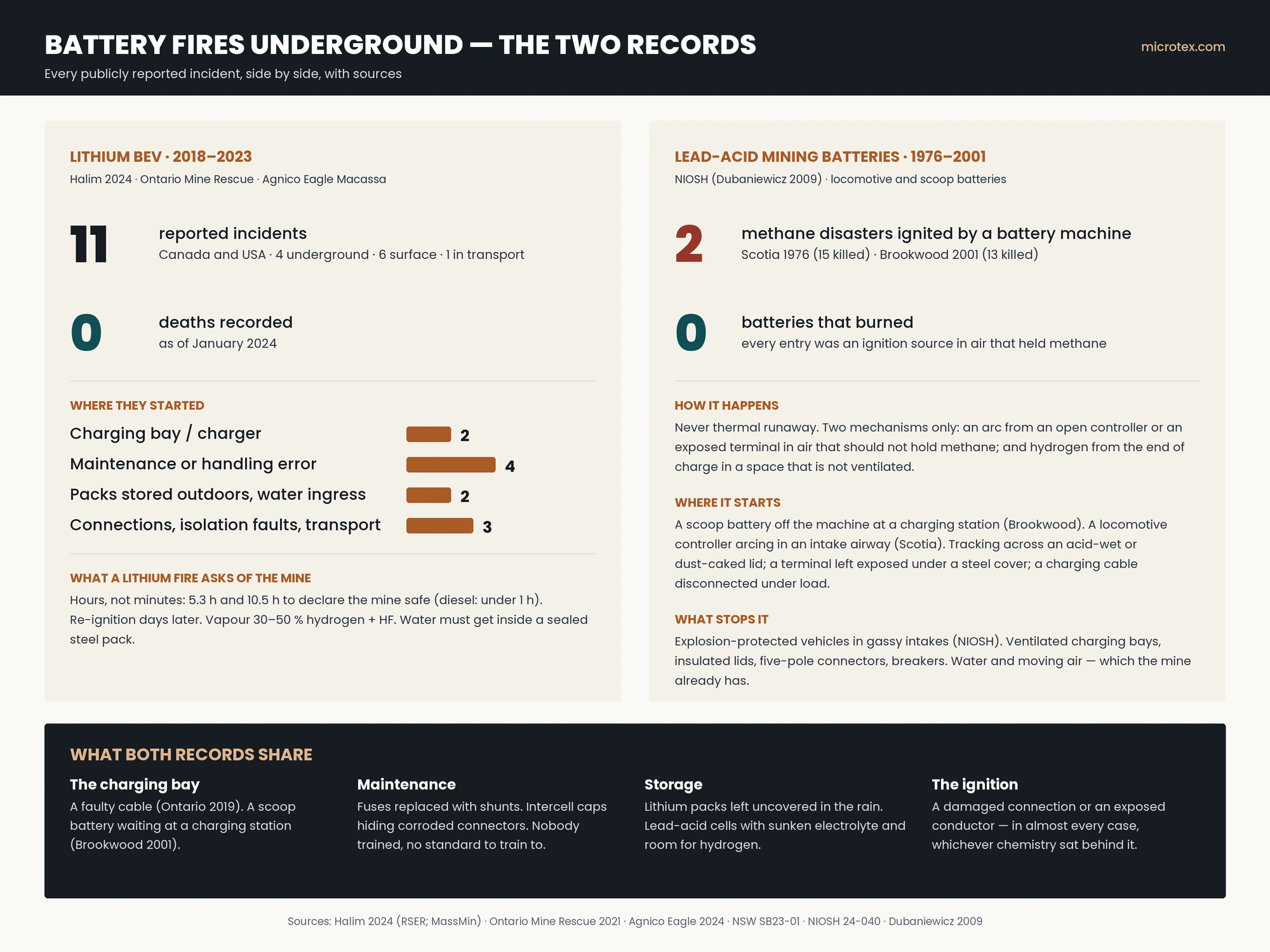
The most complete count is in a 2024 review from Luleå University of Technology, which tabulated every publicly reported fire involving battery electric vehicles or their batteries in underground mines. Its finding: eleven incidents, all in Canada and the United States, between 2018 and 2023 — four of them underground, six on surface or off site, one in transport. Two happened during charging, four were mechanical or human error, two were moisture inside a battery stored outdoors. A companion paper by the same author states the other half of the finding plainly: as of January 2024 there are no recorded fatalities from a battery electric vehicle fire in an underground mine, and there is insufficient data to say such fires are more common or more dangerous than diesel fires. The incidents are worth reading one by one, because the causes column is the whole lesson.
| Mine | Year | Where | What happened | Root cause |
|---|---|---|---|---|
| Red Lake district, Ontario | 2018 | Underground shop | A shelf of about thirty power-tool batteries on charge caught fire between shifts | Charging station failed |
| Southern district, Ontario | 2019 | Underground charging bay | Three vehicles consumed; black smoke at the shaft; surface buildings evacuated; rescue team reached the fire with a water truck about 4.5 hours after the alarm | Faulty charging cable or fixture back-fed the first battery and spread to two more |
| Borden, Ontario | 2019 | Surface | A pack removed from a vehicle and awaiting return to the maker caught fire | Coolant leak inside a module led to arcing |
| Onaping district, Ontario | 2020 | Underground | Two technicians troubleshooting a boom truck were trapped behind it when it caught fire; rescued on breathing apparatus; mine declared safe after 10.5 hours | Traction inverter failed; battery fuses had been replaced with shunts, so there was no over-current protection |
| Turquoise Ridge, Nevada | 2021 | In transport | Arcing in a battery | Isolation fault during transportation |
| Macassa, Ontario | 2022 | Underground | A scoop stalled twice; smouldering and sparks in the pack; operator put it out with a hand extinguisher; no thermal runaway | Damaged battery connection |
| Macassa, Ontario | 2023 | Surface (five events) | A decommissioned pack in the storage yard; cells shorting on a truck trailer; two modules smoking days after an earlier thermal event, submerged in water; a pack that vented and then ignited when water was applied, blowing its side doors off | Isolation faults between modules; cells touching metal; water under module control boards from packs left outdoors uncovered; a cover gasket fitted on the wrong side of its bolt holes |
Read the last column. Not one entry is a sound battery in a maintained machine deciding to burn. The Ontario industry reached the same conclusion when it sat operators, electricians and managers down in 2021 to find the root causes of its fires: inadequate maintenance processes, the absence — until CSA M424.4 arrived in 2022 — of any standard for these machines, ineffective management of change, rushed implementation, operators without training, and inadequate battery storage. The Macassa summary is the most candid document in the set: the mine’s own engineers list water ingress, a gasket on the wrong side of its bolts, and packs “left outside, uncovered and allowed to get wet” as the causes, and describe what they changed — bus-bars removed from any pack sent to surface, cells isolated, modules boxed in plywood under weather-resistant lids.
What is different about a lithium fire underground
The record does not say lithium fires are more frequent. It says three things about what happens once one starts. It takes hours, not minutes. In the two Canadian underground fires, the mine was declared safe 5.3 hours and 10.5 hours after the alarm; the Luleå author, who fought three diesel truck fires in an Australian gold mine, records those as out within thirty minutes and the mine clear within the hour. It comes back. A cell in thermal runaway keeps generating flammable vapour after the flames are out — the New South Wales regulator’s 2023 bulletin puts the mix at roughly 30 to 50 per cent hydrogen with ethane, methane and other hydrocarbons, and warns that an “extinguished” pack is an explosion risk until it is cooled and removed from the mine. Macassa’s two modules that began smoking days after the event are that warning in practice. The rule book was written for something else. In 2024 the US mine-safety institute NIOSH put a lithium pack into an explosion-proof enclosure and drove it into thermal runaway: jet flames escaped the cover joint and the enclosure deformed beyond its limits. Their conclusion was that such enclosures may not provide adequate protection against a lithium thermal runaway — a finding with direct consequences for gassy coal mines, where the flameproof enclosure is the safety case. And nobody has yet burned a full underground BEV in a test, because nobody will donate a machine that costs more than a million dollars; every firefighting procedure a mine holds for these vehicles is extrapolated from cars. Our guide to lithium fires, understood explains the chemistry without the fear-mongering; this page is about the arithmetic of the rescue.
The lead-acid record, honestly
We make lead-acid batteries, so this section is written with particular care. A flooded lead-acid cell does not go into thermal runaway; it has no organic electrolyte to burn and its only fire risk is the hydrogen it makes at the end of charge, which our guides to why batteries explode and battery-room hydrogen set out in full. That is true and it is not the whole record. The whole record, from the NIOSH study of every fatal United States coal-mine explosion between 1976 and 2006, includes two entries that every mining engineer should know. At the Scotia mine in Kentucky in 1976, the ignition source for the first explosion — fifteen dead — was the normal arcing of a battery-powered locomotive’s controller in an intake airway. At Jim Walter Resources No. 5 in Alabama in 2001, a roof fall crushed a scoop battery that had been taken off the machine for charging; the steel tray touched a terminal, the arc ignited methane, and the second explosion that followed killed the twelve men who went in to help. Thirteen died. In the same study, battery-powered vehicles account for about twenty of the hundred and sixty explosion fatalities examined. None of those batteries burned. Every one of them was an ignition source — an open controller, an exposed terminal — in air that should not have contained methane and did. The NIOSH author’s recommendation is worth quoting because it is the design principle behind every mining battery worth buying: use explosion-protected vehicles in the intake airways of gassy mines, and protect anything that stays energised in an emergency to the highest level, because a battery cannot be switched off.
Below the disasters sits the ordinary record of the batteries this page is about: traction batteries for locomotives and utility vehicles, and the stationary banks that sit underground in refuge chambers and substations. Queensland’s 2012 alert on a refuge bay that exploded, empty, because a charger failed to switch off and the overcharged sealed batteries under a seat vented hydrogen into an airtight chamber, is the most instructive entry: the ignition source was never identified, and nothing about the batteries was exotic. The lesson is the charger and the room, not the chemistry. A Soviet-era study of mine locomotive faults attributed about a fifth of electrical-fault fires to damaged batteries; the causes we have seen in forty years of building them are the same ones — tracking across an acid-wet or dust-caked lid, a terminal left exposed under a steel cover, a charging cable disconnected under load.
What the two records have in common
Put the two tables side by side and the chemistry almost disappears. The charging bay is where both records start: a faulty cable in Ontario in 2019, a charger that would not switch off in Queensland in 2012, a Brookwood battery waiting at a charging station. Maintenance is the second entry in both: fuses replaced with shunts on one side, intercell caps hiding corroded connectors on the other. Storage is the third: lithium packs left in the rain, lead-acid batteries with sunken electrolyte and room for hydrogen to gather. And a damaged connection or an exposed conductor is the ignition in almost every case, whichever chemistry sat behind it. The Ontario industry’s root-cause list for its lithium fires — maintenance, standards, management of change, training, storage — could have been written for a lead-acid battery bay in 1976, and largely was. That is the first conclusion, and it is not a comfortable one for either camp: the battery you choose matters less than the discipline you run it with.
The second conclusion is where the chemistry does matter, and it is about consequence rather than probability. A lead-acid battery bay fire is put out with the water and ventilation the mine already has; the hydrogen that caused it disperses the moment the air moves; the failure modes are visible — an acid-wet lid, a warm connector, a low electrolyte level — to a man with a lamp on a walk-round, and they have been understood for a century. A lithium pack fire asks the mine for hours, for hydrogen-fluoride protection, for a way to get water inside a sealed steel case, for somewhere safe to put a pack that may re-ignite tomorrow, and for a rescue team that has trained on a vehicle nobody has ever burned. A large, well-resourced mine with charging bays designed on exhaust air, thermal monitoring on every pack and a five-team rescue service can carry that burden, and several do. A mine with one rescue team, one water truck and a forty-minute travel time to the working level is a different proposition, and should say so before it buys, not after. Our guide to charging batteries underground sets out what either bay needs; our note on diesel versus battery underground gives the reason the fleet is going electric at all; and the mining battery cost of ownership guide is where the rescue burden belongs in the arithmetic.
Five questions before any battery goes underground
Whatever the chemistry, the record suggests the same questions. Where is the charging bay, what does its air do when the fan stops, and what happens to a fault in a charging cable at two in the morning? Who is allowed to touch the battery, what are they trained on, and can a fuse be replaced by a shunt without anyone noticing? Where do damaged and spare batteries sit, under what roof, and who inspects them? What is the ignition-protection level of anything that stays energised when the power is cut, including the battery itself? And, for lithium: how long does the rescue plan assume a fire lasts, what does the team wear against hydrogen fluoride, how does water get into the pack, and where does a pack go afterwards for its three days of watching? A mine that has written answers to those questions has done more for its people than any choice of chemistry can.
Send us the drawing
We build locomotive batteries and batteries for underground utility vehicles for mines that have decided, on their own arithmetic, that a known chemistry and a known rescue is the right answer for them. Whichever way your mine is deciding, if you have a charging-bay drawing, a ventilation sketch or an emergency plan and want a second pair of eyes on the battery side of it, send it to us. We review battery-room and charging-bay layouts free of charge, and we will tell you where the record says the fire starts.
Sources quoted: Agnico Eagle Mines, “Macassa Mine Battery Fires Summary” (G. Ladouceur), presented to Workplace Safety North, 15 February 2024.