
There is no list price for a forklift battery, and anyone who gives you one before asking about the truck is guessing. A forklift battery price is worked out from the truck, not read from a list. The battery is built for one compartment, at one voltage, to one weight. So the honest answer to “how much?” is four facts from you and a reply from us within the working day. This guide explains what sets that figure, which choices lower it safely, and which savings cost more than they save.
Why no single forklift battery price exists
A car battery comes off a shelf. A forklift battery is assembled to order: 2 V traction cells joined in series and packed into a steel tray made for the truck’s compartment. Two trucks with the same lifting capacity, from two makers, can take batteries that differ in voltage, in ampere-hours, in tray size and in weight. Crompton’s Battery Reference Book puts the maker’s position plainly: the truck designer hands over a space and the battery has to fit it, which leaves the buyer a narrow choice between the smallest capacity recommended for the truck and the largest that will go in. The quote starts from the truck, not from a catalogue.
Voltage and ampere-hours set most of it
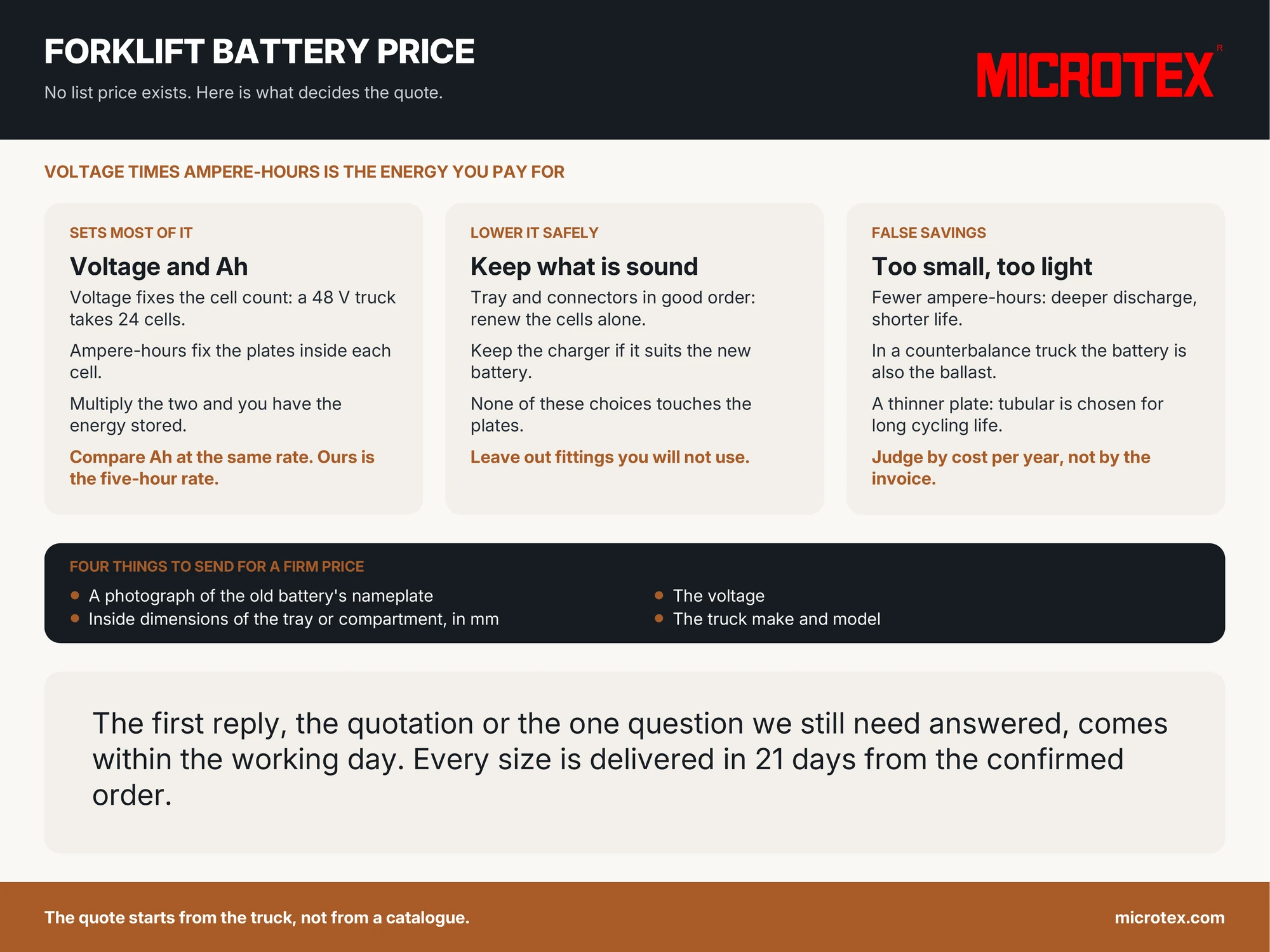
Voltage fixes the number of cells. Each cell is nominally 2 V, so a 24 V truck takes 12 cells, a 48 V truck takes 24 and an 80 V truck takes 40. Ampere-hours fix the size of each cell, because capacity comes from the number and size of the plates inside it. Multiply voltage by ampere-hours and you have the energy stored, and energy is what you are paying for. More of it means more plates, more lead, more acid and a heavier tray.
Check that the ampere-hours in every quotation are stated on the same basis. IEC 60254-1, the international standard for lead-acid traction batteries, has the maker declare capacity at the five-hour rate, and our figures are on that basis. Linden’s Handbook of Batteries, which is written from United States practice, notes that large industrial-truck batteries are generally rated at the six-hour rate. One cell shows a larger number when it is discharged more slowly, so two offers for the same ampere-hours are comparable only when the rate is printed beside the figure.
One more reason the figure will not sit still: lead is priced every day on a metal exchange, and battery prices follow it. That is why a quotation carries a validity date. Our guide to why battery prices move with lead explains what to ask about it.
What the tray, the fittings and the charger add
The cells are not the whole quote. The steel tray is made to the compartment you measure. The connectors between cells are bolted or welded. The plug and cable have to match the truck and the charger, down to the side the cable leaves from. Then come the fittings you may or may not want: a single-point watering system, electrolyte-level sensors, a discharge indicator. They are easier to specify now than to retrofit. Last is the charger, which has to suit the cell count and the capacity of the new battery. If the old one does, it stays. If it does not, our guide to choosing a forklift battery charger shows how to size the new one, and we can advise on or supply one matched to the battery.
Where the price can come down safely
Keep what is sound. A traction battery is an assembly of separate cells, so when the tray and connectors are in good order the cells alone can be renewed; our guide to traction battery cells shows how to read the cell code and what to measure. Keep the charger if it suits the new battery. Leave out fittings you will not use. In our view a watering system saves labour, not the battery, provided somebody does the watering round properly and on time. None of these choices touches the plates, and the plates are where the life is.
Where a lower price costs more
Three savings are false. The first is fewer ampere-hours. A smaller battery is cheaper on the day, but every shift then takes a deeper discharge out of it, and the life of a traction battery falls as the depth of discharge rises. The second is less weight. In a counterbalance truck the battery is also the ballast, so the minimum weight is part of the specification, and a battery below it is a stability question, not a saving. The third is a thinner plate. Tubular positive plates cost more at the outset than flat pasted ones and are chosen for long cycling life; our forklift cells are tubular. Judge a quotation by cost per year, not by the invoice. Our guide to battery total cost of ownership gives the method.
Is lithium cheaper?
Not at purchase. As of 2026 a lithium pack generally costs more to buy than a lead-acid battery of the same energy. Its case rests on what it saves afterwards in a fleet that runs two or three shifts and can charge in the breaks: spare batteries, changing, watering and floor space. For a single shift charging overnight, with a charging area already in place, lead-acid is usually the stronger answer. We set out both sides in lithium or lead-acid for a forklift, and we will tell you if your answers point to lithium.
Four things to send for a firm price
Send a photograph of the old battery’s nameplate, the inside dimensions of the tray or compartment in millimetres, the voltage, and the truck make and model. From those four we price the battery. The first reply, either the quotation or the one question we still need answered, comes within the working day. We build any voltage from 24 V to 80 V and any capacity from 42 to 1550 Ah, and every size is delivered in 21 days from the confirmed order.
If you can add two lines, add the shifts the truck works and how the old battery ended, slowly over years or suddenly in one cell. Our guide to replacing a forklift battery lists what else is worth measuring. If the truck is standing today, send us the four things now, or call, and we start from the truck.
Sources quoted: T. B. Reddy (ed.), Linden’s Handbook of Batteries, 4th ed. (McGraw-Hill, 2011), chapter 16, sections on deep-cycle and traction batteries and on their maintenance; T. R. Crompton, Battery Reference Book, 3rd ed. (Newnes, 2000), section 32.2.1 on the selection of motive power batteries; International Electrotechnical Commission, IEC 60254-1, the standard for lead-acid traction batteries (Part 1, general requirements and test methods; scope and rating basis described in our own words; check the current edition before relying on it); the Microtex forklift and traction battery pages.