
“Lithium or lead-acid?” is the wrong first question for a forklift fleet; the right first question is what your building and your shifts can support. We build lead-acid traction batteries, and we publish where lithium is better, because a fleet manager sold the wrong chemistry stops listening to everyone. Here are six questions, in the order they usually decide the matter. Prices and products move quickly, so treat everything below as the position as of 2026 and ask for current quotations.
1. How many hours does each truck really work?
A single-shift fleet charging overnight is the case lead-acid was designed for: one battery per truck, charged and cooled in the gap. Add shifts and the arithmetic changes. Our guide to the spare battery ratio sets out the 8-8-8 rule of thumb and the commonly quoted ratios, about one battery per truck for one shift, rising towards two for three. Every spare is capital, floor space and a change-out. Lithium’s strength is charging in the breaks, in the truck, which can remove the spare batteries altogether, and the more continuous the operation, the stronger that argument becomes.
2. Where will the charging and changing happen?
A lead-acid fleet needs a charging area with proper ventilation and a safe way to lift batteries out, as our guides to battery room design and to handling and lifting describe. A lithium pack charged in the truck avoids the room and the change-out, but it needs a compatible charger and a power supply at every place a truck parks, so the saving is real only if you can run the cable to where the trucks actually stop. Your existing lead-acid chargers generally cannot be reused, because a lithium pack talks to its charger through a battery-management system; our guide to choosing a forklift battery charger covers the lead-acid side.
3. Does the truck need the weight?
Linden’s Handbook of Batteries makes a point that is easily forgotten: in an electric forklift the battery’s weight is usually needed to counterbalance the load, so light weight is not automatically an advantage. A lithium pack for a counterbalance truck has to be designed or ballasted to the truck’s requirement, and approved by the truck maker. A lighter pack in a truck that expects the weight is a safety question, not a saving. Ask the truck maker in writing which packs are approved, and what happens to the truck’s warranty if you fit one that is not.
4. How cold or hot is the place?
Temperature works on both chemistries. Lead-acid loses capacity in the cold, which our guide to forklift batteries in cold stores covers in detail, and lithium cells have their own low-temperature limits on charging, which pack makers handle in different ways. Ask for the pack’s stated limits at your coldest charging point, in writing, not from a brochure.
5. What does it cost over the whole life?
As of 2026 a lithium pack generally costs more upfront than a lead-acid battery of the same energy, and its case rests on life, labour, space and energy saved. Whether it nets out depends on your numbers; our guide to battery total cost of ownership shows the method, and it applies to both columns. Two honest points for lead-acid. Linden notes that a traction battery is built as an assembly of individual cells, so when one or a few fail they can be repaired or replaced cost-effectively rather than scrapping the whole battery; ask any lithium supplier what is repairable in the field. And lead has a long-established recycling loop, whereas the recycling of lithium packs is still developing in many markets as of 2026, so ask who takes the pack back.
6. Who looks after it?
A flooded lead-acid battery needs watering and equalising discipline; a lithium pack needs neither, which saves labour and removes a common failure, the neglected watering round. Weigh that against the skill needed when something does go wrong: a lead-acid fault is usually found with a hydrometer and a meter, a lithium fault with the maker’s diagnostic tool. Ask who services the pack in your city, and how quickly.
Where each usually wins
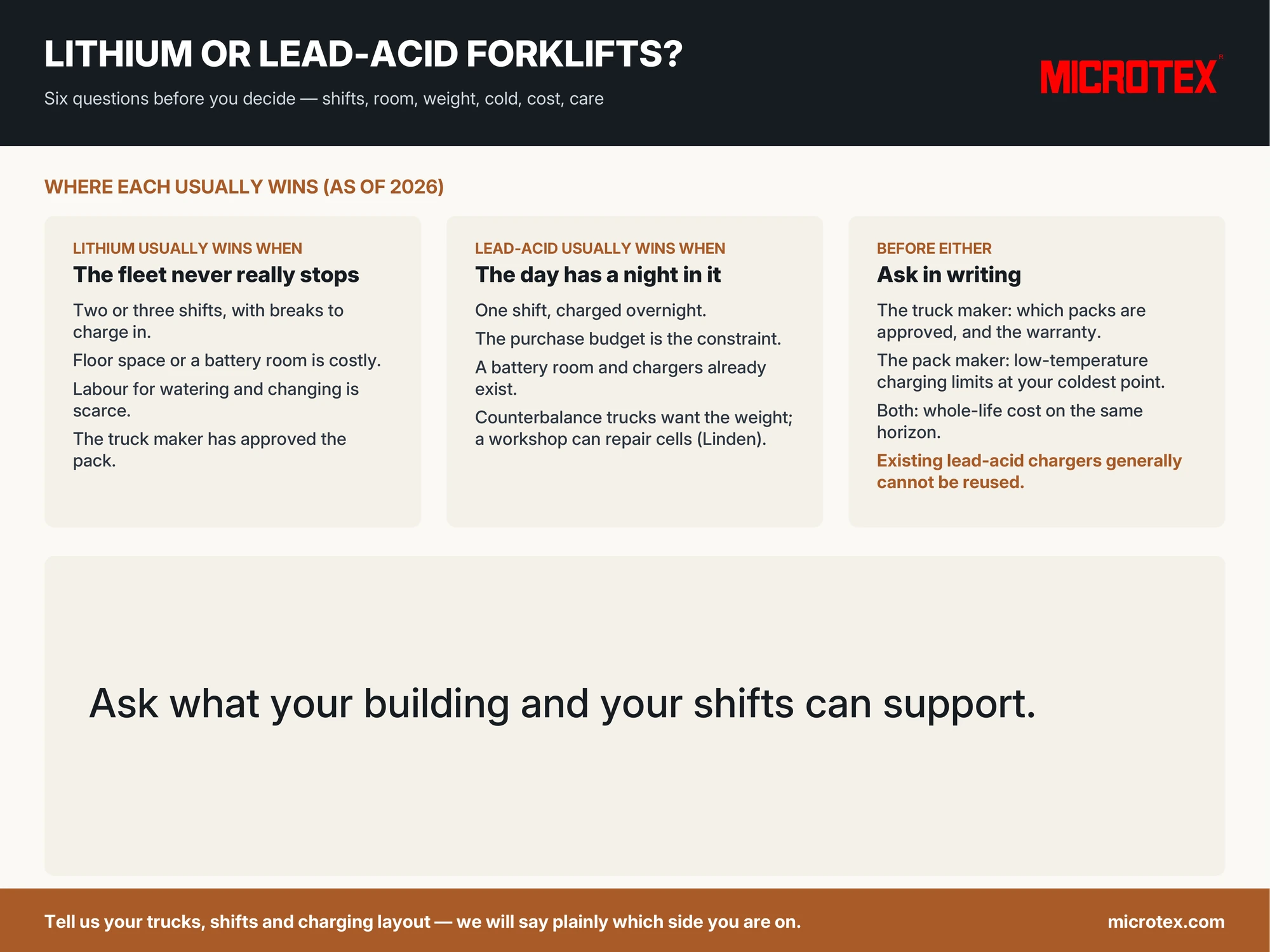
Lithium is usually the stronger answer when the fleet runs two or three shifts with natural breaks to charge in, when floor space or the cost of a battery room is tight, when labour for watering and changing is scarce, and when the truck maker has approved the pack. Lead-acid is usually the stronger answer for a single-shift fleet charging overnight, when the purchase budget is the binding constraint, when a battery room and chargers already exist, when counterbalance trucks want the weight, and when a workshop can repair cells. Our guide to lithium-ion batteries sets out the chemistry without the sales talk. Ask what your building and your shifts can support before you ask which chemistry is better.
We build tubular forklift batteries and we will say so when your answers point the other way. Tell us your truck models, your shifts and your charging layout and we will tell you plainly which side of the line you are on, even if the answer is lithium.
Sources quoted: T. B. Reddy (ed.), Linden’s Handbook of Batteries, 4th ed. (McGraw-Hill, 2011), chapter 16, section on deep-cycle and traction batteries.