
A replacement forklift battery fits only if several things match the truck, and the ampere-hour figure on its own is the least useful of them. When a battery reaches the end of its life, the quickest quotation is the one that copies the old battery’s plate, and the quickest way to a wrong battery is to copy a plate that was itself a compromise. This is the list we ask for, in the order that avoids the most expensive mistakes. Send it with photographs of the two data plates and the compartment, and the quotation will be right the first time.
Read these off the truck and the old battery
1. Voltage and cell count. A lead-acid cell is nominally two volts, so the voltage tells you the number of cells: a 48 V truck uses 24 cells, an 80 V truck uses 40. Our guide to a traction battery lists the voltage ladder. Read the voltage from the truck’s own plate as well as the battery’s, because a battery fitted by a previous owner may not be the voltage the truck was built for. Do not change the voltage to suit a battery on the shelf; the truck’s controller and the charger are built for one.
2. The compartment, measured. Measure the length, width and height of the compartment in the truck, including any clearance needed for the lifting eyes or cover. Do not rely on the old battery’s size, because the old battery may have been shimmed or may itself have been a poor fit.
3. Weight, from the truck’s plate. In an electric counterbalance truck the battery’s weight usually helps balance the load, a point Linden makes in the Handbook of Batteries. The truck’s data plate or manual normally states a minimum and a maximum battery weight. A battery below the minimum is a stability question, not a saving, and a battery above the maximum may overload the truck or the lifting gear. Ask the truck maker in writing if the plate is missing.
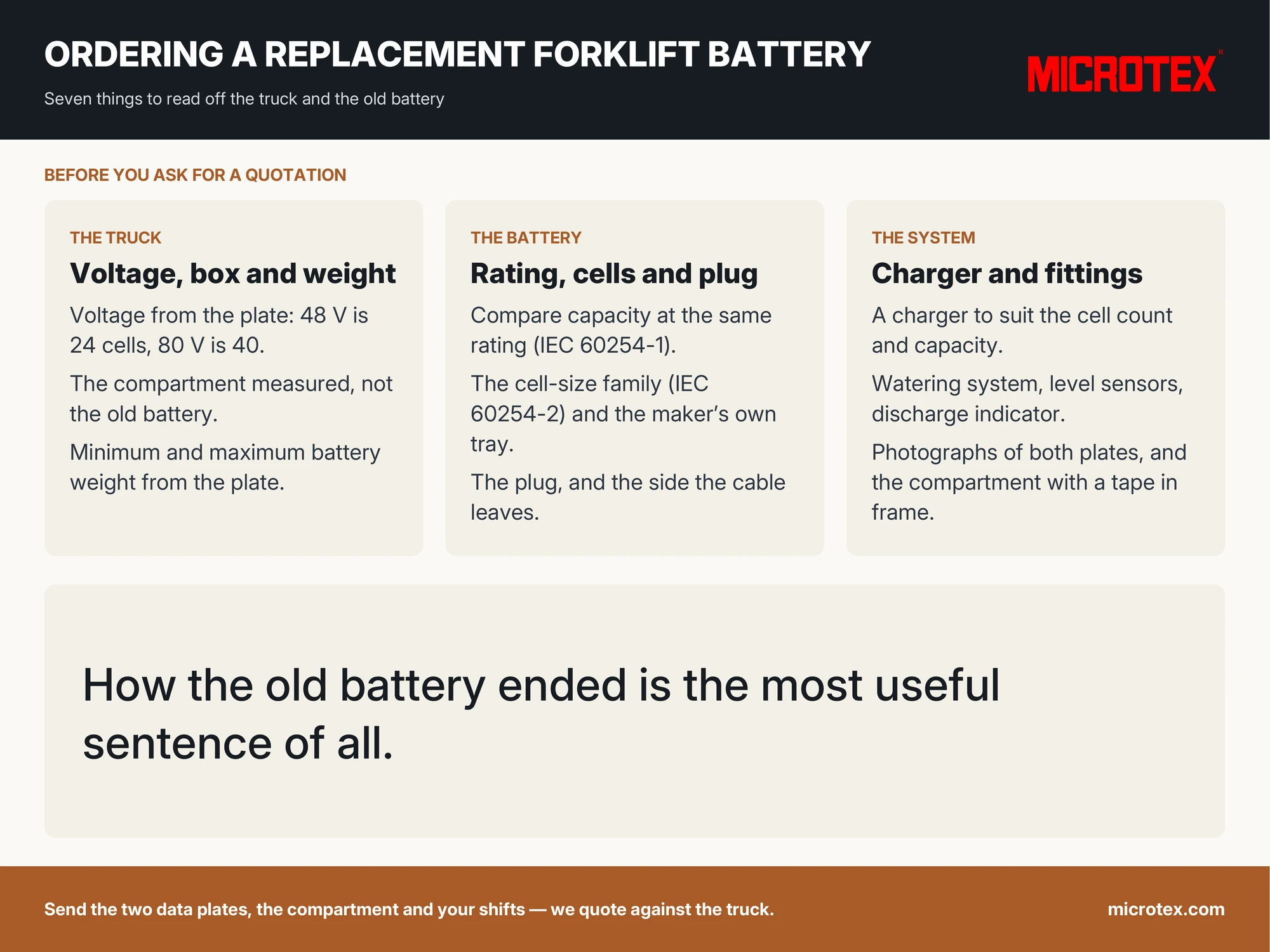
4. Capacity, and the shifts it must cover. Traction batteries are rated at a stated discharge rate; the IEC traction-battery standard, IEC 60254-1, is the test standard behind the common five-hour rating, so compare quotations at the same rating and not at whatever flatters the figure. Then tell us the shifts and the charging pattern, because a battery that is adequate for one shift will not be for three; our guide to the spare battery ratio shows the arithmetic.
5. The cell-size family. IEC 60254-2 sets maximum cell dimensions and terminal and polarity details for traction cells, including families commonly used in different regions. It does not fix your truck’s compartment, and the steel tray is the maker’s own. Ask your supplier to state the cell family they will use and to confirm it fits the compartment you measured.
6. The plug, the cable and the exit side. Note the connector type and which side the cable leaves, and keep the same unless you are changing the charger too. A mismatched plug is a small thing that stops a truck for a day.
7. The charger and the fittings. The charger must suit the cell count and capacity of the new battery; our guide to choosing a forklift battery charger covers it. Say whether you want a single-point watering system, electrolyte-level sensors or a discharge indicator fitted, because they are easier to specify now than to retrofit. For the day it arrives, see our guide to handling and lifting.
What to send with the enquiry
Photograph the truck’s data plate and the old battery’s plate, with the serial number and year legible. Photograph the compartment with a tape measure in the frame. Add the truck make, model and capacity, the number of shifts, the charger make and age, and a sentence on how the old battery ended: slowly over years, or suddenly in one cell. That sentence is the most useful of all, because a battery that ran out of life and one that was damaged call for different answers, and our guide to battery total cost of ownership shows how to compare the quotations that come back.
The honest alternatives
If the old battery lasted well, say so and say how long; if it failed early, tell us how it was charged and watered, because the cause may be the routine and not the battery, and a better battery will not fix a routine. If your fleet runs several shifts with breaks, a lithium pack may be the better answer, but a counterbalance truck needs the weight and the truck maker’s approval; our guide to lithium or lead-acid for a forklift fleet sets out the questions.
Send us the two data plates, the compartment dimensions and your shift pattern and we will quote against the truck, not the plate.
Sources quoted: IEC 60254-1:2005 and IEC 60254-2:2008, Lead-acid traction batteries, scope statements (IEC webstore; check current editions); T. B. Reddy (ed.), Linden’s Handbook of Batteries, 4th ed. (McGraw-Hill, 2011), chapter 16, section on deep-cycle and traction batteries.