
A reach truck battery, a stacker battery and a pallet truck battery are three different purchases, and the compartment, the truck’s data plate and your shift length decide each one before any catalogue does. This guide sorts out which trucks take 2 V tubular cells in a steel tray, which take monobloc batteries, and what to send so that each is quoted correctly, charger included.
Reach truck battery, stacker or pallet truck: two kinds of battery
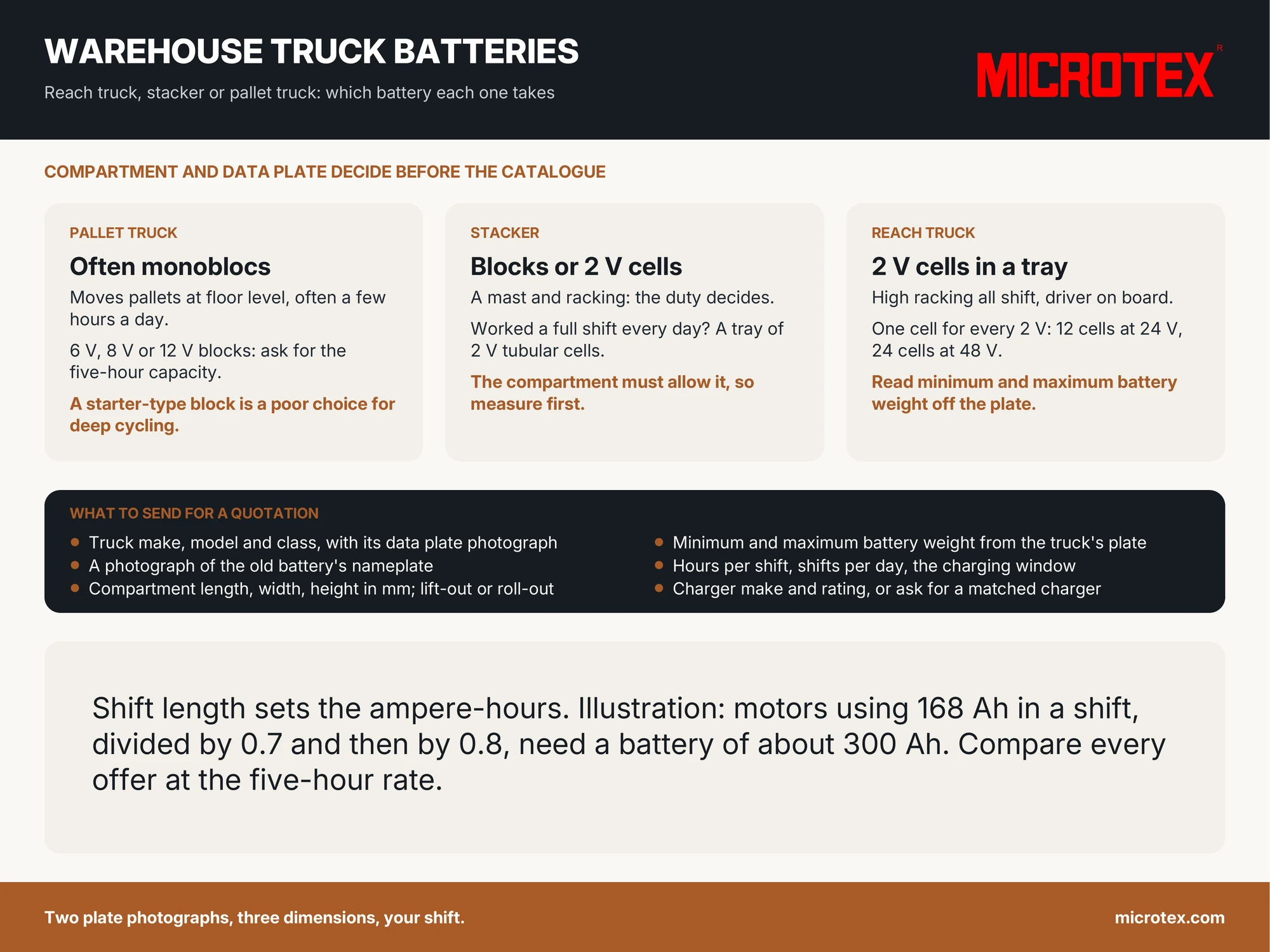
A powered pallet truck moves pallets at floor level. A stacker adds a mast and puts them into racking. A reach truck carries its driver and works high racking all shift. The work rises in that order, and so does what the battery must give.
The harder-worked machines carry what our forklift battery page describes: 2 V tubular traction cells joined in series in a steel tray built to the truck’s compartment. One cell for every 2 V: 12 cells at 24 V, 24 at 48 V. Many pedestrian pallet trucks and light stackers instead use monobloc batteries, the 6 V, 8 V or 12 V blocks sold as semi-traction batteries. They suit different depths of daily work, and the first job is to learn which your truck was designed for.
The compartment decides before the catalogue does
Crompton’s Battery Reference Book makes the point plainly: the truck designer settles the battery space first and the battery maker works inside it. In practice you choose among the standard batteries for that truck, between the smallest its maker recommends and the largest the compartment will take. So measure: the inside length, width and height in millimetres, and whether the battery lifts out or rolls out. Our 2 V cells come in two families, BS at 158 mm wide and DIN at 198 mm wide, with overall heights from 231 to 745 mm. A low compartment can rule out a tall plate whatever capacity you hoped for.
The cell-dimension standard, IEC 60254-2, published in India as IS 5154 (Part 2):2013, sets maximum outside dimensions for traction cells in a narrow and a wide series. It does not fix your compartment or the steel tray, so a standard cell is only half of the fit. Our guide to traction battery cells shows the ranges.
Weight: read the truck’s plate, not the old battery
Linden’s Handbook of Batteries notes that a light battery may be no advantage in an electric forklift, because the mass of the battery normally helps to balance the load on the forks. A reach truck or stacker is not a counterbalance truck, but its maker still rated it with a battery of a stated weight on board. Read the minimum and maximum battery weight from its data plate or manual, or ask the truck maker in writing. A battery under the minimum is a stability question, not a saving. Our quotation states the filled weight, so you can check it before you order; replacing a forklift battery lists what else to read off the truck.
Shift length sets the ampere-hours
Crompton’s method for capacity: break the shift into its movements, multiply the current each one draws by the minutes it lasts, add up the ampere-minutes and convert the total to ampere-hours. He then divides twice: by about 0.7, because a battery drawn hard and fast gives less than its nameplate figure, and by 0.8, because regular discharge should stop at about 80 per cent of capacity. As an illustration only, a truck whose motors use 168 Ah in a shift needs a battery of about 300 Ah.
Few warehouses have the currents for that sum, and they do not need them. The truck maker settles the battery sizes, and an ampere-hour meter on the truck checks the choice in real work. Tell us the hours worked, the lift heights and the shifts, and we size from that. Compare every offer at the five-hour rate: IEC 60254-1 defines a traction cell’s nominal capacity at a five-hour discharge at 30 °C, and our cells are stated at that rate. A block rated at twenty hours shows a larger number for the same lead.
Where a monobloc is right, and where it is not
A pallet truck that works a few hours a day and charges overnight is honest monobloc duty. A starter battery is generally a poor choice for deep cycling, and blocks of that construction are sold for small trucks. Ask for the capacity at the five-hour rate, the cycle life at a stated depth of discharge, and the weight. Where the truck takes blocks, we quote our 6 V, 8 V and 12 V deep-cycle monoblocs, built on tubular plates, when one of them fits the compartment, and we say so when none does.
Where a stacker or pallet truck works a full shift every day and the compartment allows it, a tray of 2 V tubular cells is in our view the longer-lived answer, at a higher first cost. The tubular plate holds its active material better and gives the stronger showing as discharge rates rise.
The charger goes in the same enquiry
A charger is built for one cell count and sized for one capacity, so a battery quoted without its charger is half a decision. Tell us the charger you have, or ask for one matched to the new battery; choosing a forklift battery charger explains the three numbers that must agree. Pedestrian trucks with on-board chargers are often plugged in at every pause. Done by design that can work; done by habit it shortens a lead-acid battery’s life, as our guide to opportunity charging sets out. If your trucks run two or three shifts on snatched charges, say so: in our own view that pattern often suits lithium better.
What to send for each truck
- Truck make, model and class, with a photograph of its data plate.
- A photograph of the old battery’s nameplate.
- Compartment inside length, width and height in millimetres; lift-out or roll-out.
- Minimum and maximum battery weight from the truck’s plate.
- Hours worked per shift, shifts per day, and the charging window.
- Connector type and the side the cable leaves.
- Charger make and rating, or a request for a matched charger.
- Number of trucks of each type, and the city or country.
Send the list for each truck type, complete or partial, through our contact page. Every size of 2 V traction battery is delivered in 21 days, counted from the day the order is confirmed against the truck and compartment details, and the first reply comes within the working day.
Sources quoted: T. B. Reddy (ed.), Linden’s Handbook of Batteries, 4th ed. (McGraw-Hill, 2011), chapter 16, section 16.5 on deep-cycle and traction batteries; T. R. Crompton, Battery Reference Book, 3rd ed. (Newnes, 2000), section 32.2.1 on the selection of motive power batteries; International Electrotechnical Commission, IEC 60254-1 and IEC 60254-2, Lead-acid traction batteries, scope and definitions only; Bureau of Indian Standards, IS 5154 (Part 2):2013, scope only. Check the current edition of each standard.