
“Semi-traction” is the most flattering label in the battery trade, and the least defined. No international standard sets out what it means. IEC 60254 defines a traction battery; the EN 50342 family covers starter batteries; between those two sits a large, profitable and entirely unpoliced middle ground where the word “semi-traction” does the work of a specification. Which means the label on the carton guarantees you nothing. If you run floor scrubbers, tow tractors, pallet trucks, access platforms or utility buggies, the only thing that protects you is knowing what the machine actually asks for — and reading the construction rather than the adjective.
The duty, honestly described
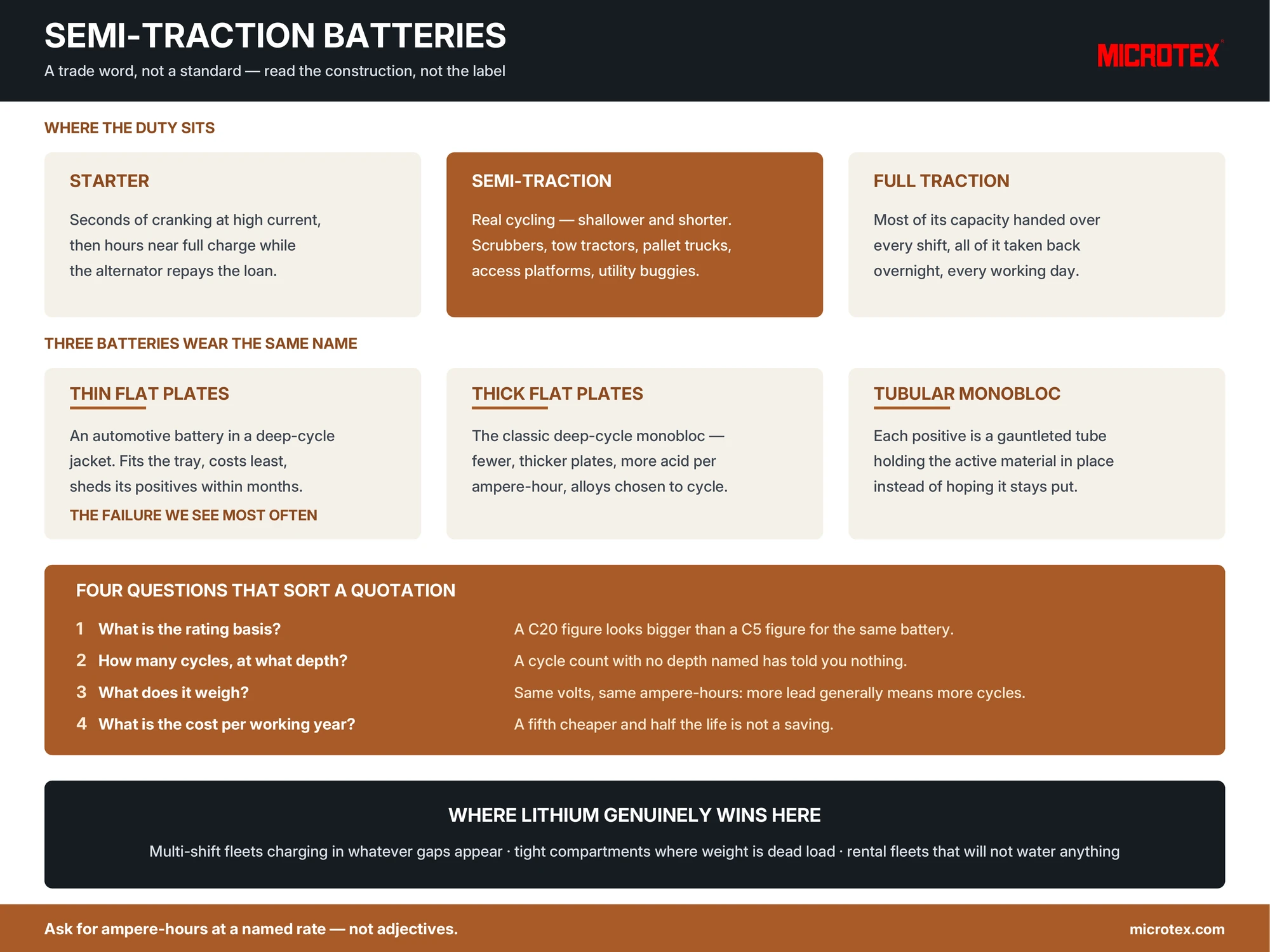
A full traction battery lives the hardest life in lead-acid: most of its capacity handed over every working shift, all of it taken back overnight, every day for years — the duty we set out in our guide to traction batteries. A car battery lives the opposite life: one violent second of cranking, then hours sitting near full charge while the alternator repays the loan. The semi-traction machine does neither. A scrubber-dryer works three or four hours of a shift, not eight. A scissor lift rises and holds and rises again, drawing modestly but for a long time. A tow tractor makes a dozen trips and then waits. Real cycling — but shallower, shorter and more forgiving than a counterbalance forklift’s. That in-between duty is a genuine engineering category. It is just not a certified one.
Three very different batteries wear the same name
Open the cases and the goods sold as semi-traction fall into three families. The first is an automotive battery in a deep-cycle jacket: many thin flat plates, built for surface area and cranking current, given a heavier lid and a confident label. It fits the tray, it costs the least, and daily cycling strips its positive plates within months — the failure we see most often in this class. The second is a genuine thick-plate flat design, the classic 6 V or 8 V deep-cycle monobloc familiar from golf carts: fewer, thicker plates, more acid per ampere-hour, alloys chosen for cycling rather than cranking. The third is a tubular monobloc, where each positive is a gauntleted tube holding its active material in place instead of relying on it to stay put — the construction difference explained in flat plate versus tubular, and the reason tubular designs survive cycling that sheds flat plates. Same shelf, same word, three quite different working lives.
The rating that flatters every quotation
Here is where money is quietly lost. Because no standard governs the class, nothing governs how its capacity is declared — and a battery rated at the twenty-hour rate publishes a larger ampere-hour number than the same battery rated at the five-hour rate. Put a C20 figure beside a C5 figure and the C20 battery looks bigger while being, quite possibly, smaller. Our guide to C-rate shows how far the two drift apart, and our note on what battery standards actually fix explains why the rating basis is the first line to check on any datasheet. Ask every supplier for the same rate, at the same end-of-discharge voltage, at the same reference temperature. If a quotation will not tell you the rating basis, that silence is the answer.
Four questions that sort the field
First: what is the rating basis? Everything above. Second: how many cycles, at what depth of discharge? A cycle count quoted at a shallow discharge is a very different promise from one quoted at a deep discharge, and a supplier who gives you a single number without naming the depth has told you nothing. Third: what does it weigh? For the same voltage and the same ampere-hours, more lead generally means more cycles — a rule of thumb rather than a law, but a useful one, and a suspiciously light block is usually a short-lived block. Fourth: what is the total cost per working year? A block that costs a fifth less and lasts half as long is not a saving, and for a fleet the arithmetic compounds; we set the method out in our guide to battery total cost of ownership.
Where lithium genuinely wins here
We build lead-acid, and we will still tell you where it loses. Lithium iron phosphate is the better answer for a cleaning fleet that runs two or three shifts and charges in whatever gaps appear — snatched partial charges are what lead-acid dislikes most, and a machine that never gets a full recharge will sulfate its way to an early death. It is the better answer where the battery compartment is tight and weight is pure dead load, since a scrubber gains nothing from ballast. And it suits rental fleets that would rather not depend on site crews to water anything. The honest counter-case is narrower than the industry pretends: a counterbalance forklift wants the weight, because there the battery is also the ballast — but that argument belongs to forklifts and should not be smuggled into a conversation about scissor lifts. Where lead-acid still wins cleanly in this class is single-shift work with a proper overnight charge, a lower price of entry, tolerance of rough handling and heat, and a scrap value at end of life that comes back as a credit rather than a disposal bill.
What we build, and what we will tell you
Microtex builds deep-cycle blocks for this middle ground — led by the 6 V 390 Ah for scissor and boom lifts — on the same tubular plates as our forklift ranges, for equipment builders, rental fleets and replacement buyers. We would rather send you away with the right answer than win an order with the wrong one: if your machines run multiple shifts on snatched charges, say so and we will tell you plainly that you are looking at the wrong chemistry. If they run one shift and get a full charge overnight, a properly constructed tubular block will almost certainly outlast anything cheaper you are being offered. Send the machine make and model, the old battery’s nameplate, the bay dimensions and an honest description of the shift pattern to our engineers, and the answer will come back in ampere-hours at a named rate — not in adjectives.