
Importing traction batteries goes well when six things are settled in writing before the order: the fit, the state the battery travels in, the charger and connector, the lead time, the delivery term with its documents, and what happens to warranty and spare cells once the factory is an ocean away. This guide is for the fleet owner, dealer or mine buying forklift or mining locomotive batteries from another country.
Fit comes first: the cell standard and the tray
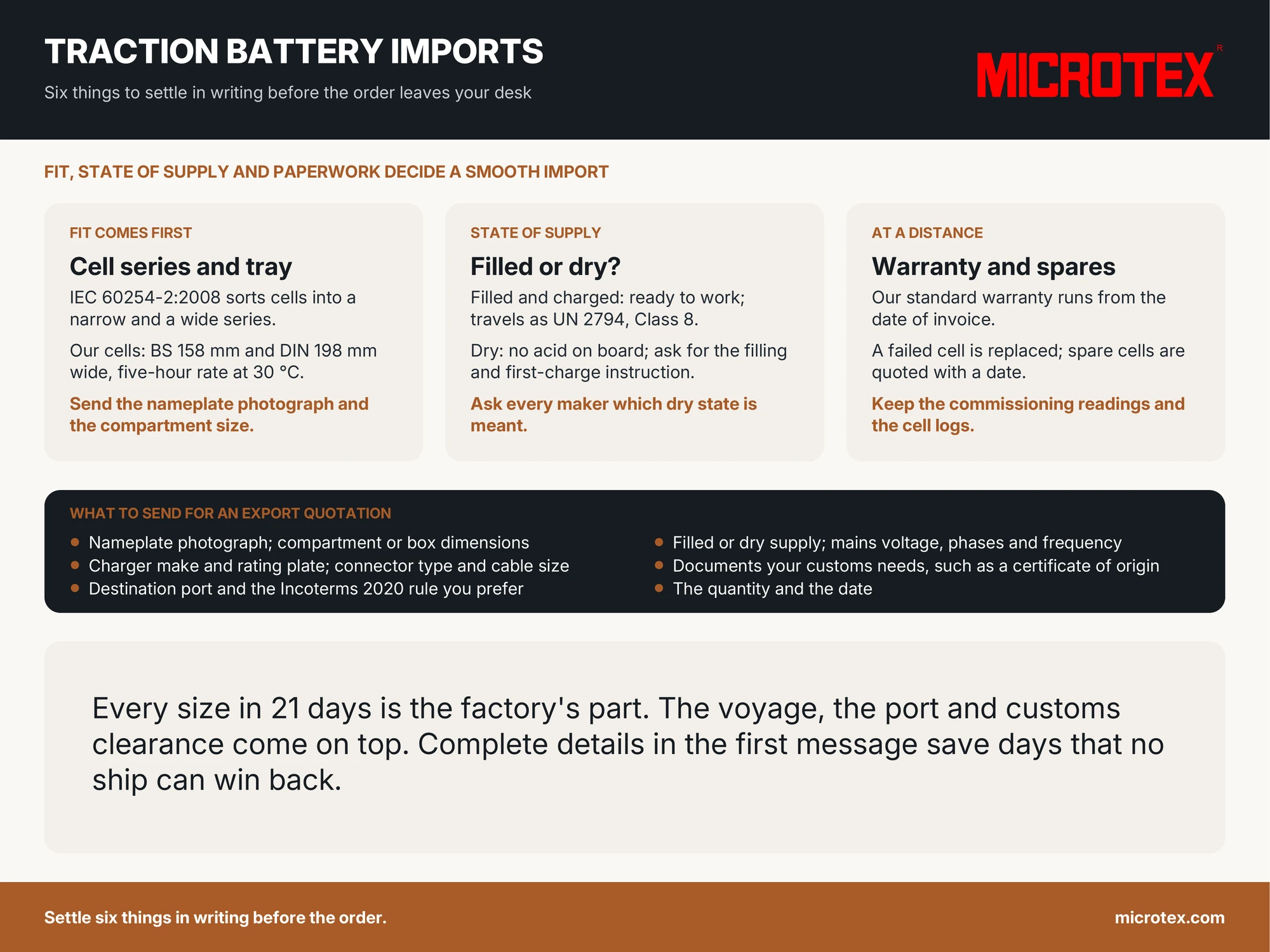
A traction battery is a set of 2 V cells assembled into a steel tray made for one truck compartment or one locomotive box, so the first check is whether the maker builds your cell size. IEC 60254-2:2008, adopted in India as IS 5154 (Part 2):2013, sorts traction cells by width into a narrow and a wide series, and lists separately the cell ranges common in Asia and in North America. A truck built for one market can therefore hold cells that a factory on another continent does not make. Our cells are 158 mm wide in the BS series and 198 mm in the DIN series, rated at the five-hour rate at 30 °C, so ask every supplier for the rate and temperature beside the ampere-hours. Send a photograph of the nameplate, the inside dimensions of the compartment or box and, for a counterbalance truck, the weight of the old battery, because there the battery is also the ballast. Our guides to traction battery cells and to the mining locomotive battery enquiry show what to measure.
Filled and charged, or dry
Linden’s Handbook of Batteries notes that wet batteries lose performance while they stand idle, faster in warm storage, and that for long storage or export the electrolyte can be left out; a dry-charged battery, it says, can wait for up to several years before it is filled, charged and tested. That figure is for dry-charged batteries, whose plates are formed and dried at the factory. Our forklift battery page lists two states of supply, factory-charged or dry-uncharged. A dry-uncharged battery has no acid on board and needs filling and a full initial charge to the maker’s instruction before it works, so ask us for that instruction and the storage limit with the quotation. Ask every maker which state is meant, because a dry-charged battery and a dry-uncharged one ask different work of the receiving workshop. Our guide to the dry-charged battery lists the other questions to ask: the acid, the first-charge instruction and the warranty. Filled supply suits an end user who needs the truck working at once; dry supply suits dealer stock or a long route, if a competent workshop waits at the far end.
How the consignment travels
The state of supply also decides the transport class. A flooded battery shipped filled travels as dangerous goods under UN 2794, Class 8, corrosive. A battery shipped without electrolyte is outside that regime, and the acid, if it is sent, is a Class 8 consignment of its own. That is the position as we understand it in 2026; the current sea provisions and your carrier’s dangerous-goods desk govern every real shipment, so confirm with your forwarder. Batteries go by sea, because their weight and corrosive contents make air freight a rare exception. Our guides on shipping lead-acid batteries and on whether lead-acid batteries are dangerous goods cover the packing and the paperwork.
The charger and the connector
An imported battery usually meets a charger and a truck plug bought elsewhere. Send the charger’s make with a photograph of its rating plate, and the connector’s make and type, the cable size and the corner of the tray the cables leave from. Our quotation carries the battery’s charging specification, so your charger supplier can confirm the match before the ship sails. If you order a charger with the battery, state your mains voltage, phases and frequency, because they differ between countries.
Lead time: factory days and door days
Our product pages state that every size of forklift and mining locomotive battery is delivered in 21 days, with the clock starting when the specification is settled. For an importer, read that as the factory’s part. The voyage, the port and customs clearance come on top, and your forwarder knows those best. What you control is the first message: complete details in it save days that no ship can win back.
Delivery terms and documents
Write the delivery term as a rule, an edition and a named place. The International Chamber of Commerce publishes the Incoterms® 2020 rules, eleven three-letter trade terms that include FCA, CIF, CIP, DAP and DPU, and ICC describes CIF as reserved for maritime trade. The term settles who arranges carriage and insurance and where risk changes hands, so read ICC’s own text, not a summary. With the cargo come the commercial invoice, a packing list that matches the cells, the safety data sheet, the dangerous-goods declaration where one applies, and the test and warranty documents. If your customs asks for anything more, a certificate of origin for instance, say so with the order: a document requested after sailing costs days at the port.
Warranty and spare cells at a distance
A warranty is a promise about manufacturing defects, not about how long the battery lasts, and at a distance it lives on paper. Read the start date first. Our product pages state the standard warranty from the date of invoice, with project terms in the offer, so the weeks at sea are part of it. Nobody from the factory can walk over to look, so a claim is settled on records: the commissioning readings, the cell voltages and specific gravities logged since, the charger settings and photographs. Our guide to reading a battery warranty shows the file to keep. Because the battery is an assembly of separate cells, a failed cell is replaced and the battery goes back to work, and we quote spare cells, connectors and covers with a date. For a remote site, ask what it costs to add spares to the first consignment, since one cell sent later is a shipment of its own.
When a local battery is the better buy
If a maker in your own country builds your cell size and keeps service nearby, buy there: a local maker can reach your truck in days, and we cannot. Importing earns its place when the size is not made locally, when the original maker has stopped supplying, or when the fleet is large enough to fill a container.
What to send when importing traction batteries
Send the nameplate photograph, the compartment or box dimensions, the charger and connector details, the destination port, the delivery term you prefer, filled or dry supply, the quantity and the date through our contact page. The first reply comes within the working day.
Sources quoted: T. B. Reddy (ed.), Linden’s Handbook of Batteries, 4th ed. (McGraw-Hill, 2011), chapter 16, sections 16.3.11 to 16.3.14 on dry charge, finishing, shipping and activation; International Chamber of Commerce, Incoterms® 2020 page, iccwbo.org, read 18 November 2026. Standards named: IEC 60254-1:2005, IEC 60254-2:2008 and IS 5154 (Part 2):2013; verify the current edition before relying on any of them. Incoterms is a trademark of the International Chamber of Commerce.