
A forklift battery charging room has five jobs: carry away the hydrogen made at the end of charge, contain and neutralise spilt acid, give every charger space and power, let a heavy battery be changed safely, and put clean water within reach. Plan them before the batteries arrive, because a battery delivered to a bay that is not ready gets charged wherever a socket is free.
A forklift battery charging room starts with one marked place
The United States rule for powered industrial trucks, OSHA 29 CFR 1910.178(g), starts simply: charging installations belong in areas set aside for that purpose. The international safety standard for traction batteries, IEC 62485-3:2014, asks for the area to be clearly marked, kept apart from flammable or explosive goods, and sited where nothing can fall on the batteries and no pipe can drip on them. A closed room and an open, marked bay both qualify.
Ventilation is sized for the end of charge
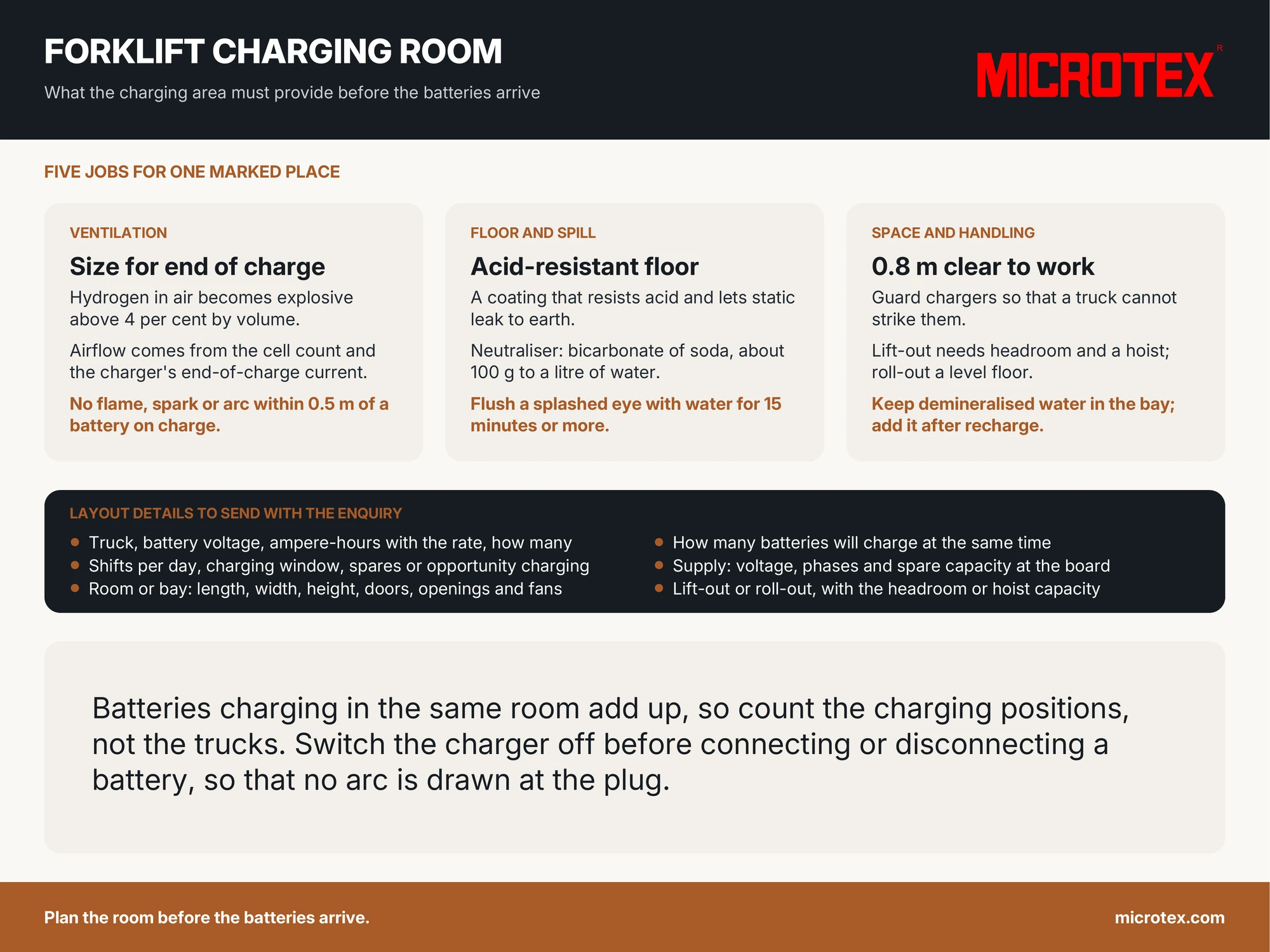
A lead-acid battery gives off very little gas through most of a charge. Near full charge, the current it can no longer store splits water into hydrogen and oxygen, and hydrogen in air becomes explosive above 4 per cent by volume. IEC 62485-3 works out the minimum airflow from two things you can read off the equipment, the number of cells and the charger’s current in the last stage of charge, and it builds in a safety factor of five. Batteries charging in the same room add up, so count the charging positions, not the trucks.
Where natural airflow is enough, the standard looks for an air inlet and an outlet, best on opposite walls. Where it is not, it wants a fan, with the charger interlocked to it or an alarm when the airflow fails, and the extracted air sent outside the building. It also keeps flames, sparks, arcs and glowing objects at least 0.5 m from a battery on charge, and the OSHA rule bans smoking in the charging area. Open the battery cover during charge so that gas and heat can leave. Our guide to battery room hydrogen ventilation explains the method.
The floor, the spill and the eyewash
The IEC standard wants a floor coating that resists acid and lets static charge leak away to earth. The OSHA rule requires facilities for flushing and neutralising spilt electrolyte, and for fire protection. In practice that means a sealed floor you can wash down, a spill kit and a neutraliser in the bay; Linden’s Handbook of Batteries gives the usual one as bicarbonate of soda, about 100 g to a litre of water, then a rinse with clean water.
Eyes come first: the IEC standard asks for clean water close to any battery being charged or serviced. The United States Bureau of Reclamation’s battery manual, written for power-station battery rooms, puts eyewash and body-spray units within 25 feet, about 7.6 m, of the batteries and says a splashed eye must be flushed with water for 15 minutes or more, followed by medical attention. Hang goggles or a face shield, gloves and an apron at the entrance.
Charger spacing and supply
The IEC standard asks for at least 0.8 m clear on every side of a battery that people must reach while it is charged or serviced. Both documents want chargers guarded so that a truck cannot strike them. The charger must be matched to the battery, which our guide to choosing a forklift battery charger covers.
Supply is our own advice, not a standard’s. Every charger that may run at the same time needs its own position and outlet, and the incoming supply has to carry them all together, so give your electrician the input rating from each charger’s datasheet. Switch the charger off before connecting or disconnecting a battery, so that no arc is drawn at the plug. If you plan opportunity charging, every charging point on the floor is a charging area too: the ventilation rule applies whether the battery is charged on the truck or off it.
Changing the battery
OSHA requires a conveyor, an overhead hoist or equivalent handling equipment, the truck positioned with its brake applied before a change, and the battery secured in the truck afterwards. The IEC standard wants changing equipment that suits the tray and its weight, checked regularly and used by trained people, and it prefers a sideways change on supporting equipment, which is less likely to tip the battery. So decide between lift-out and roll-out before the bay is built: one needs headroom and a hoist, the other a level floor and a stand at truck height.
The standard notes that gassing dies down within about an hour of the charger stopping, yet trapped gas can escape when the battery is moved, so the no-spark rule holds during a change. See our guide to battery handling and lifting, and count the parking places with our guide to the forklift battery spare ratio.
Water within reach
Flooded traction cells are topped up throughout their life, so keep demineralised water in the bay. Linden’s handbook advises adding it after the recharge, and warns that overfilling makes acid overflow, which corrodes the tray and opens leakage paths to earth. If you want a single-point watering system, say so in the enquiry. Our guide to battery water covers the rest.
Check the rules that bind you
Neither the IEC standard nor the United States rule is law where you are unless your regulator says so. Local factory, fire and electrical rules take precedence; in India, confirm the requirements with your local factory inspectorate before you build, and check the current edition of any standard. A lithium-ion truck battery needs no topping up, so its charging area is simpler; ask its supplier what it must provide.
Layout details to send with the enquiry
- Truck make and model, battery voltage, ampere-hours with the rate, and the number of batteries.
- Shifts per day, the charging window, and whether spare batteries or opportunity charging are planned.
- Closed room or open bay: length, width and height, with a sketch showing doors, openings and any fans.
- How many batteries will charge at the same time.
- The electrical supply: voltage, phases and the spare capacity at the board.
- Change-out method: lift-out or roll-out, with the headroom or the hoist capacity.
- Floor finish and drainage, and where the water and eyewash points are.
Send the list, complete or partial, through our contact page, with the charger you have or a request for a matched one. Ask every offer to state the charger’s end-of-charge current: it is the figure your ventilation engineer needs.
Sources quoted: IEC 62485-3, 2014 edition, “Safety requirements for secondary batteries and battery installations, Part 3: Traction batteries”, published by the International Electrotechnical Commission; United States Occupational Safety and Health Administration, 29 CFR 1910.178(g), Changing and charging storage batteries; United States Bureau of Reclamation, FIST Volume 3-6, Storage Battery Maintenance and Principles (April 2020), section 2; T. B. Reddy (ed.), Linden’s Handbook of Batteries, 4th ed. (McGraw-Hill, 2011), chapter 16, section 16.8.