
Filled with acid, yes: a wet lead-acid battery travels the world as dangerous goods — UN 2794, Class 8, corrosive — and the packaging, paperwork and trained handling behind those words are not optional. That is the direct answer to the question in the title. But “dangerous goods” is a transport classification, not a character judgment — the same battery that needs a declaration to cross an ocean will then sit in a substation for twenty years as the most dependable object in the building. And transport is only half of the compliance picture; the other half, the one almost nobody writes down in one place, is what the rulebooks expect of the room or store where batteries live. This page is that one place — a working sketch, dated August 2026, with the caveat this subject demands stated at the start: regulations are amended, and they differ by country and by carrier; the editions that bind you are the current ones in your jurisdiction, and confirming them is part of professional practice — ours and yours.
In transport: one battery, three regulatory personalities
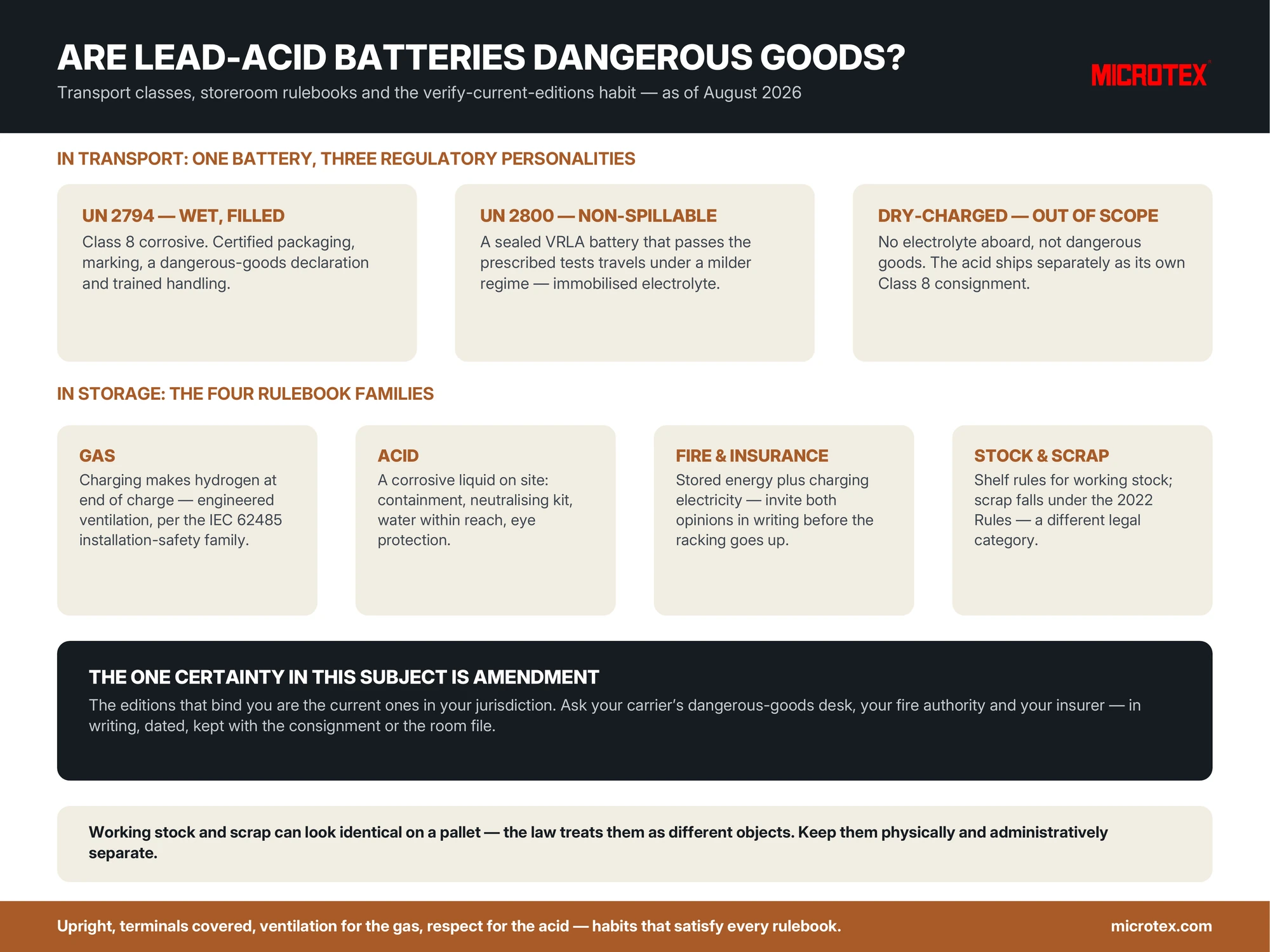
Transport law reads spillability, not brochures. A flooded battery shipped filled is dangerous goods — UN 2794, “batteries, wet, filled with acid”, Class 8 corrosive — with certified packaging, marking and a dangerous-goods declaration. A sealed VRLA battery that passes the prescribed tests can travel as UN 2800, “batteries, wet, non-spillable” — a milder regime reflecting what its immobilised electrolyte cannot do. And a dry-charged battery, shipped without its electrolyte, is not dangerous goods at all: the acid travels separately as its own Class 8 consignment, and the battery comes to life at destination through first fill and first charge. Which personality your consignment wears is a commercial decision as much as a technical one, and the full working map — packing discipline, container practice, the wet-versus-dry decision, day-one receiving checks — is our guide to shipping lead-acid batteries. What matters here: the classification question has a clean answer, your carrier’s dangerous-goods desk owns the current edition of it, and the sea and air rulebooks are amended on their own calendars.
In storage: the rulebooks that reach a battery store
Now the searched-for question with no owner: what does the law expect of the place where batteries are kept? Four families of obligation cover most of what an inspector, an insurer or an auditor will care about. Gas: charging batteries make hydrogen towards the end of charge, so any space where batteries are charged owes its occupants engineered ventilation — the timetable and the margin are the subject of our battery-room hydrogen guide, and the governing installation-safety standards are the IEC 62485 family (62485-2 for stationary installations, 62485-3 for traction), named here so you can ask for the current edition by number. Acid: a store holding electrolyte holds a corrosive liquid, and the expectations are familiar — containment where spills can happen, a neutralising kit and water within reach, eye protection — the working kit list lives in our battery safety guide. Fire and insurance: a battery store concentrates stored energy and charging electricity; your fire authority and your insurer each have expectations about layout, separation and housekeeping, they differ by place, and the professional move is to invite both opinions in writing before the racking goes up — the engineering their questions point at is our battery room design guide. Stock discipline: batteries in a warehouse are not inert cartons; the shelf rules — charge state, rotation, refresh charging — are the subject of storing batteries in stock.
And a fifth rulebook the moment it becomes waste
A battery that has finished its service changes legal category entirely. In India, from the moment a lead-acid battery becomes scrap it falls under the Battery Waste Management Rules, 2022 — registered recyclers, a documented chain of custody, producer responsibility — the user’s guide to which is our battery waste rules post, and the happier half of the story — scrap value with a positive sign — is the battery that pays you back. The practical point for a storekeeper: keep working stock and scrap physically and administratively separate, because the law treats them as different objects even when they look identical on a pallet.
Who actually answers the question
Compliance questions have owners, and the honest habit is to ask them rather than a webpage — this one included. For a shipment: your freight forwarder or carrier’s dangerous-goods desk, against the current sea or air provisions. For a store or charging room: your fire authority, your insurer, and the current edition of the installation standard. For scrap: your registered recycler’s paper trail. Ask in writing, keep the answers with the consignment or the room file, and date them — because the one certainty in this subject is amendment. What never changes is the physics underneath the paperwork: batteries upright, terminals covered against anything metal, ventilation for the gas, respect for the acid, and records that match the goods. Those habits satisfy every rulebook yet written. If you are planning a battery store or your first export consignment, ask us — we have been doing both since 1969, and we will tell you exactly what we do and which documents travel with our crates.