
A traction battery exists to move things. The international standard IEC 60254-1 defines traction batteries as power sources for electric propulsion — in road vehicles, locomotives, industrial forklift trucks and material handling equipment. The working definition is blunter: a battery discharged deeply across a working shift, recharged fully overnight, and expected to repeat that punishing rhythm every working day for years. It is the hardest duty in lead-acid — and every detail of the traction battery’s construction follows from it.
Traction battery meaning: the definition, precisely
Two standards frame the product. IEC 60254-1 sets the rating convention: capacity is the ampere-hours a cell delivers over a five-hour discharge to an end voltage of 1.70 V per cell — the C5 rating. IEC 60254-2 fixes the external dimensions, so cells from any maker drop into standard truck compartments; two dimension families dominate worldwide, the European DIN series and the British BS series. What the standards deliberately do not fix is the internal construction — and that is exactly where traction batteries are won and lost. End of life, by convention, arrives when capacity falls below 80% of rated.
Why declare capacity at five hours? Because the discharge rate changes the capacity itself: the same cell delivers noticeably fewer ampere-hours in one hour than in five — the Peukert effect, unpacked in what C-rate means. Compare batteries C5 to C5, or you are comparing advertising.
Traction, starter, stationary — three different jobs
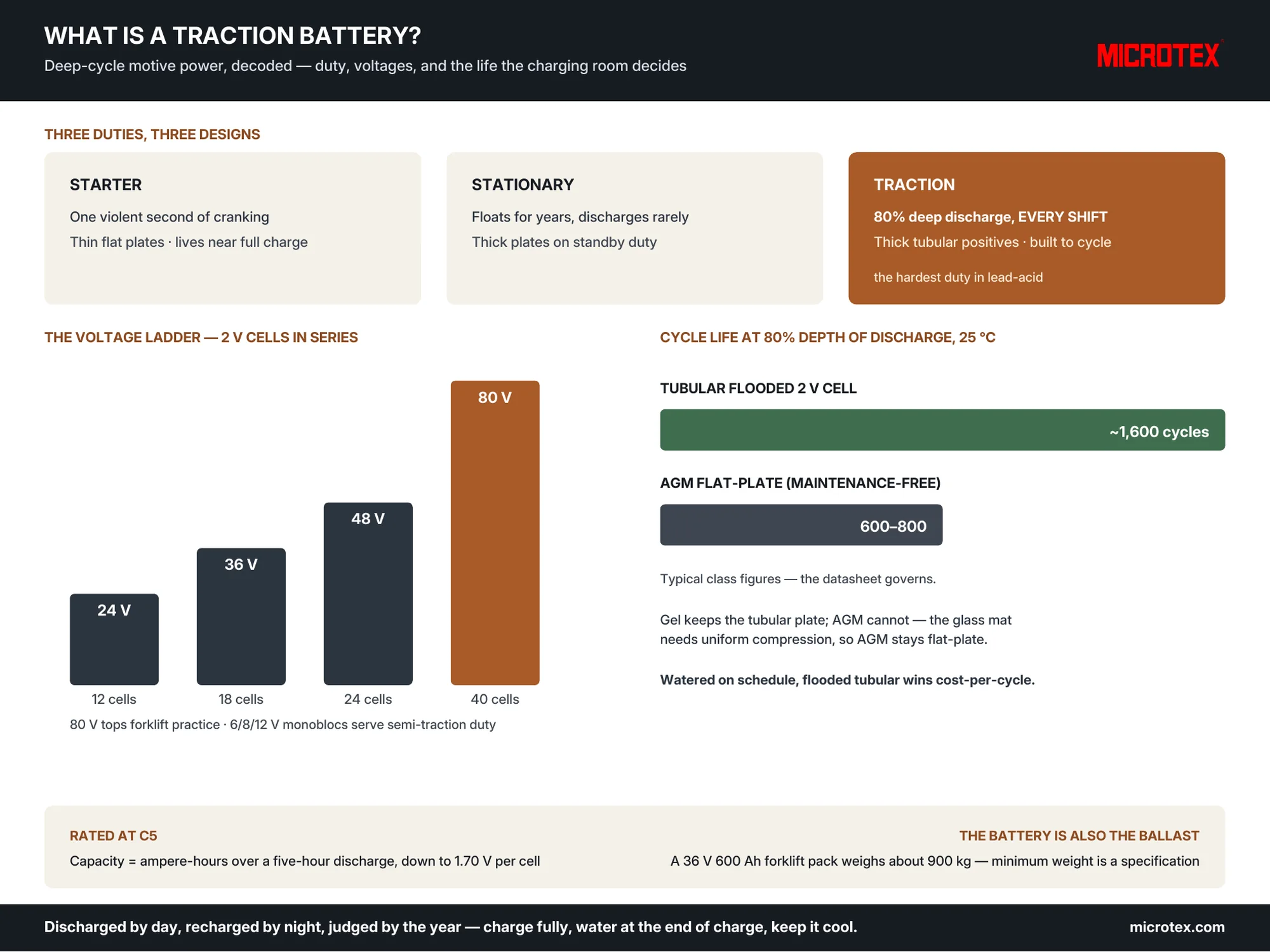
The question behind “what is a traction battery” is usually “how is it different from a normal battery” — and the answer is that there is no normal battery, only batteries shaped by their duty. A car starter battery delivers one violent second of several hundred amperes, then lives near full charge while the alternator repays the loan; thin flat plates give it that surface area. A stationary battery floats for years at full charge, waiting for an outage that may never come. The traction battery does neither: it hands over most of its capacity every single shift and must take it all back overnight.
| Duty | Typical discharge | Plate construction | What ages it |
|---|---|---|---|
| Starter (automotive) | Seconds of cranking at very high current | Many thin flat plates for surface area | Grid corrosion, heat, vibration |
| Stationary (standby) | Rare — an occasional deep outage discharge | Thick flat or tubular plates on float | Positive-grid corrosion on float |
| Traction (motive power) | Up to 80% of capacity, every working shift | Thick tubular positives, robust separators, mud room | Cycling stress — and undercharge sulfation |
Inside a traction cell
Every deep cycle must be repaid with a long recharge at elevated voltage, and that voltage slowly oxidises the positive grid itself: the conducting alloy gradually converts to lead dioxide, and the grid grows as it corrodes. The spine alloy is therefore the heart of the design. Microtex casts its positive spines from a proprietary corrosion-resistant low-antimony alloy — refined with tin, copper, sulphur, selenium and arsenic additions developed over decades — chosen to resist both corrosion and creep growth through years of daily recharging.
Around each spine, a woven or non-woven polyester gauntlet holds the active material firmly in place. The tubes are dry-filled with lead oxide powder at 3.6–3.8 g/cc, and formation converts it with a generous share of α-PbO₂ — the denser form of lead dioxide that serves as the plate’s long-life skeleton, while β-PbO₂ provides the ready capacity. That gauntlet grip is why tubular plates survive thousands of expansion-contraction cycles that would shed a flat plate’s material onto the cell floor.
The negative plate is pasted spongy lead at about 4.4 g/cc, with expander additives that keep it porous through years of cycling. Separators of polyethylene, microporous rubber or PVC keep the plates apart; beneath everything, a bottom prism leaves collection space so that whatever material does shed settles harmlessly instead of bridging the plates into a short circuit. Cells interconnect through lead-plated copper connectors, and the electrolyte is sulphuric acid filled at 1.275–1.285 specific gravity, corrected to 27 °C. Maintenance-free variants swap the alloys to lead-calcium-tin and seal the cell. The full construction story — and the patent behind ours — is on the tubular plate technology page.
The voltage ladder
A traction cell is 2 V whatever its size; packs are built by series connection. Forklift practice climbs a standard ladder — 24 V (12 cells), 36 V (18), 48 V (24) and 80 V (40 cells), with 80 V the practical ceiling for counterbalance trucks. Below the big trucks, 6 V, 8 V and 12 V monoblocs serve the semi-traction duties: golf carts, access platforms and floor-cleaning machines, whose daily cycling is real but lighter. The truck’s compartment decides the rest — DIN or BS cell dimensions, tray size, and a minimum weight, because in a counterbalance forklift the battery is also the ballast.
Flooded or maintenance-free?
The great majority of forklift packs worldwide are flooded tubular 2 V cells, and the trade-off explains why. Maintenance-free versions exist in two forms: AGM, which must use flat plates because the glass-mat separator needs uniform compression, and gel, which keeps the tubular positive. What you trade away with maintenance-free is cycle life: a 2 V tubular flooded cell typically gives around 1,600 cycles at 80% depth of discharge at 25 °C, against roughly 600–800 for an AGM flat-plate design — typical class figures; the datasheet governs. Where someone waters the batteries on schedule, the flooded tubular cell wins the cost-per-cycle contest by a wide margin.
One trap the low price of a single 2 V cell sets: replacing individual dead cells inside an aged battery. The newcomers get dragged down to the condition of the old string and fail early — budget for banks, not band-aids. And lithium? It earns its keep in multi-shift operations that snatch charge at every break. For single-shift work with a proper overnight charge, the flooded tubular cell remains formidably economical. The duty cycle chooses the battery.
Life is decided in the charging room
Cycle life on the datasheet assumes discipline in the charging room, and four habits do most of the deciding. First, recharge fully after every working day — chronic undercharge, including casual opportunity charging, leaves sulphate unconverted until it hardens, the slow disease covered in our sulfation guide. Second, keep the battery cool: sustained heat roughly halves life for every 10 °C. Third, water at the END of charge, never before — levels rise during charging, and an overfilled cell pushes acid out over the lids. The sole exception: if plates are exposed, add just enough demineralised water to cover them before starting. Never acid. Fourth, respect the floor — don’t ride the truck below the C5 endpoint of 1.70 V per cell. Deep is the duty; flat is abuse.
Leave the vent plugs fitted while charging — they are designed to breathe, and open cells spray acid mist and admit sparks. Expect a full recharge to be slow by design, typically 8–10 hours depending on the state of charge; the battery and charger manuals govern. And keep records: cell voltages and specific gravity at the start and end of charge, gravity corrected to 27 °C as shown in our battery acid guide. The logbook is the earliest failure alarm you own.
Three questions forklift users ask us
Why do forklift batteries explode?
Almost always because cells ran dry. Plates exposed above the electrolyte overheat the separator during charging, the damage invites an internal spark — and charging evolves hydrogen, which is explosive above just 4% in air. Correct levels, fitted vent plugs and a ventilated charging area remove the ingredients. The full mechanism, and the 4% rule, is in why batteries explode.
How much sulphuric acid is inside?
A forklift battery ships factory-charged with electrolyte at 1.275–1.285 specific gravity — roughly 13–15 ml of acid per ampere-hour of capacity, standing about 40 mm above the separator guard (typical values; the manual governs). The acid is the third active material, alongside the two plates, and its purity matters to battery life. In service you never add acid: top up with demineralised water only, and never overfill — spilt electrolyte corrodes the steel tray and finds the truck’s electronics.
How heavy is a forklift battery?
Deliberately heavy — the battery doubles as the counterweight that keeps the truck planted when the forks lift a load. A 36 V 600 Ah pack weighs about 900 kg. That makes minimum weight a specification, not a nuisance: a too-light replacement battery unbalances the truck at full lift. Check the truck’s data plate before substituting anything.
Ready to specify one? The commercial side lives on our traction battery range — and forklift owners can go straight to the forklift battery page, where quotations come back the same working day. Any term that puzzled you is in the glossary; a duty that doesn’t fit the patterns above belongs in an enquiry — sizing is our day job.