
Temperature is the silent third party in every battery contract. It moves the voltage your charger should apply, the reading your hydrometer shows, the capacity you can withdraw, and — most expensively — how many years the battery lives. The rules are few and they are simple; here they are in one place, including one distinction that even experienced hands blur.
First, the distinction: battery physics vs charger practice
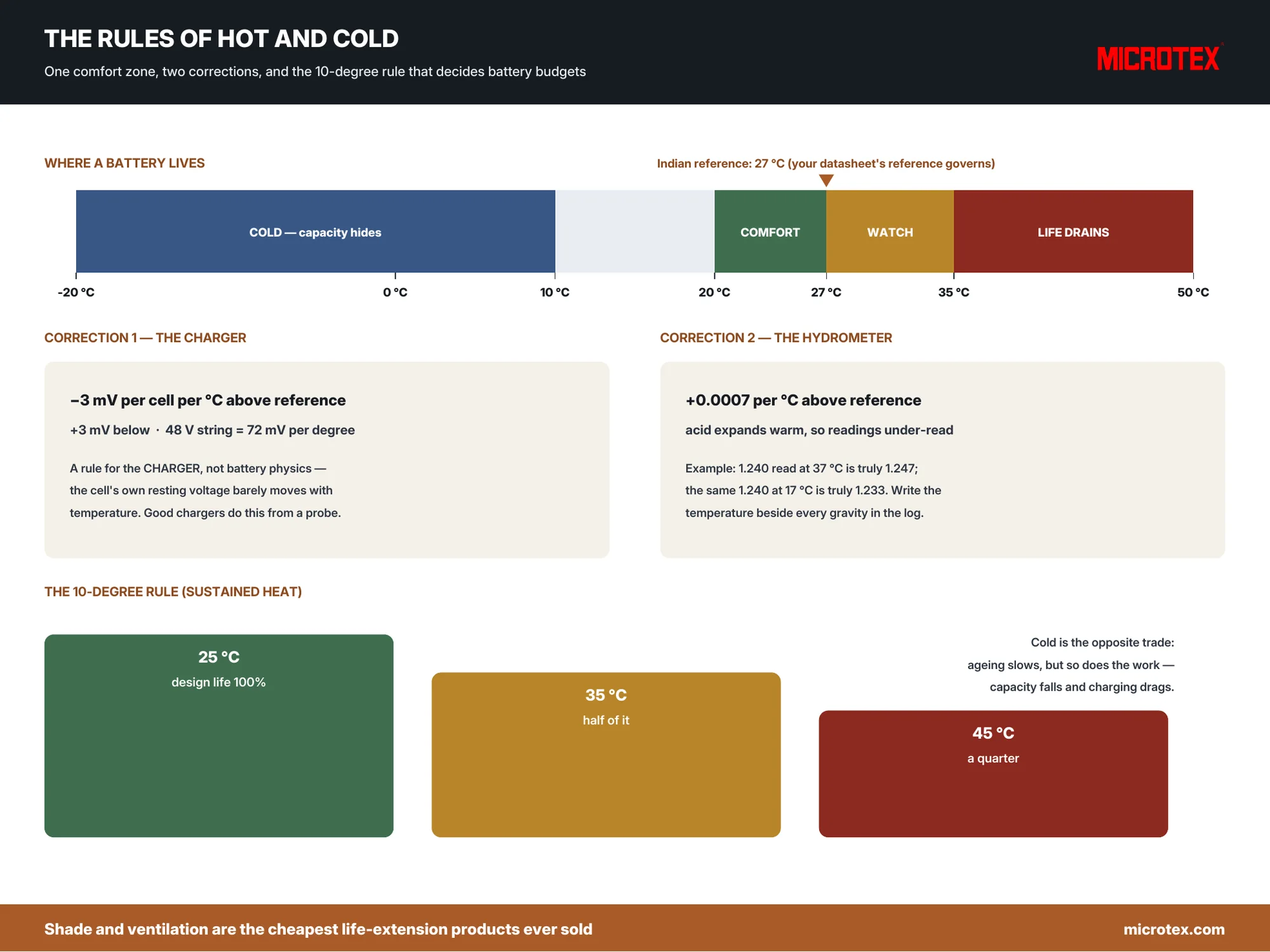
Two different things get called “the temperature coefficient”, and confusing them breeds myths. The cell’s OWN resting voltage barely notices temperature — the thermodynamic shift is a fraction of a millivolt per degree, negligible in field work. What changes strongly with temperature is what the battery can TOLERATE while charging: a warm battery gasses, corrodes and loses water at a voltage a cold battery accepts gratefully. So the famous slope — subtract about 3 mV per cell for every °C above the reference, add the same below — is a rule for the CHARGER, not a property of the open-circuit cell. It exists to keep the charge and float voltage correctly placed relative to gassing at whatever temperature the battery actually lives.
| Condition | Charger correction |
|---|---|
| Each 1 °C ABOVE reference | −3 mV per cell (≈ −72 mV on a 48 V, 24-cell string) |
| Each 1 °C BELOW reference | +3 mV per cell (≈ +72 mV on a 48 V string) |
The hydrometer needs correcting too
Acid expands as it warms — a few per cent across a 50 °C swing — so a hydrometer under-reads in heat and over-reads in cold. The correction from the battery acid guide: add 0.0007 to the reading for every °C above the reference temperature, subtract below. In India the reference is 27 °C. A cell reading 1.240 at 37 °C is really 1.247-strength acid; the same reading at 17 °C is really 1.233. Uncorrected readings quietly mislabel a battery’s state of charge — always note the temperature beside the gravity in the log.
The hot side: where life is spent
Heat is the great accelerator. Every internal process — grid corrosion, water loss, self-discharge — runs faster in a warm cell, and the toll compounds by the Arrhenius rule of thumb the whole industry designs around: service life roughly halves for every 10 °C of sustained operation above the comfort zone. A battery specified for twenty years at 25 °C is a ten-year battery at 35 °C and a five-year battery at 45 °C. From about 35 °C upward the damage curve steepens sharply; persistent heat also demands more frequent topping-up and closer voltage attention. Shade, ventilation and separation from heat sources are the cheapest life-extension products ever sold.
The cold side: where capacity hides
Cold is the opposite trade — it slows the ageing chemistry (cold storage is a preservation trick) but it slows the WORKING chemistry too: available capacity falls as the acid thickens and diffusion drags, cranking demands rise just as the battery weakens, and charging takes visibly longer. A discharged battery’s thin acid can even freeze. The full winter playbook — compensation in practice, the freezing table, the charge-before-the-cold rule — lives in battery charging in cold weather.
The comfort zone
Everything above condenses to one placement rule: lead-acid is happiest living around 20–27 °C. Indian standards rate and correct at 27 °C; temperate-country datasheets often use 20 or 25 °C — the number on YOUR datasheet is the one your corrections count from. Batteries forgive occasional excursions in both directions; what they bill you for is sustained residence outside the zone. The whole family portrait is in the complete guide, vocabulary in the glossary — and if your battery room runs hot and you want the honest life arithmetic before buying, ask us; we design for Indian summers.