
The lead-acid battery is the oldest rechargeable battery in the world — and it is still made in greater numbers than any other. More than 165 years after Gaston Planté first coaxed a charge back into a lead cell, its descendants start cars, drive forklifts through night shifts, and stand guard in substations and power plants. This guide is the map of the whole subject: how the cell works, where it came from, how it is built, the family it grew into, and where each deep-dive article in this series fits.
The cell in one paragraph
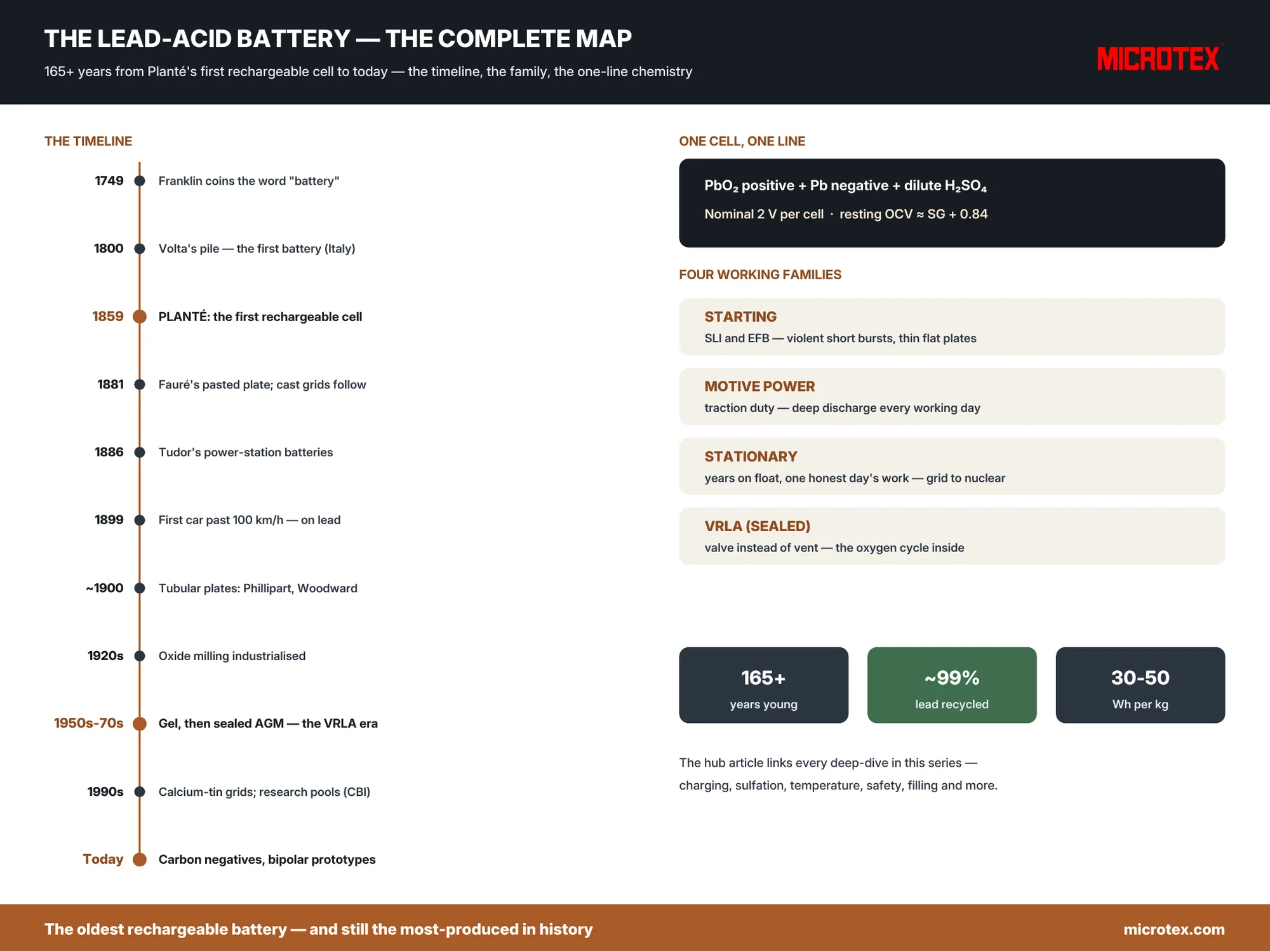
A lead-acid cell is three materials in conversation: a positive plate of lead dioxide, a negative plate of spongy lead, and dilute sulphuric acid between them. On discharge both plates convert toward lead sulphate while the acid gives up its strength — the double-sulphate reaction described by Gladstone and Tribe in 1882 — and on charge the whole conversation runs in reverse. That is why a hydrometer can read a lead-acid battery like a fuel gauge: the electrolyte is a participant, not a bystander. Each cell contributes a nominal 2 volts, and its true resting voltage follows the acid (open-circuit voltage per cell ≈ specific gravity + 0.84). The full electron-by-electron story has its own article; the acid itself has another.
A short history of a long-lived idea
The word came before the thing: Benjamin Franklin borrowed “battery” from artillery in 1749 to describe his linked Leyden jars. Luigi Galvani’s twitching frog legs in the 1780s set the puzzle; Alessandro Volta answered it in 1800 with the pile — the first true battery — and William Cruickshank soon laid Volta’s couples on their side in the trough battery, the first mass-produced form. All of these could only spend charge, never save it. The saving trick arrived in 1859, when the French physicist Gaston Planté immersed two coiled lead sheets in dilute sulphuric acid and found the cell could be discharged and recharged — the world’s first practical secondary battery.
What followed was a relay race of practical men. Camille Fauré’s 1881 pasting process — lead-oxide paste spread on plates instead of waiting years for Planté’s pure lead to roughen — made capacity manufacturable, and grid-casting patents followed within months. Henri Tudor built the first durable power-station batteries in 1886. The tubular plate arrived around the turn of the century — Phillipart’s rings and Woodward’s fabric bags — ancestors of the tubular designs that still dominate deep-cycle duty. And the young technology showed off: in 1899 Camille Jenatzy’s electric La Jamais Contente became the first road vehicle past 100 km/h — about 106 km/h — on lead-acid cells, years before petrol cars caught up.
| Year | Milestone |
|---|---|
| 1749 | Franklin coins “battery” for linked Leyden jars |
| 1800 | Volta’s pile — the first battery (primary only) |
| 1859 | Planté: the first rechargeable cell — lead in sulphuric acid |
| 1881 | Fauré’s pasted plate; cast grids follow within months |
| 1886 | Tudor’s first long-life power-station batteries |
| ~1900 | Tubular plates emerge (Phillipart, Woodward) |
| 1898–1920s | Oxide production industrialised: Barton pot, then ball mills (Shimadzu) |
| 1940s–50s | Expanders (lignin) rescue winter starting; antimony begins its long retreat |
| late 1950s–1970s | Gel cells in Germany; sealed AGM cells in America — the VRLA era opens |
| 1990s | Calcium-tin grids mature; industry research pools into a global consortium (today’s CBI) |
| 2000s | Enhanced flooded batteries (EFB) for start-stop cars |
| Today | Carbon-enhanced negatives, bipolar prototypes — the old chemistry still learning |
How a modern battery is made — and why it outlives its ancestors
Every improvement in life and reliability traces to manufacturing as much as chemistry. Lead oxide, once made by slow corrosion in sheds, is now produced in hours in Barton pots and ball mills. Grids that began at around 11% antimony — sturdy, but thirsty for water and prone to self-discharge — run below 2% antimony with selenium grain refining, or use lead-calcium-tin alloys that made maintenance-free and VRLA designs possible (the calcium alloys initially failed early in deep cycling until metallurgists — R. D. Prengaman’s work is the landmark — showed tin cures the passivation). Assembly changed just as much: inter-cell connections that once looped over partitions are now squeeze-welded straight through the wall, shortening the current path; plate groups once hand-burned together are cast-on-strap, welding every lug identically; separators once slid in as leaves now wrap each plate as an envelope, ending the side-short. Tubular positives graduated from slotted rubber tubes to woven and non-woven gauntlets. None of this is visible from outside — all of it is why a well-made battery today outlasts its grandfather several times over.
The family map — and where each deep-dive lives
One chemistry, four working families. Starting batteries (SLI and its tougher start-stop sibling, the EFB) deliver violent short bursts from thin flat plates. Motive-power batteries earn their living discharged deeply every day — the traction battery guide covers forklifts and their kin, and the C-rate article explains why the same ampere-hours behave differently under different currents. Stationary batteries spend years on float waiting for one honest day’s work — substations, power plants and, at the demanding extreme, nuclear facilities; our 2V HDP stationary cells serve this family. Valve-regulated batteries trade the vent plug for a one-way valve and an internal oxygen cycle — the choice between their two forms is the AGM-versus-gel question, and tubular gel versus flooded settles the deep-cycle variant.
The care-and-feeding shelf is already written: charging is the master article, with equalizing, cold-weather charging and winter storage as its seasons; state of charge teaches the fuel gauge; sulfation names the disease most batteries actually die of; and why batteries explode covers gas and ventilation. New alongside this guide: the honest ledger of advantages and disadvantages, operating temperature, handling safety, and first fill and first charge.
Strengths, weaknesses, and the recycling story
The honest summary: lead-acid is heavy (lead’s atomic mass is 207 against lithium’s 6.9) and stores roughly 30–50 Wh per kilogram, a fraction of lithium-ion’s figure; it charges slowly and cycles fewer times. In exchange it is inexpensive per stored kilowatt-hour, tolerant of abuse that would endanger other chemistries, serviceable with a hydrometer and a voltmeter, and content in unconditioned battery rooms. And it holds one title no other chemistry approaches: it is among the most recycled products of any kind on earth — in mature markets about 99% of battery lead returns through recycling, and a spent battery has scrap VALUE rather than a disposal fee. Lithium recycling is developing quickly, but lead’s circular economy has a century’s head start. The full case for and against — including where lead-acid is now the wrong answer — is argued in the advantages-and-disadvantages article linked above.
Installing and commissioning a large bank — the disciplined overview
Large stationary banks are installed by trained personnel against written standards — IS 1651 in India; IEEE 484 (installation), 485 (sizing) and 450 (maintenance and testing) internationally — and the manufacturer’s manual governs where they differ. The rhythm: inspect on receipt and record any damage before accepting; assemble racks level and plumb BEFORE loading them; lift cells from the bottom, never by terminals; arrange polarity alternating and verify cell-by-cell — a single reversed cell, charged backwards, can destroy a bank. Connector faces and terminals get a thin film of petroleum jelly; every bolt is pulled to the recommended torque, never beyond (lead posts deform). First fill uses acid to the manufacturer’s specified gravity, rested and cooled; the commissioning charge then runs gently at about 3–5% of rated capacity until voltage and specific gravity hold constant across three consecutive hourly readings. After a day’s rest comes the acceptance test — a C₁₀ discharge expecting at least 85% of rated capacity, with full capacity typically arriving within the first few cycles, temperature-corrected per the standard. Every reading goes into the record book: the log is the bank’s medical history. The personal-protection rules that surround all of this live in the safety article, and the fill-and-first-charge detail in the filling guide — both linked in the family map above.
Where it goes next
The research frontier is busy for a technology this old: carbon additives teaching negatives to survive partial-state-of-charge duty, hybrid designs pairing a battery with a supercapacitor for high-rate bursts, bipolar constructions chasing lighter grids. Lithium will keep winning where weight and footprint rule — and lead-acid will keep winning where cost, safety, serviceability and proven recycling rule, which is a very large territory. The temperature rules that govern all of it are in the operating-temperature article above; terms are in the glossary. And if you are specifying, replacing or troubleshooting a battery in that territory, talk to us — we have been making these batteries since 1969.