
No working environment on earth is harder on a battery than an underground mine. Heat, dust that conducts electricity, corrosive damp, constant vibration, gases that must never meet a spark — and consequences, when equipment fails, measured in more than money. Because live rails and trailing cables are non-starters in most galleries, underground transport runs on traction batteries; and because the environment is what it is, the difference between a battery built FOR mines and a battery merely sold TO them is visible in every design decision. This article walks through those decisions — the engineering behind our mining battery range.
Reliability is not a feature underground — it is admission
A mine cannot lose a shift’s production to a battery, and it cannot gamble on safety at all. So the reliability bar sits where mining companies put it: rated performance from day one, every unit, no exceptions. Meeting that bar is a process discipline, not a slogan — under our ISO 9001 system every manufacturing stage is checked for electrical, chemical and physical properties, every finished mining battery is tested for performance and safety before it ships, and the critical internal welds face something stronger than inspection: each shift, a sample joint is destructively torn apart to prove the process, not just the piece. Batteries also arrive ready for the pit — pre-assembled, charging plugs fitted, tested, at top of charge for a full first shift — with lifting eyes positioned for stable hoisting into the loco compartment, because underground, installation skill and space are luxuries.
The chemistry of not overheating
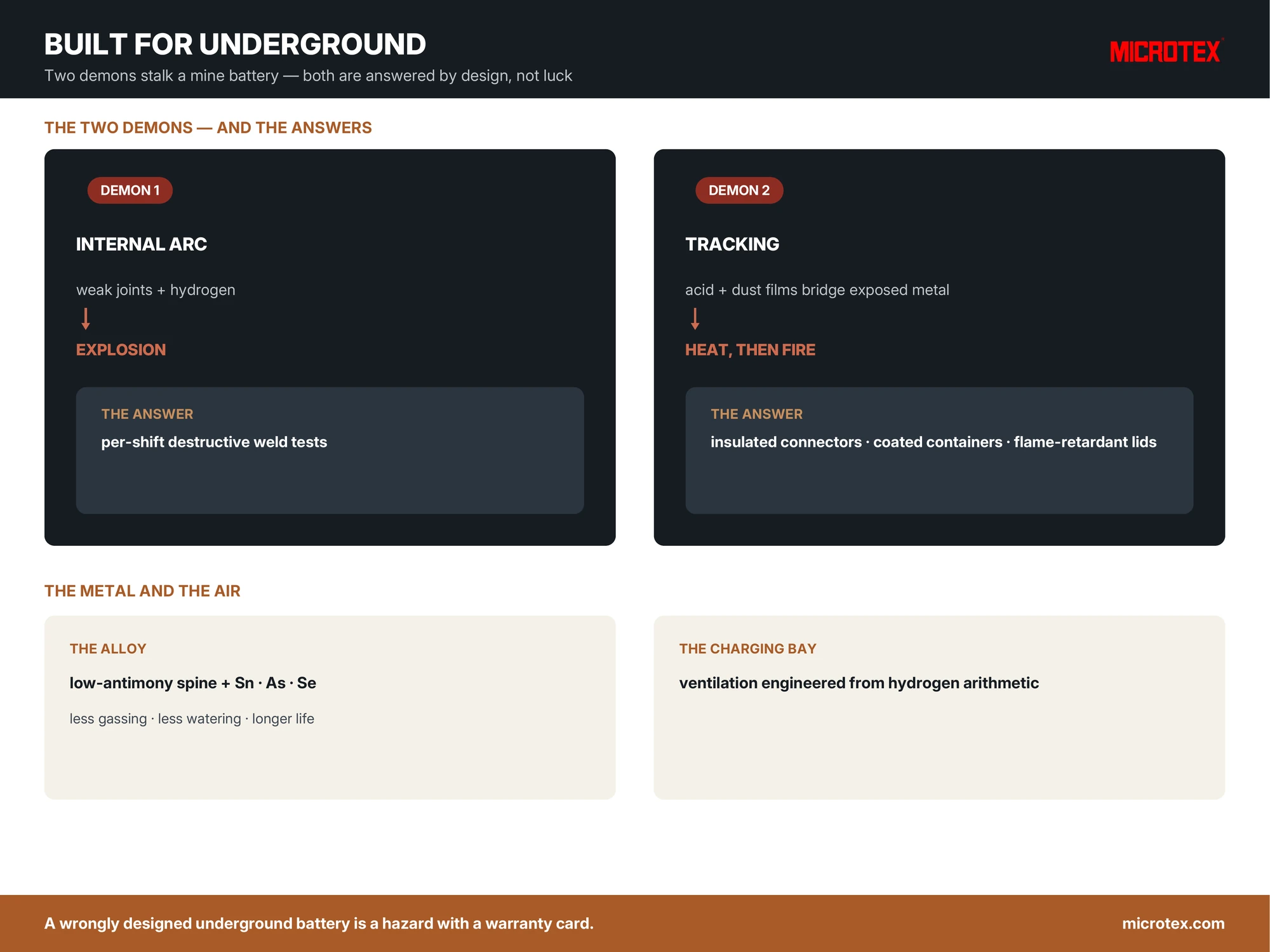
Underground duty is deep daily cycling in warm air, so the plate had better be the tubular construction — the highest-energy, longest-cycling plate in the lead-acid family — and the details had better manage heat. Overheating is a compounding tax: it accelerates water loss, corrodes grids, and increases gassing on charge. Our answers are specific. Bolted inter-cell connectors with guaranteed contact area in solid brass and copper, so connections do not become heaters. A positive-spine alloy with deliberately LOW antimony — less gassing, less watering, less hydrogen in the gallery — strengthened with tin, arsenic and selenium for corrosion resistance and creep strength, which also restrains the positive-plate growth that ages cycled cells. Electrolyte-level indicators that show watering needs without opening a cell. And a matched mining battery charger, developed over long experience with this exact duty, that finishes the charge with minimal gas. Cells come in DIN and BS tubular ranges, sized to the duty cycle — sizing against the real operating pattern, not the nameplate, is where lowest cost-per-shift is won.
The two demons: arc and fire
Underground battery safety has two named enemies. The first is the INTERNAL arc: a weak joint between bus bar and plate can spark at switch-off or on a jolt — and a spark inside a cell rich with charging hydrogen is how batteries explode. That is why those welds get the destructive-test regime above; sharply reducing arc risk is a manufacturing habit, not an accessory. The second enemy works on the OUTSIDE: electrical tracking. Field experience in European coal mines taught our engineers that most underground battery fires start not inside cells but across their tops — surface acid or conductive mineral dust bridging exposed metal, carrying a high-resistance leakage current that heats, chars and finally ignites. The design answer is to leave tracking nothing to track across: flame-retardant cell-lid materials, fully insulated bolted connectors with no exposed metal, and steel containers coated in a flexible insulating polyester that resists the knocks which would bare the metal — because an exposed container invites earth leakage, which quietly steals operating voltage and capacity even when it never starts a fire. The remaining risk lives in the charging room, where hydrogen collects — and here the literature offers comfort: hydrogen evolution is ARITHMETIC, a predictable volume per ampere-hour of overcharge (the working constant, and the 4% flammability threshold it must never meet, live in why batteries explode), which means charging-bay ventilation can be engineered from numbers rather than guessed from habit. We design or review charging areas for customers without charge, and that calculation is the heart of the service.
Choosing a mining battery supplier
Strip the brochures and the questions that matter underground are these: Does the maker test EVERY battery, or batch-sample? Are the internal welds process-proven destructively, or trusted? Is the alloy chemistry designed for low gassing, or borrowed from automotive practice? Is the container insulated against tracking, or just painted? Is the charger matched to the battery, or someone else’s problem? And has the supplier actually lived with this duty — we have built for mining locomotive fleets for more than fifteen years, and the locomotive battery and MUV and scoop battery pages carry the products that experience produced. A wrongly designed underground battery is not a procurement mistake; it is a hazard with a warranty card. Send us the duty cycle, and the proposal comes back engineered for the gallery it will live in.