
When a battery dies early, two stories are always told — and only one of them is in the battery. The user’s story says the battery was faulty; the seller’s story says the battery was abused; and between them stands the only honest witness: the battery itself, which cannot lie and cannot be cross-examined, only OPENED. Failure analysis is the discipline of reading that witness. We publish our method here for a blunt reason: a buyer who knows exactly how a failure will be judged can predict the judgment — and suppliers who keep the method mysterious usually have a reason.
Step 1 — the history: most verdicts are written before the battery is opened
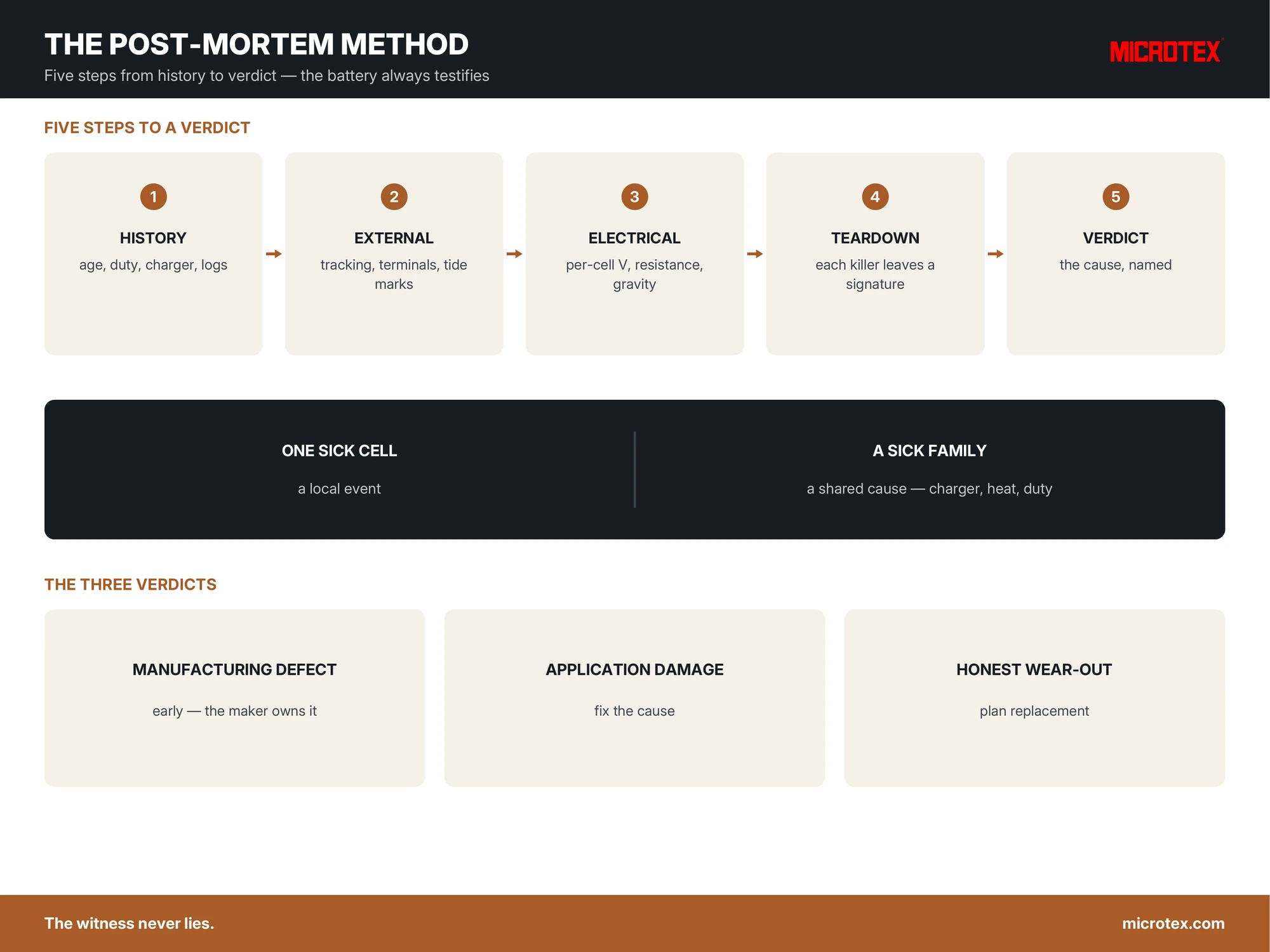
A competent post-mortem starts with paper, not pliers. When did service begin, and against what duty? What charger, at what settings — and can they be seen, not just described? Do logs exist: per-cell voltages, gravities, topping-up records, temperatures? What changed in the weeks before the complaint — a new charger, a new shift pattern, a heat wave, a long idle? Age is the first great sorter: a battery failing in EARLY life points toward manufacturing or application error, because genuine wear-out needs years to do its work; a battery failing near its design life has usually just finished an honest career and become a warranty conversation about arithmetic, not defects. Duty is the second sorter — a bank that spent its life hot, undercharged or over-discharged carries that biography inside, and the teardown will read it back.
Steps 2 and 3 — the outside, then the electricity
The external examination reads the housekeeping: acid trails and dust bridges on the lid (the tracking story the mining guide tells), corroded or heat-discoloured terminals betraying loose connections, container distortion whispering about heat or overcharge, electrolyte levels and their history of neglect written in tide marks. Then the electrical survey, before anything is disturbed: per-cell open-circuit voltages after rest, internal-resistance readings against commissioning baselines where they exist, specific gravities in flooded cells — and the PATTERN matters more than any single number. One cell far adrift in an otherwise healthy string suggests a local event: a short, a defect, physical damage. ALL cells uniformly degraded suggests a shared biography: the charger, the temperature, the duty — causes that live outside the battery. That one distinction — one sick cell versus a sick family — does more diagnostic work than any instrument in the kit.
Step 4 — the teardown: what the plates confess
Opened on the bench, each of the five killers leaves a signature no argument can talk away. Grid corrosion shows as positive frameworks grown, brittle and crumbling — dark honest old age, arriving early only when heat or overcharge hurried it. Shedding shows as sediment: active material piled below flat plates, the fingerprint of deep cycling (and the failure tubular gauntlets exist to prevent). Sulfation shows as pale, hard, crystalline patches on plates that should be uniformly dark — the residue of undercharge, idleness or chronic partial charging, and on tall cells its VERTICAL distribution even records stratification. Dry-out shows as starved separators and, in sealed cells, the parched signature of overcharge heat. Shorts show themselves directly — a puncture, a bridge, a mossed-through separator — and their LOCATION speaks: a short at a manufacturing joint in a young battery points at the factory; a short through sediment in an old flat-plate cell points at the calendar. We photograph what we find, and the photographs go in the report — evidence, not adjectives.
The verdict — and why we publish the method
Every examination ends in one of three honest verdicts. Manufacturing defect — it exists, announces itself early, and is the maker’s to own without argument; our per-shift destructive weld testing and 100% final testing exist to make this verdict rare, not to make it deniable. Application damage — the wrong charger, chronic undercharge, heat, over-discharge, contaminated water; the battery’s interior testifies, and the remedy is fixing the CAUSE, because a warranty replacement into an unchanged application is just the same funeral with a delay. Honest wear-out — the design life delivered, the 80% line crossed, a career completed; the conversation is replacement planning, not blame. The warranty document governs the commercial consequences of each verdict; this page governs something we think matters more — that the verdict itself be PREDICTABLE, because it follows a published method applied to physical evidence. If a battery of ours disappoints you, this is exactly the examination it will receive, with the readings and photographs shown to you. And if another maker’s battery has died mysteriously and you want to know why before you buy its successor — bring us the body. The witness never lies.
A battery detective story — on film
Early in his career on the British railways, Dr. McDonagh bolted a mechanical data logger into a maintenance pit to catch batteries dying on one locomotive class. What it caught had nothing to do with the batteries.