
No battery lives forever, but almost none die of old age alone. Ask what “battery life” means and you get two different clocks. The CYCLE clock counts work: every discharge-recharge round wears the plates a little, and the datasheet promises so many rounds at a stated depth. The CALENDAR clock counts time itself: some chemistry inside a battery proceeds whether you use it or not, at a pace set by temperature. A battery dies when EITHER clock runs out — a hard-worked forklift battery dies by cycles in a few years; a gently floated substation bank dies by calendar after fifteen or twenty. Understanding the five killers behind those clocks is the difference between a battery that reaches its design life and one that dies young with the same nameplate.
Killer 1 — positive-grid corrosion: the natural death
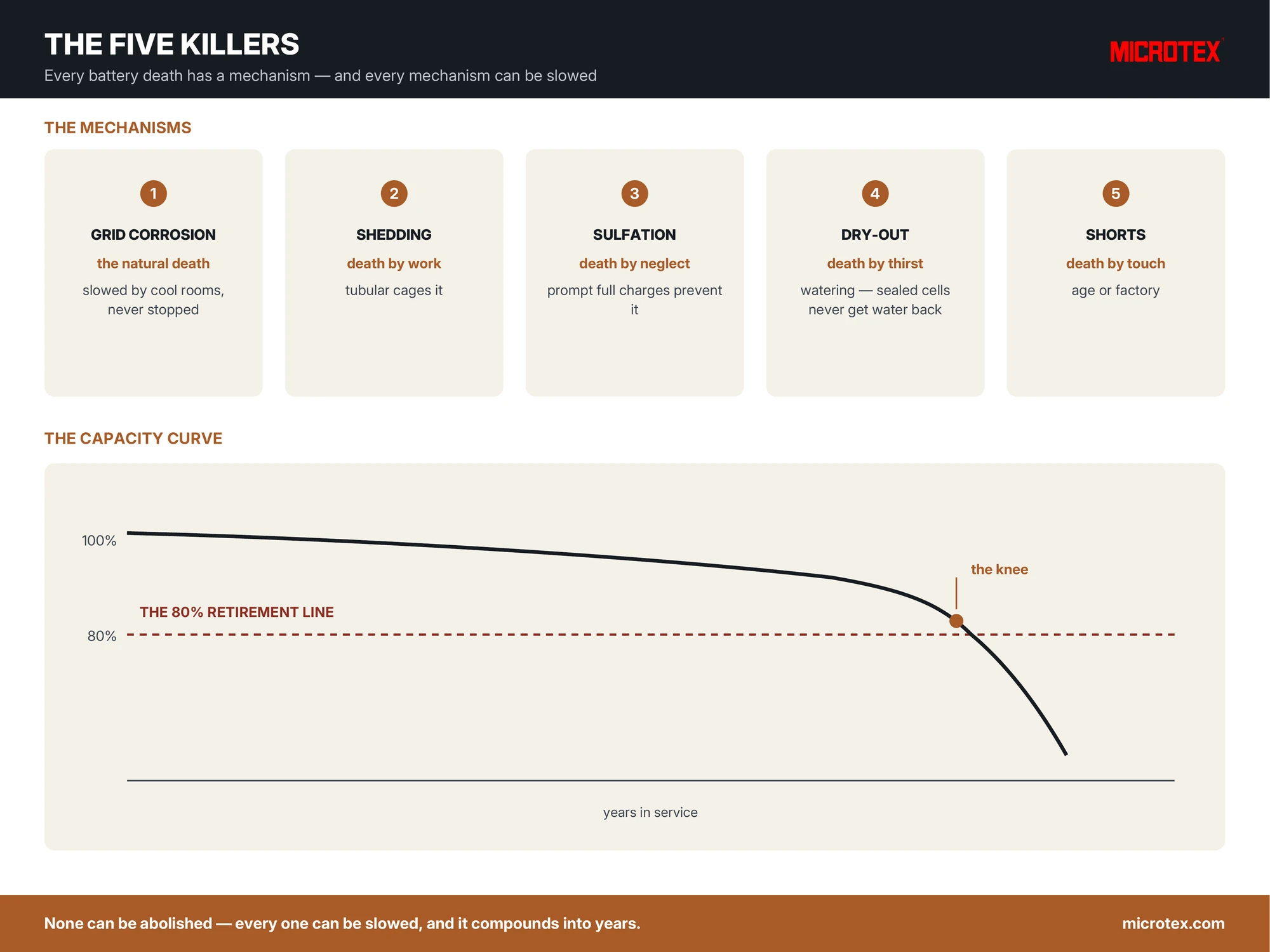
Here is the honest one first. The positive grid — the lead framework carrying current through the positive plate — lives its whole life in acid at an oxidising potential, and it slowly converts to lead dioxide and corrosion products. This is not a defect; it is the thermodynamic rent the chemistry pays, and it is THE reason float life is quoted in years. As the grid corrodes it thins electrically and physically GROWS, slowly losing contact with its active material; capacity fades, and in advanced age the growth can distort plates. You cannot stop it — but its pace obeys Arrhenius, which means every degree of sustained heat you spare the battery slows its natural death; and alloy metallurgy (the tin, arsenic and selenium additions our spine alloys carry) is designed precisely to corrode slowly and resist that growth. The natural death can be postponed for years. It just cannot be cancelled.
Killers 2 and 3 — shedding and sulfation: the deaths by work and by neglect
Every cycle, the active material physically breathes — it changes composition and volume on discharge and back again on charge — and flat pasted plates gradually SHED loosened material to the sediment space below. Deep cycling accelerates it; it is death by honest work. It is also the death the tubular plate was invented to slow: with the active material caged in woven gauntlets, it cannot fall away, which is why deep-cycle duty and tubular construction belong together. Sulfation, by contrast, is death by neglect, and it is nearly always preventable: lead sulphate is a normal discharge product, but left standing — in a discharged battery, an idle battery, a chronically undercharged battery — its crystals harden beyond what charging can reconvert. The battery loses capacity it never had to lose. Prompt recharge, full charges, and equalising when readings drift are the entire vaccine.
Killers 4 and 5 — drying and shorting: the deaths by thirst and by touch
Water leaves a flooded battery legitimately (gassing near full charge) and illegitimately (overcharge, heat), and if topping up is neglected until plates see air, the exposed material sulfates and the damage stays. In sealed batteries the same killer wears a different mask: the valve returns nothing, so every episode of overcharge-driven gassing is water gone forever — the slow dry-out that is the characteristic VRLA death. And finally the internal short: separators wear thin, shed sediment piles high in old flat-plate cells, or conductive bridges grow through — and a cell quietly self-discharges, runs hot, or dies outright. Age causes some shorts; manufacturing causes the rest, which is why we tear a sample weld apart every shift rather than trust appearances. A battery that dies YOUNG of a short is telling you about its factory, not its chemistry.
What “end of life” actually means — and how to buy years
The trade defines end of life as the point where a battery no longer delivers 80% of its rated capacity — a convention, not a cliff, chosen because the fade curve has a knee: beyond that point deterioration accelerates and reliability falls faster than the remaining numbers suggest. A bank at 79% still works today; it can no longer be TRUSTED with tomorrow’s full-duration outage, and for standby batteries trust is the product. So plan replacement at the convention, not at the funeral. And between now and then, the years are bought with boring discipline, each owned by a guide on this site: keep the room cool (temperature is the calendar clock’s dial), choose a sensible working depth and recharge promptly, equalise on readings, keep cells watered and tops clean, and match the charger to the battery. None of the five killers can be abolished. Every one of them can be slowed — and the difference compounds into years. If a bank in your care is fading and you want to know which killer is at work, ask us — the readings usually name the culprit.