
Every AI answer you read is underwritten by a room full of batteries. The data centre is the decade’s defining building, and its glamour all lives upstairs — the accelerators, the cooling, the fibre. Downstairs, in a room with no visitors, sits the equipment that decides whether a grid flicker becomes a non-event or a headline: the UPS plant and its battery strings. As the AI build-out multiplies data centres, it quietly multiplies battery rooms — and the battle for that unglamorous floor is one of the most consequential contests in the battery industry. Here is the backup story told straight: the demand numbers worth trusting, what the batteries actually do, the honest lead-versus-lithium scoreboard, and why conservatism rules under a billion-dollar building.
The boom, in numbers worth trusting
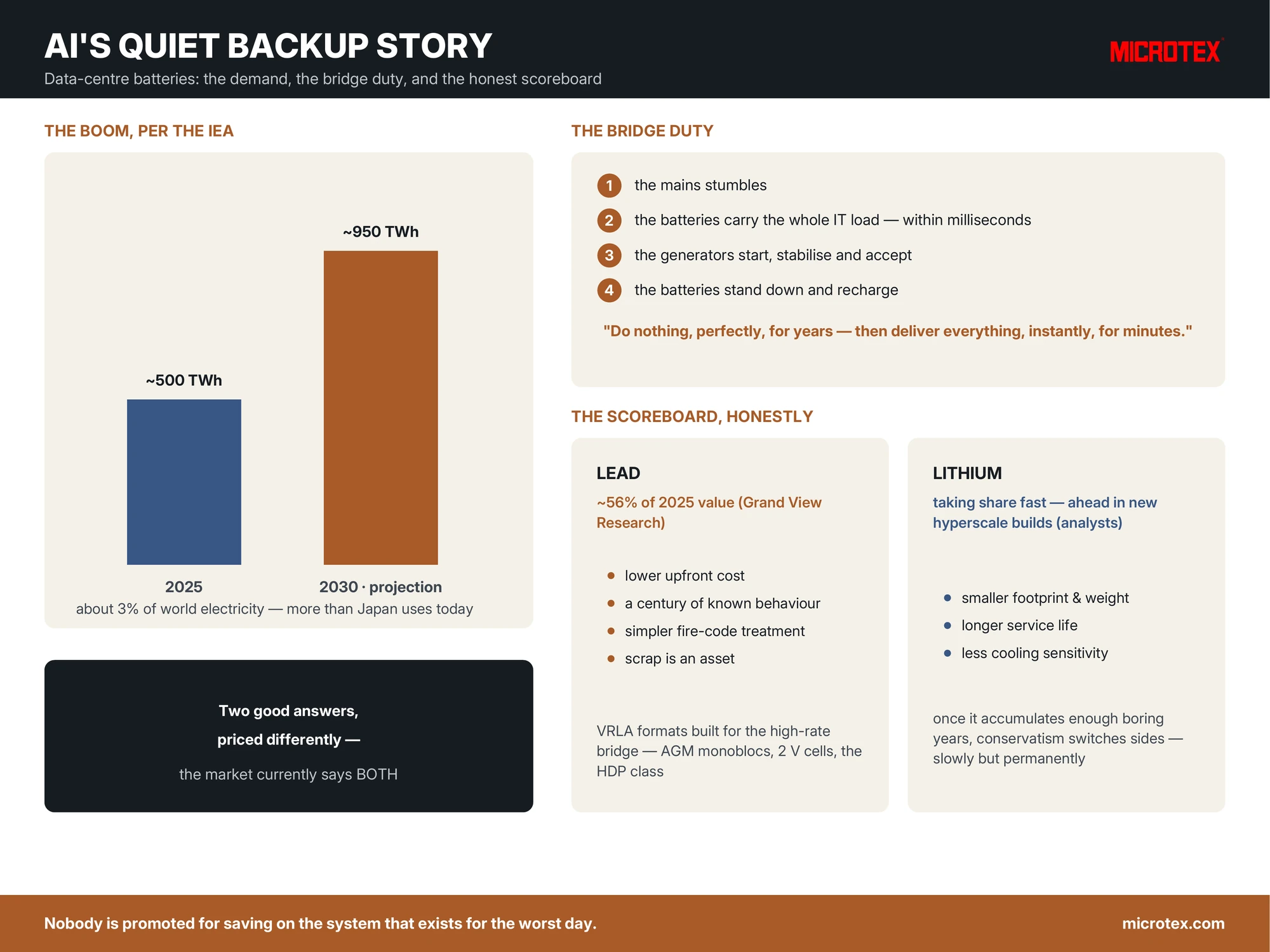
The reliable arithmetic comes from the International Energy Agency’s work on energy and AI: data centres consumed roughly 500 terawatt-hours of electricity in 2025, and the IEA projects consumption approaching 950 terawatt-hours by 2030 — call it a doubling in five years, taking the sector to around 3% of world electricity, more than Japan consumes today. A projection is a projection, and we label it one; but the direction is not in doubt, because the buildings are already under construction. For the battery trade the consequence is mechanical: every new hall ships with a UPS plant sized to its load, and every UPS plant ships with strings of batteries standing at float, waiting for the worst second of the year. Backup power is the rare battery market that grows with someone else’s boom regardless of which chemistry wins the cars.
What the battery room actually does
A data-centre battery has one of the strangest job descriptions in the industry: do nothing, perfectly, for years — then deliver everything, instantly, for minutes. When the mains stumbles, the UPS carries the entire IT load from its batteries within milliseconds; the diesel generators start, stabilise and accept the load; the batteries stand down and recharge. The battery is the BRIDGE, and the classic design philosophy sizes it in minutes — enough to cover generator start with margin, because past that point the generators, not the batteries, are the endurance athletes. A second philosophy buys longer runtimes where operators want less generator dependence; the trade-off is space, weight and money, and it is argued hall by hall. Either way the duty is pure stationary standby — years at float, occasional high-rate calls — which is why the discipline around it is classic stationary practice: temperature control (the calendar-life arithmetic is merciless in a warm room), periodic testing and per-cell trending, and replacement planned on readings rather than funerals.
Lead versus lithium in the UPS room
Now the scoreboard, honestly. Lead still held roughly 56% of data-centre battery value in 2025, per Grand View Research — but lithium is taking share fast, and several market analysts already put it ahead in new hyperscale builds, so this is a genuine contest, not an incumbency. Lithium’s case is real: far smaller footprint and weight (floor space in a data centre earns revenue), longer service life between replacements, and less cooling sensitivity — strong arguments when a hyperscaler designs a flagship. Lead’s case is equally real: lower upfront cost; a century of understood behaviour in exactly this duty, with failure modes that announce themselves to ohmic trending rather than arriving unannounced; the VRLA formats — from monobloc AGM to 2-volt AGM cells and high-discharge designs like the HDP class — built precisely for high-rate bridge duty; simpler fire-code treatment, since lithium battery rooms carry additional detection, suppression and spacing requirements under NFPA-class storage codes; and a recycling route so established that the battery’s end-of-life is an asset, not a liability. Two good engineering answers, priced differently — which is why the market currently says “both”.
Why conservatism rules the basement
Understand one asymmetry and the whole market makes sense: the battery room is a rounding error in a data centre’s budget, and the thing it protects is the entire budget. An hour of downtime in a large facility costs more than the battery plant did; no operator is promoted for saving lakhs on the one system that exists for the worst day. So the basement buys like an actuary: proven designs, predictable ageing, testable state of health, replaceable strings, service networks everywhere on Earth, and vendors with long memories. That culture — not nostalgia — is why lead remains so embedded in standby duty, and it is also, honestly, why lithium’s advance is real: once a technology accumulates enough boring years of its own, conservatism switches sides slowly but permanently. Our forecast matches our future-outlook post: lithium keeps gaining share upstairs in the flagships; lead keeps being specified wherever cost, recyclability and known behaviour outweigh footprint — which is a very large “wherever”, from enterprise rooms to telecom to every economy where capital is dearer than floor space. We have built 2-volt standby cells for switchgear, telecom and UPS duty since before the word “hyperscale” existed; if there is a battery room in your plans, talk to us and we will size it like actuaries too.