
Walk any battery exhibition and you will hear the same argument by the second coffee. How long does lead-acid have? Ten years? Twenty? Is lithium finishing the job, and is sodium-ion coming for whatever is left? The debate is loud because both sides can point at true things. As a company that has made lead-acid batteries for over five decades — and that publishes an honest chemistry comparison on this very site — we owe our readers the version without the comfort. Here it is, with figures as of July 2026 and every number’s source named. We refresh this page every six months — each January and July — because a market article that hides its date is already lying.
The scoreboard today (2026)
The whole battery market — every chemistry, every use — stands around US$ 175–180 billion in 2026 by most research-house counts, with lithium-ion taking roughly half to sixty percent of that value and climbing. And lead-acid? Here is your first dose of honesty, about the market-research industry rather than the battery one: depending on which firm you pay, the global lead-acid market in 2025–26 is “worth” anywhere from about US$ 50 billion to US$ 105 billion, growing at 3–5% a year toward US$ 75–140 billion by 2035. The two-to-one spread comes from scope games — what gets counted, at which point in the chain. Treat every single-number headline accordingly. What every count agrees on is the shape: lead-acid is GROWING in absolute terms, modestly and steadily — and SHRINKING as a share of the battery world, rapidly, because lithium is growing explosively. That one sentence, properly understood, dissolves half the convention-hall argument: both sides are right. Lead-acid is not dying. It is being outgrown.
The battlefield, segment by segment
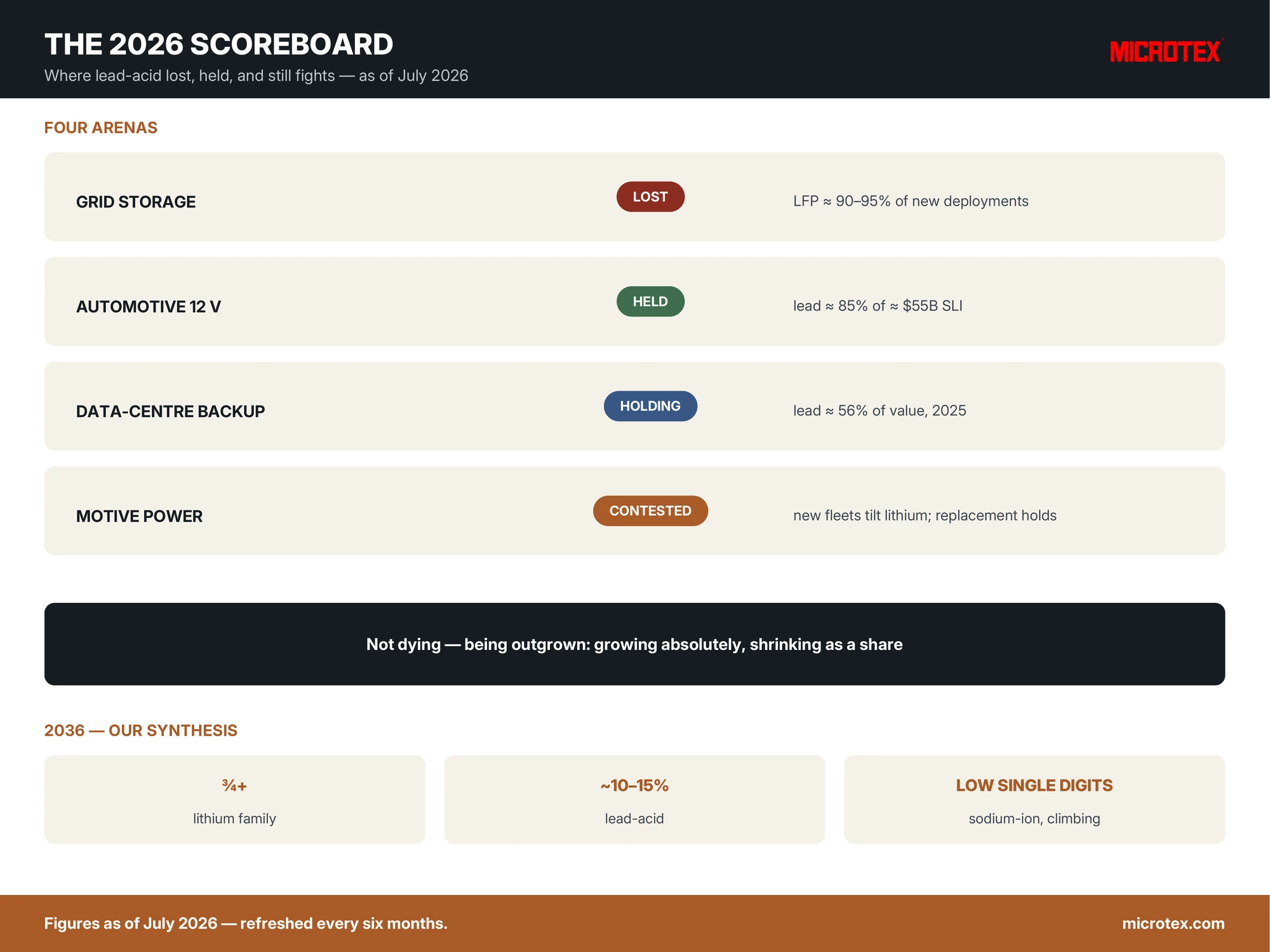
Grid-scale storage: lost, and let us not pretend otherwise. The world deployed 112 GW / 307 GWh of new battery storage in 2025 and BloombergNEF forecasts 158 GW / 459 GWh in 2026 — and lithium iron phosphate takes roughly 90–95% of these new deployments. The IEA notes grid battery capacity multiplied twelve-fold in four years; none of that wave was ours. The lead industry’s own consortium (CBI) has set an ambition of 100 GWh of the roughly 550–616 GWh annual ESS market expected by 2030 — note the word ambition; today’s held share is a small fraction of that. Anyone at a convention telling you lead-acid will win back grid storage is selling you a feeling.
Automotive 12 V: the fortress — holding, with cracks worth watching. The SLI (starting-lighting-ignition) market is around US$ 55 billion in 2025, projected toward US$ 68 billion by 2033, and lead-acid still holds roughly 85% of it. The fortress logic is brutal in our favour for once: the world’s enormous existing vehicle fleet needs replacement batteries for decades regardless of what new cars do — and even electric vehicles carry a low-voltage auxiliary battery, a segment growing faster than SLI overall. The cracks: premium cars are adopting lithium 12 V units, Chinese standards work anticipates lithium and sodium low-voltage systems in new-energy vehicles, and at least one sodium-ion start-up claims its cells beat lead-acid on every SLI metric including total cost — a vendor’s claim from a press release, unproven at automotive scale and price, but pointed exactly at our largest room. Watch it without panic and without denial.
Motive power: contested, and honestly tilting. New forklift fleets in Europe, North America and increasingly China specify lithium for the opportunity-charging economics; that trend is not reversing. What lead-acid holds — our own reading from the field, stated as such — is the replacement market for the vast installed fleet, price-sensitive and hot-climate markets, and duties where the battery’s weight is the counterweight and abuse tolerance beats elegance. Backup power: holding far better than the obituaries predicted. In data centres — the decade’s boom — lead-acid still took about 56% of battery value in 2025 (Grand View Research), because when a room full of energy sits above a billion-dollar facility, fire conservatism and proven cost still buy lead. Telecom, honestly, has largely gone to lithium in new builds. And the conservative industrial world — substations, railways, underground mining, oil and gas, nuclear support — moves at qualification speed, values a century and a half of failure knowledge, and remains lead’s deepest moat.
2036: the realistic picture
Project the cited trajectories forward and the picture assembles — and to be clear, the percentages that follow are OUR synthesis of those sources, because no research house publishes a tidy 2036 chemistry table. The total battery market heads toward the US$ 550–770 billion range by 2033–35 on current research-house forecasts. Grid storage alone reaches a cumulative 2.9 TW / 10.5 TWh by 2036 on BloombergNEF’s ten-year outlook — essentially all of it lithium-family, with sodium-ion taking a growing slice of the stationary cheap end. Against that flood, lead-acid’s steady 3–5% growth carries it to perhaps US$ 75–140 billion — meaning its share of battery value falls from roughly a third in the early 2020s to something like 10–15% by the mid-2030s, with lithium chemistries at three-quarters or more and sodium-ion in the low single digits but climbing. In tonnes and in units, lead-acid in 2036 remains one of the largest manufactured electrochemical products on earth. In share-of-headlines, it will look like an afterthought. Both facts will be true at once, and every convention argument that ignores one of them is theatre.
Why it survives — and what could actually kill it
Lead-acid cannot win the energy-per-kilogram war; thermodynamics fixed its ceiling long before any marketing department existed, and lithium’s ceiling is simply higher. What keeps lead-acid alive is everything the headline metric ignores: the lowest upfront cost per kilowatt-hour of backup; a closed recycling circle so complete the industry substantially mines itself, at a time when battery-material supply chains are a geopolitical anxiety; a safety profile without thermal-runaway chemistry, prized wherever batteries sit unmanaged; abuse and heat tolerance that forgives real-world sites; and a century and a half of installed practice inside industries that qualify suppliers in decades, not quarters. The honest kill-list is shorter but real: sodium-ion maturing at the value end — the first chemistry aimed at lead’s price point rather than lithium’s performance point; complacency in an industry that has heard “lead is dead” so often it has stopped checking the locks; commodity price wars that starve the R&D lead-acid still needs (carbon-enhanced designs and the like); and regulatory pressure on lead itself, which the industry’s recycling record defends but can never take for granted.
What we are doing about it
Our answer to the ten-year question is visible in what we build: not commodity batteries into price wars, but deep-cycle and standby batteries into the segments the analysis above marks as defensible — mining, railways, substations, oil and gas, motive-power replacement, and the backup rooms of a data-centre decade — with the documentation and honesty conservative buyers require. We publish where lithium is better on our own website, because a supplier who lies about the market’s direction will lie about a datasheet too. Lead-acid’s next decade belongs to manufacturers who treat it as a specialised industrial product with an unmatched recycling story — not a commodity with a glorious past. That is the plan here, in writing, dated July 2026. Come back next July and check our numbers against what happened; or come talk to us about a battery decision you have to make this decade, not next.
Sources for the figures above
BESS deployments and ten-year outlook: BloombergNEF, “Energy Storage Enters the 100-Gigawatt Era” (2026) and Energy-Storage.News on BNEF’s 2026 forecast. Grid-battery growth and LFP dominance: IEA, Global Energy Review 2026 — Battery Storage. Lead industry outlook and ESS ambition: Consortium for Battery Innovation / Avicenne market data and Battery Council International. Data-centre battery split and SLI market: Grand View Research, Data Center Battery Report and SLI Battery Report. Total-market and lead-acid ranges: multiple research houses (Grand View, Fortune Business Insights, Precedence, GM Insights, Fact.MR and others) — quoted deliberately as ranges. Sodium-ion SLI claim: vendor press release (UNIGRID), cited as a claim, not a fact. Figures compiled July 2026.