
From February 2027, a battery sold into Europe will need to carry its own biography. Scan a QR code on the case and a digital record must open: what the battery is, where and how it was made, what its manufacture emitted, and — in time — how much of it is recycled material. The trade calls it the battery passport, and it is the flagship of the European Union’s sweeping Battery Regulation. For an Indian battery maker that has exported for decades, this is not an abstraction: it is data plumbing, deadlines and duties. Here is the rulebook explained plainly — with the same caution we attach to every regulatory guide on this site, stated properly at the end.
The regulation behind the passport
The parent law is the EU Battery Regulation — Regulation (EU) 2023/1542 — which entered into force in August 2023 and replaced a two-decade-old directive. Two things make it a different animal from the rules it superseded. First, it is a REGULATION, applying directly and identically across every member state — no national translations to shop between. Second, it regulates the entire life of the battery rather than just its disposal: carbon footprint, responsible sourcing of materials, recycled-content minimums, performance and durability classes, collection and recycling targets, and the passport that stitches the record together. It sorts batteries into categories — portable, starter, light means of transport (e-bikes and scooters), industrial, and electric vehicle — and hangs different obligations and dates on each. The batteries this site cares most about, stationary and motive-power industrial cells like our OPzS and OPzV ranges, sit squarely in the industrial category.
The passport itself — what and when
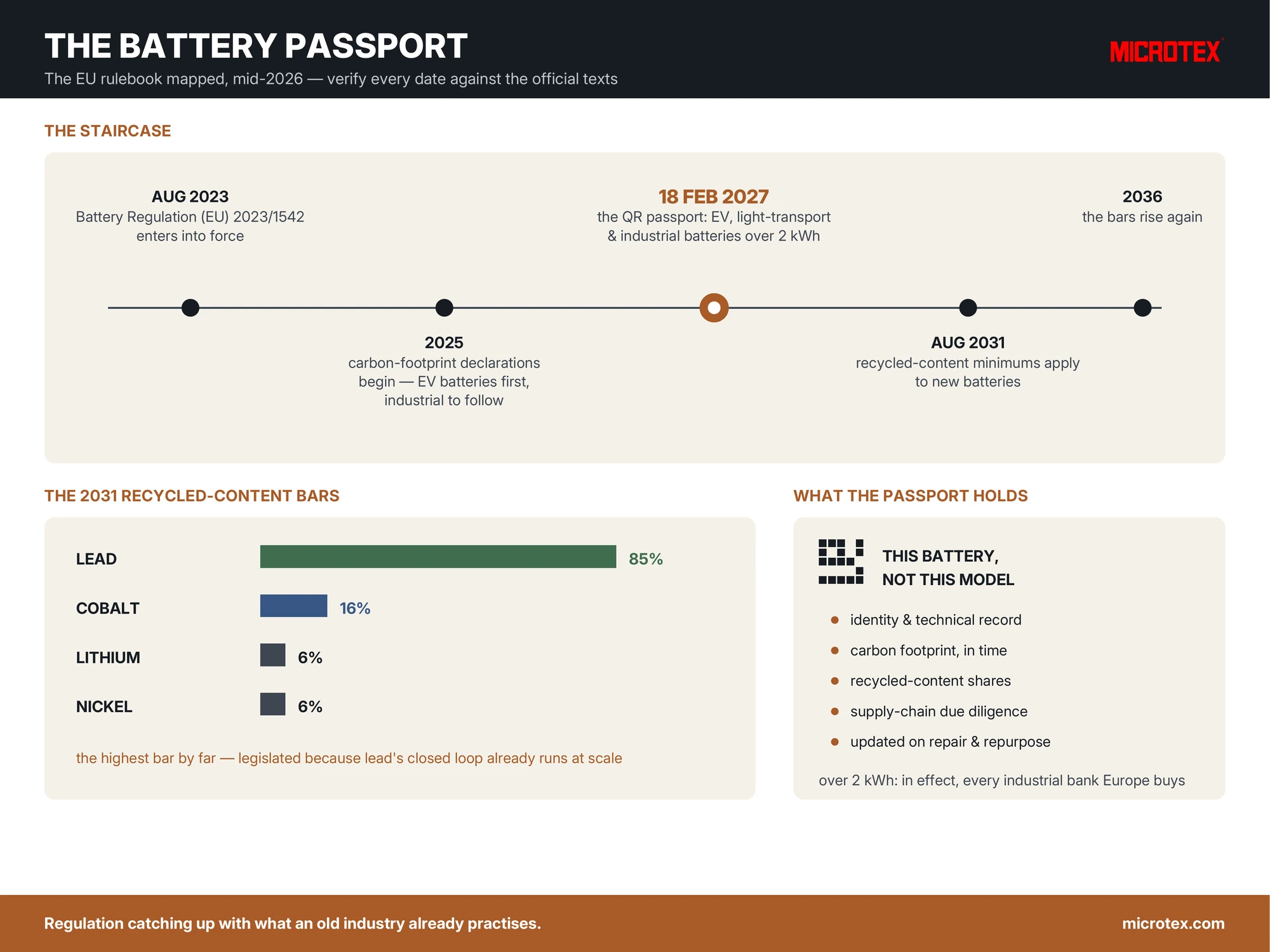
Per the regulation’s texts, from 18 February 2027 every electric-vehicle battery, light-means-of-transport battery and industrial battery above 2 kilowatt-hours placed on the EU market must carry a digital battery passport, reached through a QR code on the battery. Each passport is individual — this battery, not this model — and holds the battery’s identity and technical characteristics, with the record expanding over time to carry carbon-footprint data, recycled-content declarations and supply-chain due-diligence information. The passport must stay alive through the battery’s life, updated by whoever repairs or repurposes it. The obligations rest on the ECONOMIC OPERATOR PLACING THE BATTERY ON THE EU MARKET — which, for an exporter like us, means the importer and the manufacturer must between them have the data pipeline standing before the battery ships. A 2 kWh threshold is a low bar: it captures effectively every industrial cell and bank in our catalogue that Europe buys.
The wider timetable worth diarising
The passport is one deadline in a staircase. CARBON-FOOTPRINT DECLARATIONS phase in category by category — electric-vehicle batteries first, from 2025, with rechargeable industrial batteries following — each step governed by delegated acts spelling out the calculation method, a number of which were still being finalised as of 2026; the declared footprint must eventually be carried in the passport, and later years add footprint classes and maximum thresholds. RECYCLED CONTENT comes next: per the regulation, from August 2031 relevant new batteries must contain minimum shares of recycled material — 85% for lead, 16% for cobalt, 6% for lithium and 6% for nickel — with the bars rising again from 2036. Notice the lead figure. It is by far the highest, and it is no accident: the lead-battery industry’s closed recycling loop has run at industrial scale for generations, which made an 85% bar realistic to legislate. It is a rare and quietly satisfying case of regulation catching up with what an old industry already practises.
What an Indian exporter should actually do — and the caveat that governs everything above
If Europe is in your order book, the work is data, and it is slower to build than a label. Concretely: per-model and per-plant carbon accounting with auditable inputs; material traceability up the supply chain; recycled-content documentation; serialisation that can mint a QR-linked record per battery; and an agreed division of passport duties with your EU importers. None of this is exotic — it is the same discipline as any export compliance, as our guide to shipping batteries shows for the transport rulebook — but 2027 is close, and retrofitting data is costlier than collecting it as you go. NOW THE GOVERNING CAVEAT, exactly as that shipping guide gives for IMDG and IATA rules: this post is a snapshot written in mid-2026, in plain language, by a battery maker — not a law firm. The regulation’s provisions, delegated acts, thresholds and dates have already shifted during drafting and may shift again; before any compliance decision, verify every requirement against the current official EU texts and your own advisors. Treat this page as the map, never the territory. And if you want a supplier whose batteries arrive with their paperwork thought through, talk to us — exporting batteries with their documents in order has been our trade since 1969.