
Most battery cost comparisons are decided before the spreadsheet opens — by what gets left out. Here is the method we would ask any buyer to hold us to, line by line, both chemistries, same rules.
The honest unit: ₹ per usable kWh-year
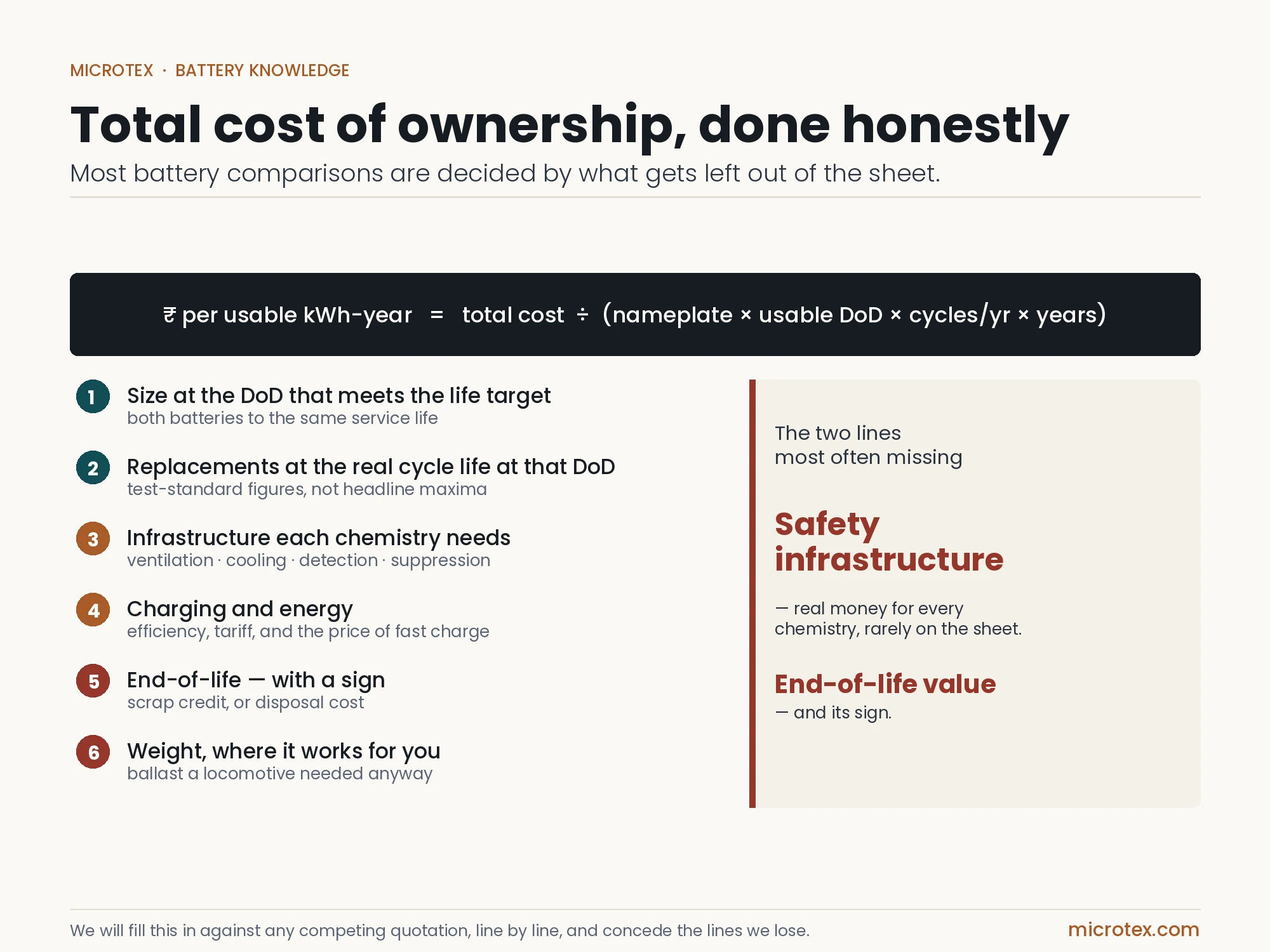
Not price per battery, and not even price per kWh of nameplate. The denominator that matters is usable energy, per year of actual service: nameplate × usable depth of discharge × cycles per year, across the years the battery genuinely lasts in your duty. Everything else is a numerator item.
The lines that decide the answer
1. Size at the DoD that meets the life target. A lead-acid bank sized for 50% daily depth costs more capacity upfront and buys years of life in return; a lithium pack cycled hard runs the same trade in the other direction. Neither is wrong — but the comparison must show both batteries sized to reach the same service life, not one sized to a brochure.
2. Replacements at the real cycle life at that DoD. Use test-standard figures at your stated depth, not headline maxima. Then price the replacement schedule over the machine’s life, not the battery’s.
3. The infrastructure each chemistry needs. Both sides carry site costs, and both belong in the sheet: for lead-acid, ventilation engineering and watering labour (or a gel/VRLA design that removes the watering). For lithium, thermal management and its parasitic power, off-gas detection, fire suppression engineered for sustained cooling rather than flame knock-down, and the emergency-response provisions confined installations require. Comparisons that count our ventilation but not their cooling and suppression are not comparisons.
4. Charging and energy. Charge efficiency, tariff, and — where duty allows — whether gentler charging (which both chemistries reward) fits the shift pattern. Fast charging is a productivity choice with a battery-life price; price it as one.
5. End-of-life, with a sign. Lead batteries close with a scrap credit through India’s established recycling loop. Young-chemistry packs commonly close with a disposal cost today. Put both numbers in, dated today.
6. Weight, where it works for you. In a locomotive or an LHD, battery mass is ballast the machine needs for adhesion anyway. Charging a “weight penalty” against a battery whose weight replaces steel you would otherwise buy is double counting — in the machine classes where lead-acid lives, the penalty is often a credit.
A worked skeleton (illustrative structure, not a quotation)
Bank A: lower capital, replacement at year 7–10 at stated DoD, ventilation + maintenance labour, scrap credit at each change-out. Bank B: higher capital, longer cycle count, cooling parasitics + suppression infrastructure + detection, disposal line at end of life. Run both to the same machine life at the same delivered duty, divide by usable kWh-years, and the sheet — not the brochure — picks the winner. In deep daily-cycling, energy-dense duty, lithium frequently earns its price. In shift-and-charge duty, standby, and confined installations where the safety infrastructure line grows, the old chemistry wins more of these sheets than the headlines suggest.
Questions buyers ask us
Will you fill this sheet in against a lithium quotation?
Yes — line by line, with our assumptions shown and sources named, and we will concede the lines lithium wins. Send both duty cycles.
What discount rate and horizon?
Your finance department’s, and the machine’s life — not the battery’s. State both on the sheet.
Biggest hidden line in most comparisons?
Safety infrastructure and its upkeep. It is real money for every chemistry, and it is almost never on the sheet.
Related reading: cycle life vs depth of discharge · the closed recycling loop · forklift batteries · request a TCO working