
Battery acid sits at the very bottom of the pH scale — below 1 — and that is the last honest number anyone can give you. The liquid in question is dilute sulphuric acid, H₂SO₄, mixed with demineralised water to the strengths our battery acid guide sets out in full. People arrive at this question from two directions — curiosity (“how acidic is it really?”) and caution (“how carefully must I treat it?”) — and both deserve a straight answer. The curious get an honest one below: why “below 1” is where truthfulness stops and false precision begins. The cautious can take their answer now: acidic enough that eye protection and gloves are not negotiable, and the full working respect of our battery safety guide applies every time the caps come off.
What pH actually measures
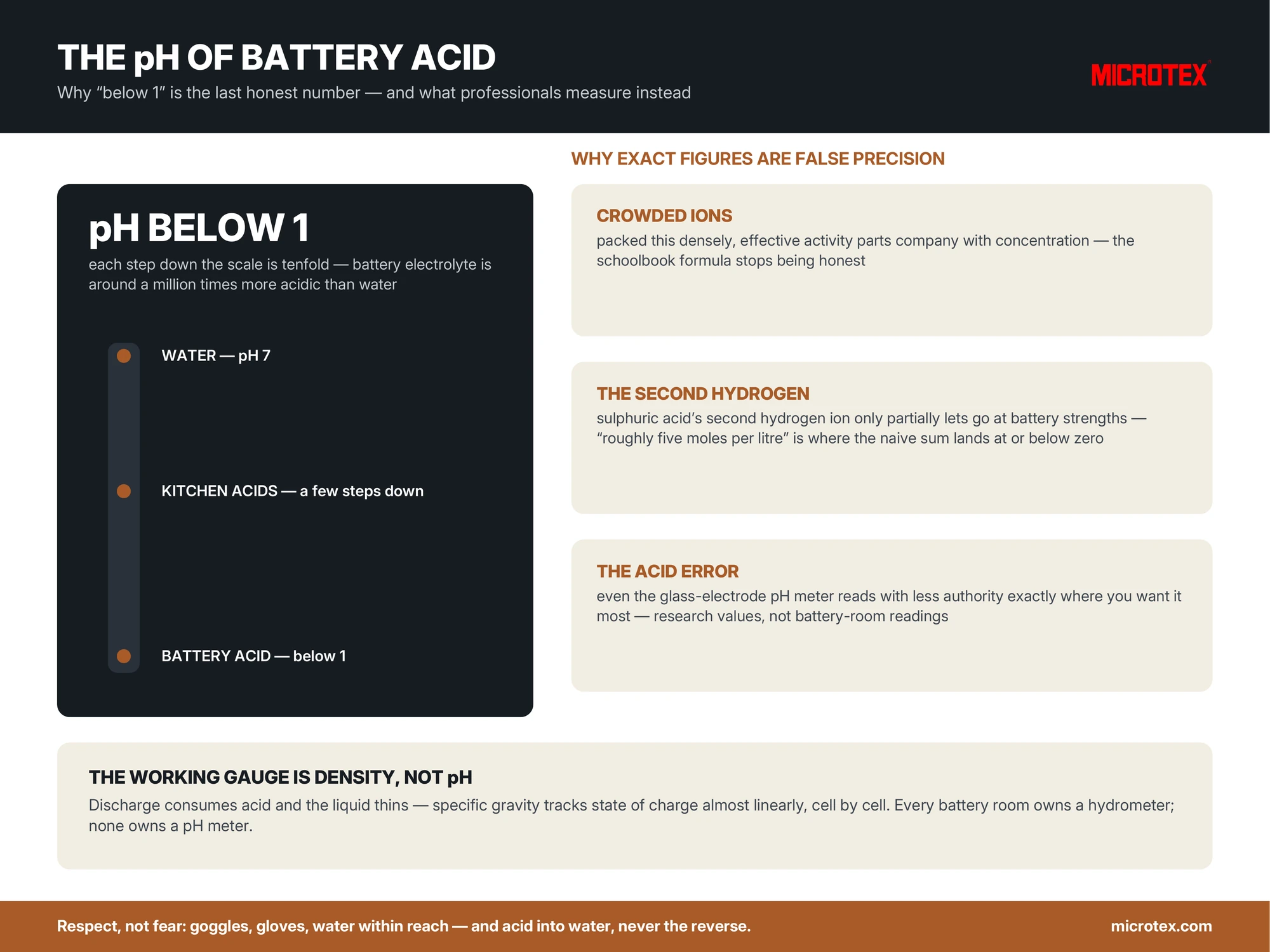
pH is a logarithm: it expresses how active the hydrogen ions in a solution are, on a scale where each whole step means a tenfold change. Pure water sits at 7. Kitchen acids — vinegar, lemon juice — live a few steps down the scale. Every step down multiplies the acidity by ten, so by the time a liquid reaches 1, it is not “six steps” more acidic than water but a million times so. Battery electrolyte lives below that mark. The scale was built for the dilute world — soils, foodstuffs, water treatment, blood — and in that world it is a superb tool. Battery acid is not the dilute world, and that is where the trouble with an exact figure begins.
Why nobody can honestly give you the exact number
Run the schoolbook arithmetic and see it break. A fully charged cell’s electrolyte at the strengths in our acid guide works out to roughly five moles of sulphuric acid per litre — and since the naive pH formula takes a negative logarithm of concentration, a number that size lands the calculation at zero or below before the second hydrogen ion has even been counted. But concentrated acids refuse to follow the schoolbook. Ions crowded this densely interfere with one another, so their effective activity parts company with their concentration; sulphuric acid’s second hydrogen only partially lets go at these strengths; and even the instrument built for the job — the glass-electrode pH meter — carries a known “acid error” in strong acid, reading with less and less authority exactly where you want it most. Chemists have rigorous tools for this territory, but they produce research values, not battery-room readings. So every serious reference stops where our acid guide stops: strongly acidic, pH below 1. Any page quoting battery acid’s pH to two decimal places is quoting false precision — and the figure would refuse to stay put anyway, because discharge consumes acid into the plates, as the chemical reactions guide shows, thinning the electrolyte as the cell works.
The gauge that actually works
Here is the professional punchline: the battery trade solved this measurement problem a century ago by ignoring pH altogether. The property worth measuring is density. As a cell discharges, acid is consumed and the electrolyte thins towards water; as it charges, the acid returns — so the liquid’s specific gravity is a direct, nearly linear record of the state of charge, readable with a hydrometer costing less than a decent lunch. pH would barely move in any usefully readable way across that same journey; density tells the story cell by cell, reading by reading. That asymmetry is the whole answer to why every battery room owns a hydrometer and none owns a pH meter — and the craft of the reading, including the three moments it lies, belongs to our specific gravity guide. It also settles the sibling questions the search data asks: what acid is in a battery — sulphuric, H₂SO₄, and only that; there is no mystery ingredient, and everything about its strengths, purity and preparation lives in the acid guide.
Respect, not fear
“Below 1” translated into behaviour: goggles and gloves whenever electrolyte can move; water within reach for skin and eyes, used immediately and generously; spills neutralised on the floor and never inside a cell — the kit, quantities and drill are in the safety guide. And if you ever prepare electrolyte, one rule stands above the rest — acid is always added to water, never the reverse — with the full ritual and worked dilution tables in the acid guide, where they belong. None of this is drama: this liquid is handled safely a million times a day by people who follow the drill. It simply never forgives casualness. If you want the working values for our own batteries — filling gravities by type, temperature corrections, the datasheet numbers this page deliberately does not invent — ask our engineers and we will send the documents themselves.