
Every battery is a chemical reaction with its two halves held apart — forced to trade electrons through your equipment instead of directly. Understand that one sentence and every behaviour of the lead-acid battery — the voltage, the fuel-gauge acid, sulfation, gassing — stops being mysterious. This is the reaction story, from the one-line version to the equations, honestly told.
The three working materials
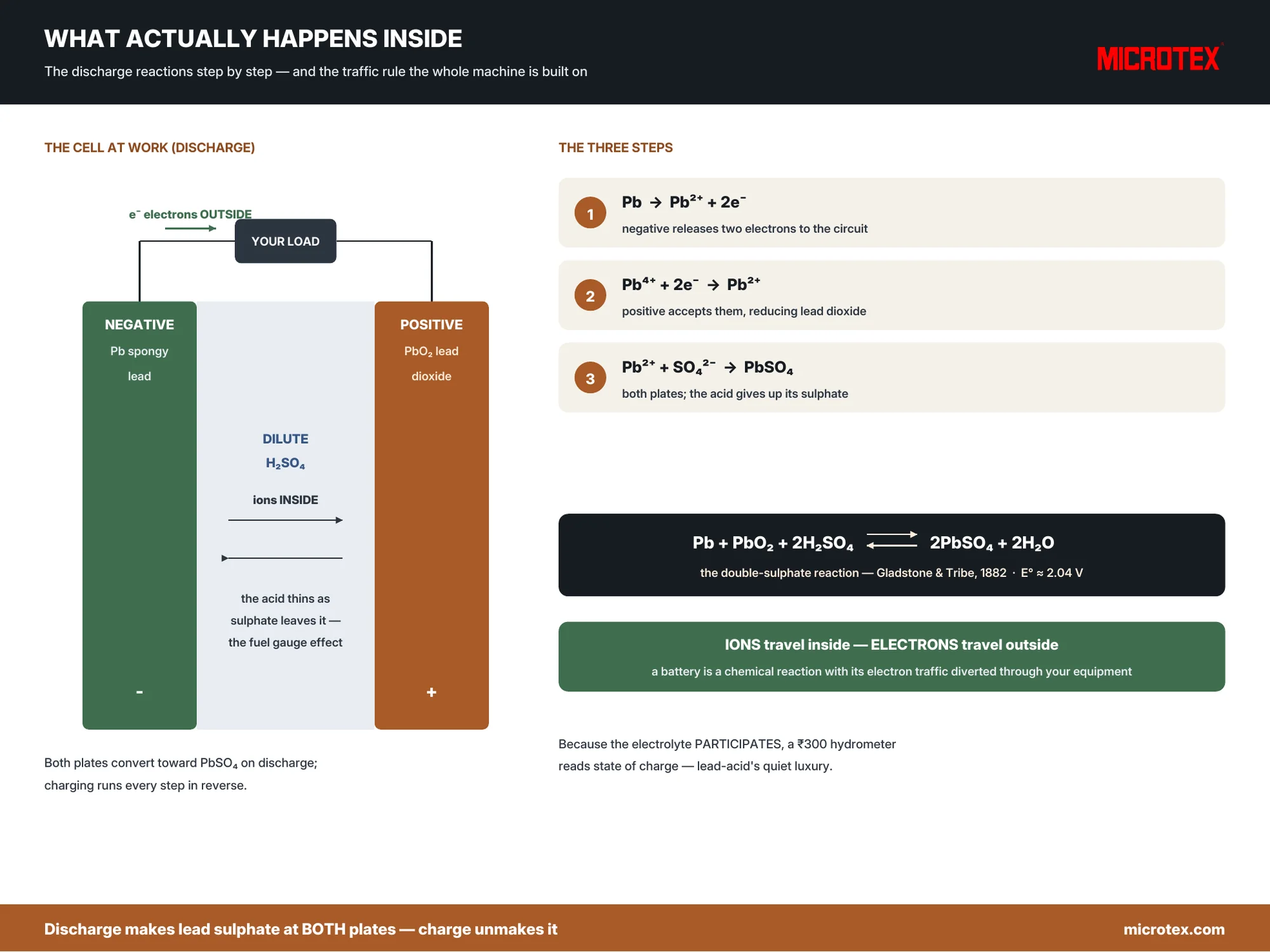
A charged cell holds lead dioxide (PbO₂) as the positive plate, spongy lead (Pb) as the negative, and dilute sulphuric acid — specific gravity roughly 1.200 to 1.280 by application, higher (about 1.300–1.310) in VRLA designs where acid volume is small, as the battery acid guide tabulates. Both plates are made porous on purpose, so the reaction reaches deep inside the material rather than just the surface. The separator between them is an insulator with fine pores: it blocks metallic contact but lets IONS swim through. And here is the division of traffic the whole device is built on: ions travel inside the cell through the electrolyte, electrons travel outside through your circuit. The electrolyte conducts no electrons; the wires conduct no ions. A battery is simply a chemical reaction with its electron traffic diverted through a load.
Discharge, step by step
Connect a load and three things happen at once. At the negative plate, lead atoms give up electrons: Pb → Pb²⁺ + 2e⁻. Those electrons flow out of the negative terminal, do their work in your equipment, and arrive at the positive plate, where they reduce lead dioxide’s Pb⁴⁺ to the same ion: Pb⁴⁺ + 2e⁻ → Pb²⁺. At BOTH plates the freshly made lead ions meet sulphate from the acid: Pb²⁺ + SO₄²⁻ → PbSO₄. Both plates convert toward the same substance, lead sulphate, while the acid loses sulphate and thins toward water — which is precisely why a hydrometer reads state of charge: the electrolyte is a consumed ingredient, not a mere conductor.
The net reaction — and the voltage it sets
Summed and balanced, discharge and charge are one reversible line — the double-sulphate reaction, established by Gladstone and Tribe in 1882:
Pb + PbO₂ + 2H₂SO₄ ⇌ 2PbSO₄ + 2H₂O (→ discharge, ← charge)
Thermodynamics prices this reaction at a standard potential of about 2.04 volts — the “2 V nominal” on every cell. The practical resting voltage moves with acid strength around that figure, by the series’ pocket rule: OCV per cell ≈ specific gravity + 0.84. On recharge all three steps run backwards: lead sulphate surrenders its lead ions, electrons are pushed in from the charger, plates return to lead and lead dioxide, and sulphate returns to the acid. That full round trip — and the practical craft of driving it without cooking the battery — is the charging guide’s territory. When the round trip fails and sulphate hardens in place, that is sulfation.
For the curious: the bisulphate detail
The tidy equations above hide one refinement. In working acid, sulphuric acid dissociates mostly to hydrogen ions and BISULPHATE ions (HSO₄⁻) rather than bare sulphate. So the negative-plate step is more honestly written Pb + HSO₄⁻ → PbSO₄ + H⁺ + 2e⁻, and the positive step consumes those hydrogen ions to make water. Nothing about the net line changes — but this detail explains why acid concentration matters to reaction speed, and it is the level at which battery scientists actually model the cell.
How the neighbours do it
| System | Positive | Negative | Electrolyte | Electrolyte’s role |
|---|---|---|---|---|
| Lead-acid | Lead dioxide PbO₂ | Spongy lead | Dilute sulphuric acid | PARTICIPATES — consumed on discharge, restored on charge |
| Lithium-ion | Lithium metal oxides | Graphite (lithium intercalated) | Lithium salts in organic solvent | Carries ions; not consumed in the net reaction |
| Nickel-cadmium | Nickel oxyhydroxide | Cadmium | Dilute potassium hydroxide | Carries ions; concentration nearly constant |
| Nickel-metal-hydride | Nickel oxyhydroxide | Hydrogen in metal alloy | Dilute potassium hydroxide | Carries ions; concentration nearly constant |
Two closing notes. Primary cells run their chemistry once — no reversible arrow, no second act; secondary cells like lead-acid regenerate all three ingredients on charge, which is the entire meaning of “rechargeable”. And in valve-regulated batteries a second, quieter reaction rides along during charge — oxygen generated at the positive travels to the negative and is turned back into water, the internal oxygen cycle that lets the cell live sealed; the VRLA article tells that story properly. Vocabulary lives in the glossary; and if your application’s chemistry questions have commercial stakes, our engineers enjoy exactly these conversations.