
Cells in a battery never age in perfect step — the equalizing charge is how you bring the family back together. It is a deliberate, controlled overcharge applied to an already-charged battery, taken into the gassing region so that every last patch of unconverted lead sulphate is driven back to active material and the stirring bubbles erase electrolyte stratification. Done when the readings call for it, it is the cheapest life-extension in the maintenance book. Done blindly or on the wrong battery, it is just slow cooking. Here is the difference.
Why cells drift apart
Ordinary service charging rarely finishes the job completely. An automotive system tops out around 14.4 V on a 12 V battery; inverter and UPS chargers typically hold 13.8–14.4 V — enough for daily duty, not enough to convert the last stubborn sulphate in every cell. Small manufacturing differences do the rest: cell by cell, specific gravity and voltage drift apart, dense acid settles toward the bottom of taller cells, and the weakest cell quietly sets the whole battery’s capacity. The remedy has been in the trade for a century: a periodic bench charge that takes the battery, under supervision, into free gassing until every cell reads full.
Vinal’s gassing ladder
| Cell voltage on charge | Gassing | Gas composition (H₂ / O₂) |
|---|---|---|
| 2.2 V | None | — |
| 2.3 V | Slight | 52% / 47% |
| 2.4 V | Normal, established | 60% / 38% |
| 2.5 V | Copious | 67% / 33% |
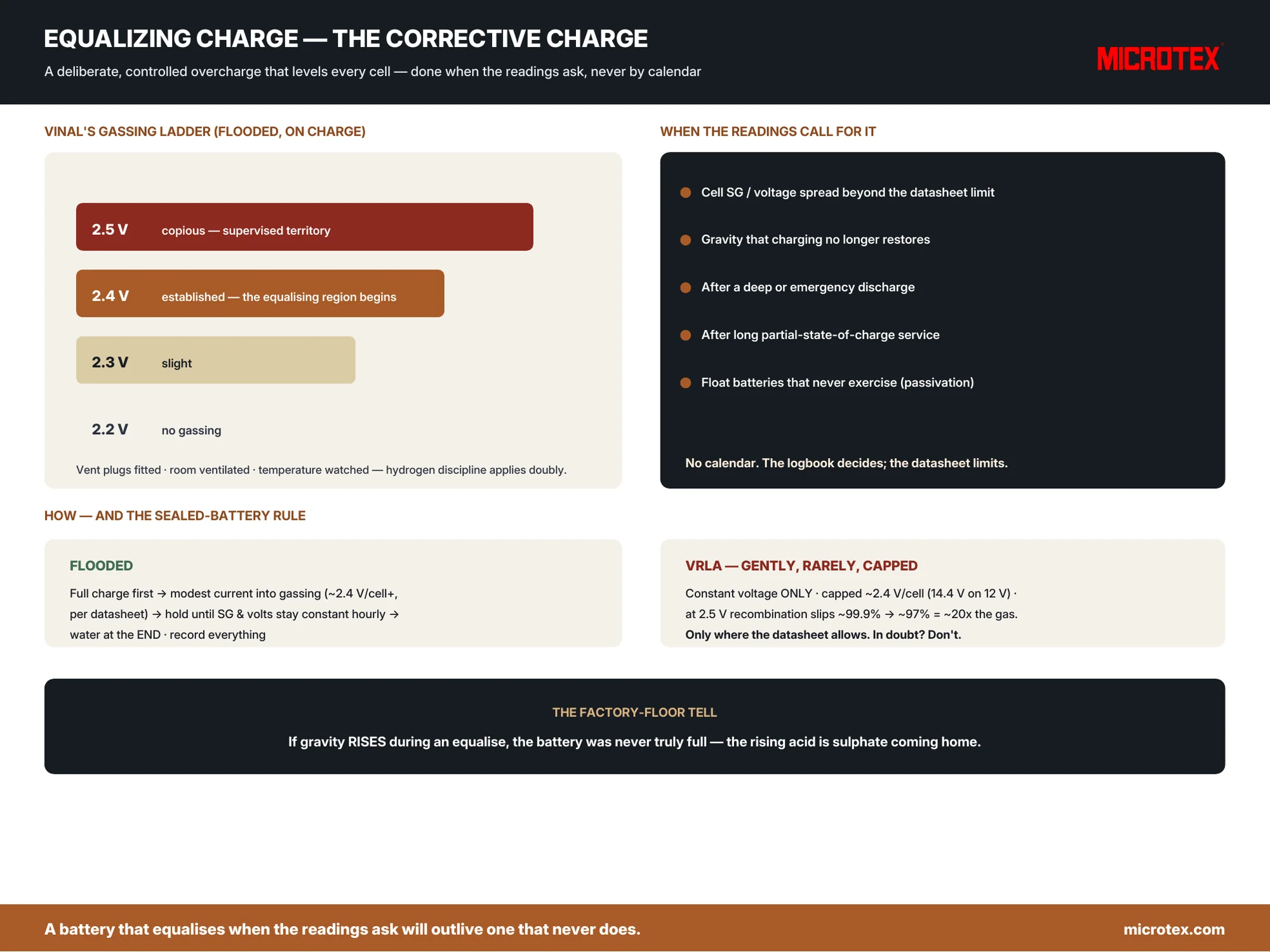
The ladder explains both the method and the safety rules. Equalising works around 2.4 volts per cell and above because that is where gassing is established: current beyond what the plates can absorb splits water, the bubbles stir the acid uniform, and the rising, then steady, specific gravity tells you the conversion is complete. It is also why every equalise happens with vent plugs fitted, the room ventilated and the temperature watched — the full hydrogen discipline of why batteries explode applies doubly here.
When the readings call for it
There is no calendar for equalising — the logbook decides, and the datasheet sets the limits. The classic triggers: the spread between highest and lowest cell voltages or specific gravities widening beyond what your manufacturer allows; gravity readings that charging no longer restores to their usual full-charge value (correct them to 27 °C first, per the battery acid guide); after a deep or emergency discharge; after long service at partial state of charge — the duty that breeds sulfation; and for float batteries that never see an outage, an occasional, deliberate brief exercise where operating rules allow it — the cure for what the trade calls float passivation. A battery that equalises when the readings ask will outlive one that never does; forklift fleets know this better than anyone, as the forklift battery page attests.
How it is done — flooded batteries
The battery is first brought to a normal full charge. Then, on the bench or per the charger’s equalise mode, a modest constant current carries the voltage into the gassing region — around 2.4 volts per cell and, under supervision and where the manufacturer permits, higher still (traditional workshop practice runs heavy bench charges toward 2.6–2.75 volts per cell — 16 V and beyond on a 12 V battery — always per the datasheet, never casually). Hold until every cell’s specific gravity and voltage stop rising and stay constant across successive hourly readings, with all cells gassing freely and evenly. Then stop, let it rest, top up with demineralised water at the end as always, record everything. An expert’s tell from the factory floor: a battery whose gravity RISES noticeably during an equalise was never truly full when it left its ordinary charger — the rising acid is sulphate coming home.
VRLA: gently, rarely, capped
Sealed batteries change the rules, because gas you make is water you may never get back. At float voltages a healthy VRLA recombines essentially everything — around 99.9% — but push a cell to 2.5 V and recombination slips to roughly 97%, which sounds small until you notice it means about twenty times the gas escaping the valve. So the VRLA version of equalising is constant-voltage only, capped at the manufacturer’s limit — typically 2.4 volts per cell, 14.4 V on a 12 V battery — held briefly, done rarely, and only where the datasheet explicitly allows it. If only a constant-current source exists, the terminal voltage is watched continuously and the current wound down so the cap is never crossed. When in doubt with sealed batteries: don’t. The trade-offs live in AGM vs gel.
The machine, and the inverter question
Two practical notes complete the picture. First, the machine: purpose-built equalisation chargers exist, and choosing one is its own small discipline — our guide to equalisation chargers covers it, built around one rule worth repeating here: a charger’s capability to equalise is never permission — the battery’s datasheet grants that, or nothing does. Second, the setting on your inverter or solar charge controller: many home and solar systems offer an “equalisation” mode, and the same law applies unchanged. It is for flooded batteries whose maker approves it, at the maker’s voltage and interval, with the caps off a ventilated battery — and for sealed VRLA batteries in inverter duty the correct setting is OFF unless the datasheet explicitly says otherwise. An inverter that quietly equalises a gel battery on a calendar is not maintaining it; it is shortening its life on a schedule.
Equalising is the corrective arm of the discipline taught in how to charge correctly and measured by the routines in float charging. Terms live in the glossary; a string whose spread keeps returning no matter how often you equalise has something else wrong — describe it to us and an engineer will find it.