
A battery’s first drink decides much of its life. Batteries reach dealers and users in different states of readiness — some needing acid and a long first charge, some needing acid and only a boost, some sealed and needing nothing but commissioning — and applying the wrong ritual to the wrong type wastes capacity permanently. Here is the sorting guide: what you received, what it needs, and the factory story behind the differences.
First, one reconciliation
The safety article teaches that acid is never added to a battery in service — only water. That law stands. FIRST FILL is the one legitimate exception, because an empty battery has no acid to dilute: it receives measured, battery-grade sulphuric acid at the gravity the manufacturer specifies, once, and thereafter the water-only rule governs for life.
Dry and uncharged: the long first charge
A dry-uncharged battery ships with plates formed at the factory but assembled dry, and its negatives have partially re-oxidised in air. The ritual: fill each cell with acid 30–35 points BELOW the target final gravity — if the datasheet’s finished value is 1.250, fill around 1.215–1.220 — up to the maximum level mark, never beyond. Filling warms the cells several degrees; let them soak and cool before connecting a charger. Then charge gently: begin at the charger’s lowest setting for the first hour, raise to about 5–10% of the rated ampere-hour capacity, and continue — vents open, gassing expected late in the run — until voltage and specific gravity hold constant across three consecutive hourly readings. Time on the clock proves nothing; unchanging readings prove everything. Why fill low? Lead sulphate is MORE soluble in weak acid, so conversion runs faster and charge acceptance is better — the gravity then rises toward target as charging returns sulphate to the electrolyte. If the final gravity misses the target, adjust: stronger acid (about 1.400) to raise, demineralised water to lower, in every cell that needs it, followed by a short mixing charge. Finish by replacing the vent plugs and washing and drying the top — no acid film should remain.
Dry-charged: fill, boost, go
A dry-charged battery left the factory with BOTH plates fully formed and charged, sealed against air. It needs acid at very nearly the working gravity — typically 1.240–1.245 for a 1.250-class battery — and only a booster charge. The built-in freshness test is temperature: note the electrolyte temperature before and after filling. A rise of only a few degrees means the negatives stayed well preserved — a short boost at about 10% of rated capacity completes the job quickly. A larger rise means air found the negatives in storage and more re-conversion is needed — boost longer. Either way the endpoint is the same readings rule: steady voltage and gravity across three consecutive hourly checks, then it is ready for service and normal charging practice takes over.
Why the two types behave so differently
The chemistry of storage explains the rituals. In a dry-uncharged battery the positives remain 85–90% lead dioxide — nearly ready — but spongy lead is air-hungry, and roughly HALF of an exposed negative’s lead can re-oxidise before filling. That oxide neutralises some filling acid on contact (part of the warming you observe) and must be re-converted electrically, which is why the first charge is long. A dry-charged battery’s plates were formed, dried and sealed under protection, so the acid meets mostly finished material: little heat, little work, quick boost. The temperature-rise test reads exactly this difference.
Behind the factory fence: formation and VRLA filling
Two related processes belong to manufacturing, described here for understanding rather than imitation. Jar formation is how a battery assembled from cured-but-unformed (“green”) plates — over 90% lead oxide with a few per cent basic lead sulphates — is brought to life in its own container: chilled acid (the oxide-acid reaction is fiercely exothermic), filled some 40–45 points below target, cooling water baths, and a gentle stepped-current schedule of the kind Pavlov’s formation literature describes, pausing whenever electrolyte temperature climbs to the specified ceiling (around 48 °C, with brief excursions higher tolerated but never sustained). Formation pushes several times the battery’s rated ampere-hours through it — the published literature cites figures around 400% — before capacity is proven by discharge test. VRLA filling is even less a field affair: precise acid mass, vacuum-assisted filling for complete wetting of the compressed separator stack, and a controlled first charge — which is why a VRLA battery arrives sealed, is never opened, and is never “topped up”. If a sealed battery seems low on capacity, the answer is a proper commissioning charge or a service call — never a syringe.
The sorting table
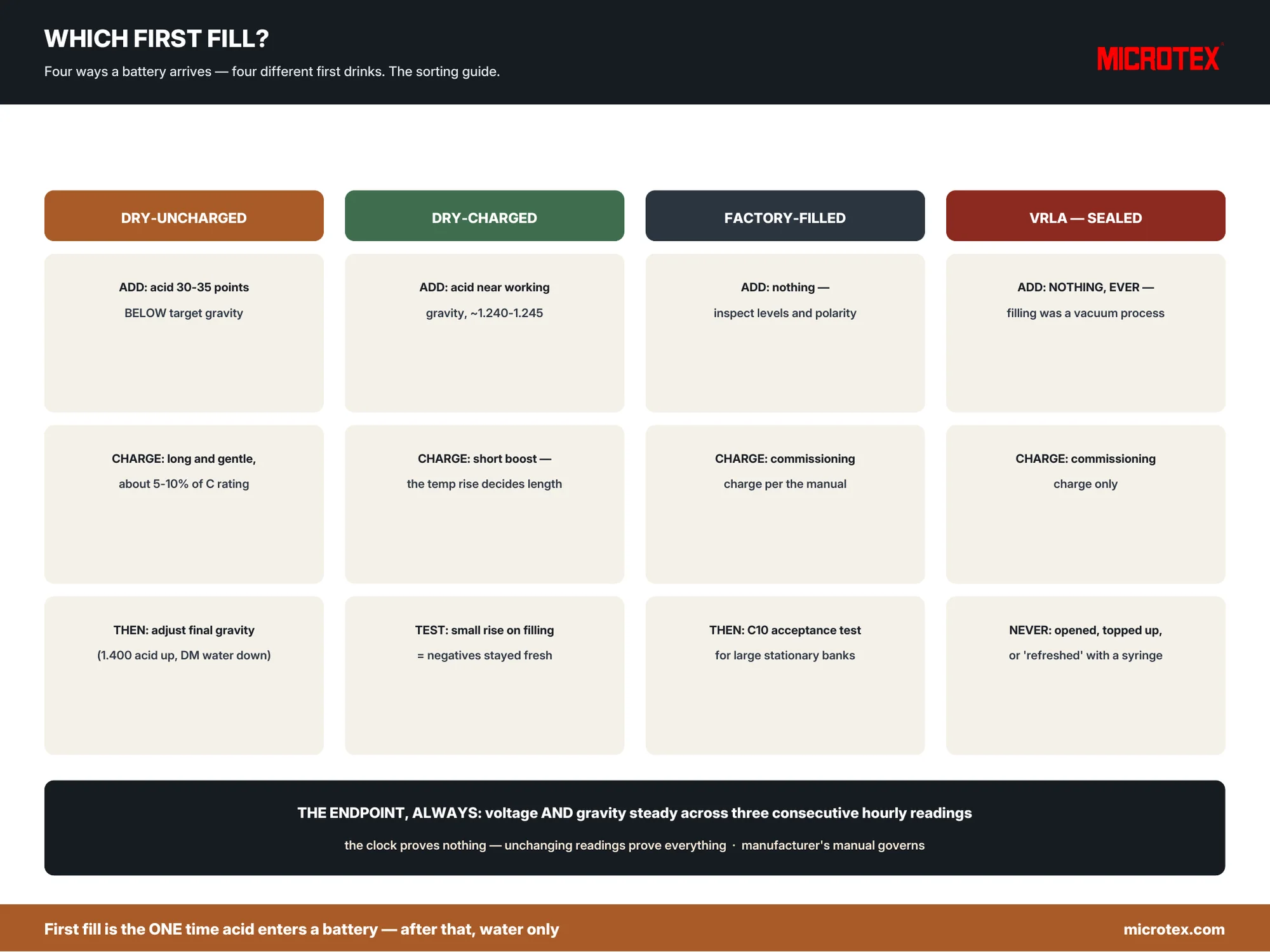
| As received | You add | First charge |
|---|---|---|
| Dry and uncharged | Acid 30–35 points below target gravity | Long, gentle (≈5–10% of C rating) until readings hold steady; adjust gravity at the end |
| Dry-charged | Acid near working gravity (≈1.240–1.245 for a 1.250 design) | Short boost; temperature rise after filling decides how short; readings rule ends it |
| Factory-filled flooded | Nothing — inspect levels and polarity | Commissioning/freshening charge per the manual |
| VRLA (sealed) | NOTHING, ever | Commissioning charge only; filling was a factory vacuum process |
Large stationary banks add rack-and-torque discipline around the same chemistry — that ritual lives in the complete guide’s commissioning section. Terms in the glossary; and if you are commissioning batteries in quantity and want the procedure blessed for your specific models, ask us — ten minutes of confirmation beats a warehouse of undercharged cells.