
Two batteries can print the same ampere-hour number and be a tenth — or a quarter — apart in real capacity. The number is honest in both cases; what differs is the small print beside it — the hours, the end voltage, the temperature. A battery datasheet is one of the most compressed documents in engineering: a dozen lines that decide whether a bank will hold a substation through a blackout or leave a forklift stranded at three in the afternoon. Most of those lines are numbers with conditions attached, and the conditions are where buyers get hurt. This guide walks the sheet top to bottom and says, for each line, what the number means, what must be printed beside it for the number to mean anything, and where the honest questions are. It is the reading companion to our guide on writing a battery specification: that one tells you what to demand; this one tells you how to check what arrived.
Line one: capacity — and the three conditions hiding beside it
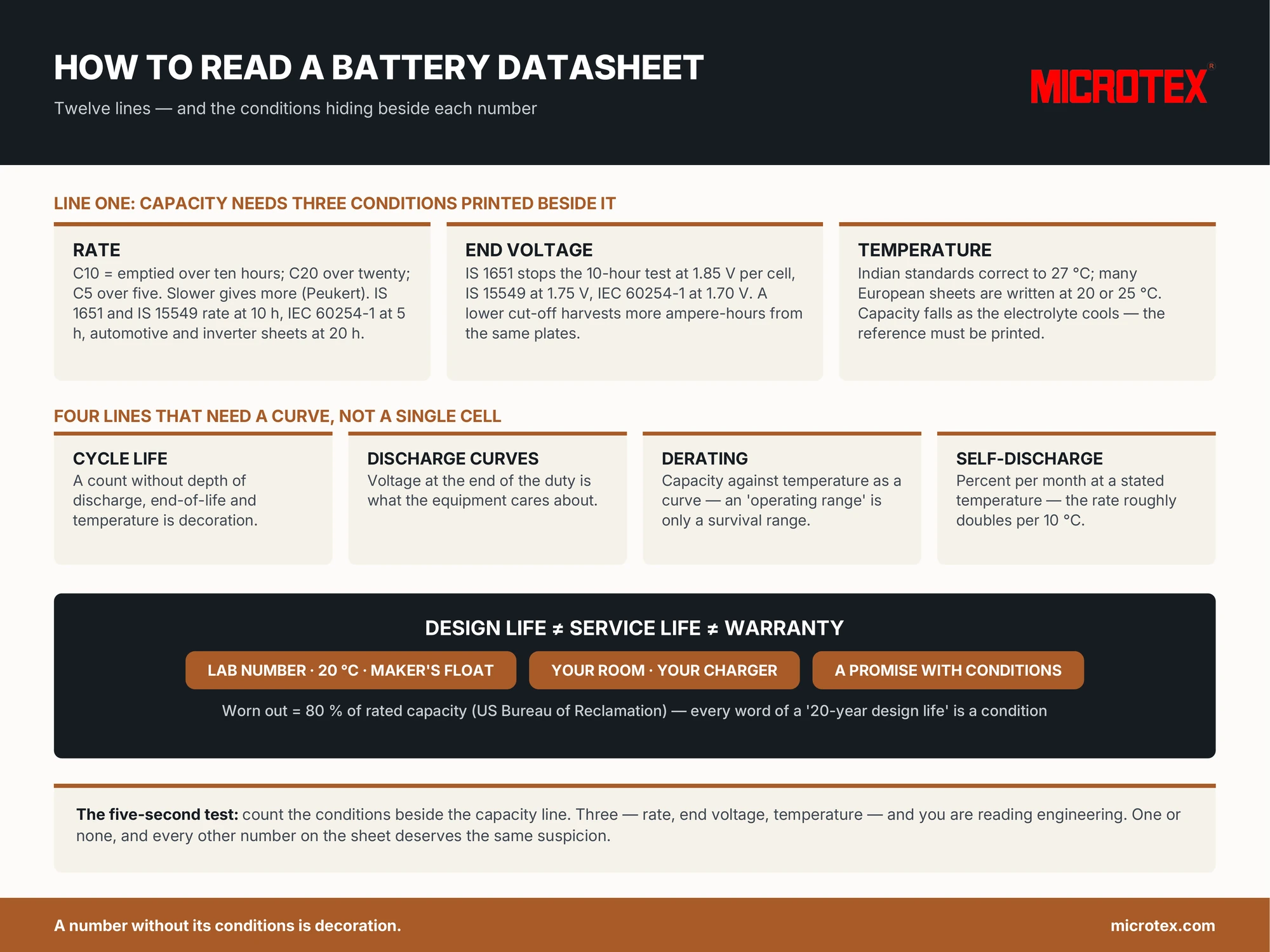
The headline number is ampere-hours, and it is meaningless alone. Linden’s handbook defines the rate notation with a small letter: n is “the time, in hours, for which rated capacity is declared”. C10 means the capacity the battery gives when emptied over ten hours; C20, over twenty; C5, over five. The same physical cell publishes a different ampere-hour figure at each, because the slower you discharge a lead-acid battery the more it gives — the effect our Peukert’s law guide explains with one runner. So a “200 Ah” battery rated at C20 and a “200 Ah” battery rated at C10 are not the same battery; the C10 one is the bigger cell. Which rate is customary depends on the trade: as our standards guide sets out, the Indian stationary standards IS 1651 and IS 15549 rate at the ten-hour rate, the traction standard IEC 60254-1 at the five-hour rate, and automotive and inverter batteries are conventionally quoted at twenty hours — which is exactly why an inverter battery’s number looks generous next to a stationary cell of the same size. The second condition is the end-of-discharge voltage: IS 1651 stops the ten-hour test at 1.85 V per cell, IS 15549 at 1.75 V, IEC 60254-1 at 1.70 V — a lower cut-off lets the test run longer and harvests more ampere-hours from the same plates. The third is temperature: Indian standards correct to 27 °C, many European sheets are written at 20 or 25 °C, and capacity falls as the electrolyte cools. Rate, end voltage, reference temperature: if any of the three is missing from the capacity line, the capacity line is decoration. Our C-rate guide shows how far the figures drift, and the capacity calculator converts a figure at one rate to another so that two sheets can be compared on equal terms.
Lines two to five: voltage, resistance, weight and the box
Nominal voltage is two volts per lead-acid cell whatever the construction — our electrochemistry guide shows where the number comes from. What matters on the sheet is the cell count that a monobloc hides: a “12 V” battery is six cells in one box, and the datasheet’s per-cell figures must be multiplied accordingly. Open-circuit voltage, if printed, should carry the state of charge and rest time it was measured at, or it is a guess. Internal resistance is printed in milliohms at a stated frequency or method and a stated state of charge; it is a trend number, not a capacity number — our internal-resistance guide explains why a low figure on the sheet is a health baseline for later, not a promise. Weight is the least glamorous and most honest line: for a given plate design, lead is capacity, and two sheets claiming the same ampere-hours with very different weights deserve a question. Dimensions and terminals decide whether the bank fits the stand and whether the connectors fit the posts — read the tolerance, and read whether the height includes the terminal.
Lines six to nine: the numbers that need a chart, not a cell
Four lines on a good datasheet are not single numbers but curves, and a sheet that prints them as single numbers is hiding the conditions. Cycle life is the worst offender: a cycle count without a stated depth of discharge, end-of-life criterion and temperature is marketing — our guide on cycle life versus depth of discharge shows why the same battery gives several thousand shallow cycles and a few hundred deep ones, and both numbers are true. Discharge curves — voltage against time at several currents — are the sheet’s most useful page for a system designer, because they tell you the terminal voltage at the end of a duty, which is what the connected equipment cares about. Temperature derating should appear as a curve of capacity against temperature; a single “operating range” line is not derating, it is a survival range, and our guide to operating temperature explains the difference. Self-discharge should be stated as a percentage per month at a temperature, because the rate roughly doubles for every ten-degree rise; a figure without a temperature is a figure for some other room.
Lines ten to twelve: design life, warranty and the electrolyte
Here is where buyers are most often misled, and rarely by a lie. Design life, service life and warranty are three different things, and a 2014 Battcon conference paper by Searles and Schiemann is the clearest statement of it: “the design life should not be compared with service life as the two are actually separate. And neither should be confused with warranty.” Design life is a laboratory number. The paper quotes the European industry association’s definition — “the estimated life determined under laboratory conditions, and is quoted at 20 °C using the manufacturer’s recommended float voltage conditions” — and reproduces the association’s four expected-life groups (3–5, 6–9, 10–12 and over 12 years), while recording that the groups were acknowledged to be “arbitrary with overlaps”. Service life is what the battery actually delivers in your room, at your temperature, on your charger — our guide to how batteries die lists the five things that shorten it. Warranty is a commercial promise against manufacturing defect with its own conditions, and the conditions page is part of the datasheet whether or not it is stapled to it. The industry convention, stated plainly in the US Bureau of Reclamation’s battery manual, is that a battery is worn out when it can no longer deliver 80 percent of rated capacity — so when a sheet says “20-year design life”, the honest reading is: in a laboratory at 20 °C, on the maker’s float conditions, this design is expected to still deliver 80 percent after twenty years. Every word of that sentence is a condition. Finally, for flooded types, the electrolyte line — filled specific gravity at a stated temperature — is what your hydrometer will be checked against for the next decade; our specific-gravity guide explains why a “normal range” only exists relative to the maker’s stated filled value.
The five-second test
Before reading anything else, find the capacity line and count the conditions printed beside it. Three — rate, end voltage, temperature — and you are reading an engineering document; the rest of the sheet is probably honest too. One or none, and the sheet was written to be compared favourably rather than read carefully, and every other number on it deserves the same suspicion. We publish our own sheets to be read the hard way: every capacity at the ten-hour rate to a stated end voltage at 27 °C, cycle life against depth of discharge, derating as a curve, and the standard each figure was measured under. If a competing sheet is sitting beside ours on your desk and the numbers refuse to line up, send us both — converting them to the same conditions takes our engineers ten minutes, and the comparison is usually more interesting than either sheet.
Sources quoted: T. B. Reddy (ed.), Linden’s Handbook of Batteries, 4th ed. (McGraw-Hill, 2011); C. Searles and M. Schiemann, “Understanding and Differentiating Design Life, Service Life, Warranty and Accelerated Life Testing for Lead Acid Batteries”, Battcon 2014.