
Every plate in a lead-acid battery begins as refined lead, and the two steps that turn it into oxide and then into paste decide a good deal of what the finished battery can do: its strength, its early capacity and how long it keeps either. A buyer never sees this stage, which is exactly why it is worth understanding. What follows are the general industry routes, drawn from the two references listed at the foot of the page. The recipe any one maker uses is that maker’s to state, and we print none.
Start with refined lead
The lead for grids and active material has to be highly refined, usually primary lead of corroding grade under the relevant ASTM specification, so that nothing in the raw material contaminates the battery. The reason is practical: a stray metal does not stay put. Antimony is the clearest case. Once it reaches the negative plate it starts a small local discharge, as our guide to antimony in lead-acid batteries explains. The chemistry that everything below serves is set out in our guide to the lead-acid battery chemical reaction.
Two ways to make oxide
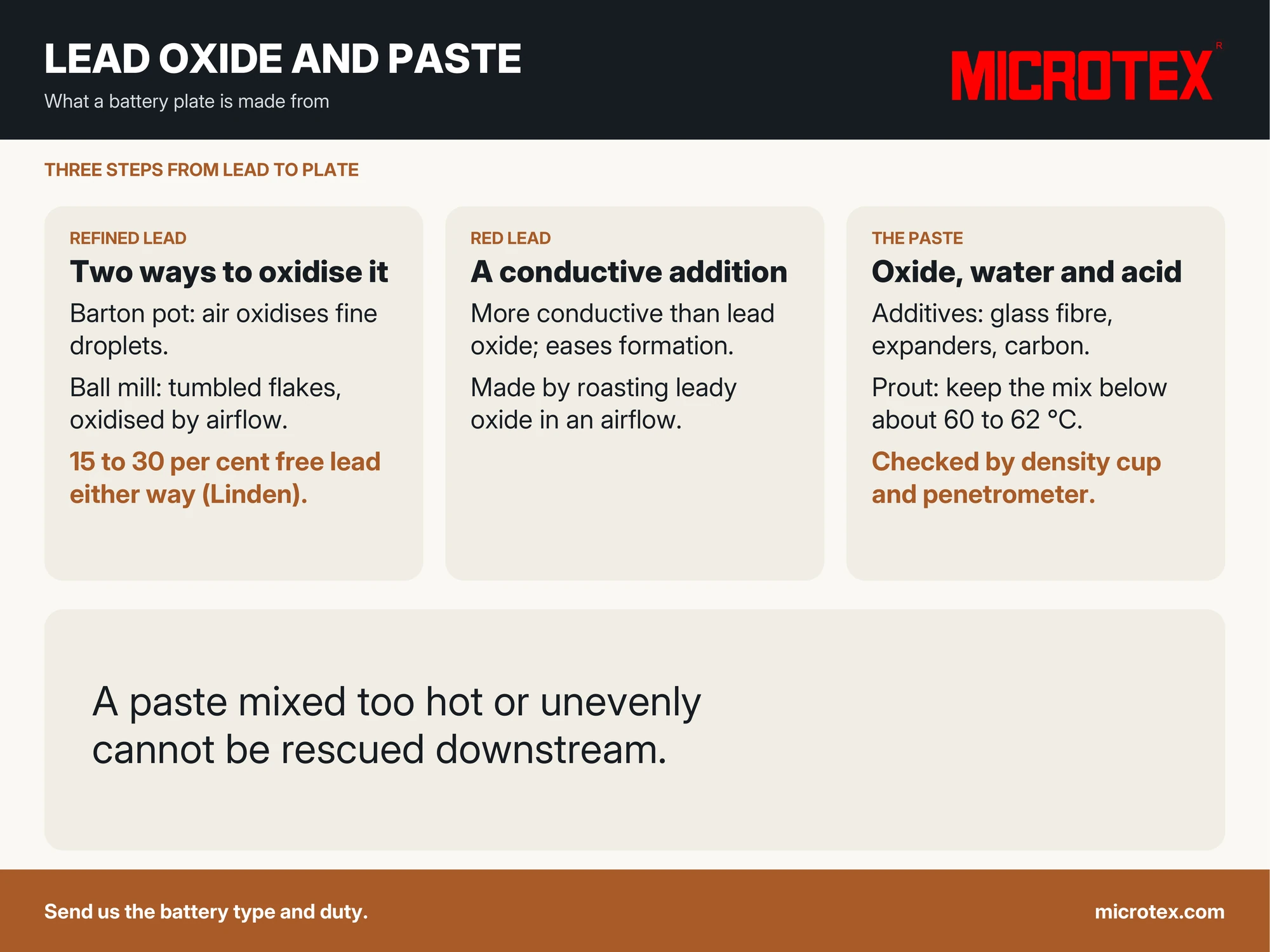
Two processes make the industry’s starting material, which the trade calls leady oxide. In the Barton pot, a fine stream of molten lead is swept around a heated vessel and air oxidises the droplets, leaving an oxide coating round each one. In the ball mill, lead pieces are tumbled so that attrition makes fine metallic flakes, an airflow oxidises them and carries the oxide to a baghouse. Typical oxide from either route still contains 15 to 30 per cent free metallic lead, on Linden’s figures, and the particle shapes differ: a spherical particle with a lead core from the pot, a flattened platelet from the mill. That free lead matters later, as the next two sections show.
Red lead and tubular filling powders
Some positive plates take an addition of red lead, which is more conductive than lead oxide and so eases the formation of lead dioxide. It is made by roasting leady oxide in an airflow, which cuts the free lead and generally enlarges the particles. Tubular positives are different again. Their filling powder ranges from wholly red lead to wholly lead oxide, with every blend between, and the blend decides how much free lead is left to deal with in the step that follows, which we cover in our guide to plate curing.
Making the paste
For flat plates the oxide becomes a paste. Leady oxide is mixed with water and dilute sulfuric acid in a mechanical mixer; three types are common, the change-can or pony mixer, the muller and the vertical muller. Dry additives are blended into the oxide first: microglass fibres for strength, expanders that keep the negative plate porous in service, carbon, and each maker’s own additions. The mix heats up, both from the work of mixing and from the acid reacting with the oxide, so the mixer is cooled or water is allowed to evaporate. As mixing proceeds, the power drawn by the mixer motor rises and then falls, and that curve is how the stiffness of the paste is followed from batch to batch.
The temperature that sets the crystals
The crystal pattern of the plate is set at the mixer, not later. Holding the maximum temperature in the mix below about 60 to 62 °C, and spreading the dilute acid thoroughly through it, is what starts the needle-shaped basic lead sulfates that give a cured plate its strength; the figure is from L. Prout’s paper on plate curing in the Journal of Power Sources. A paste mixed too hot or unevenly cannot be rescued downstream, which is why the mixer is not the place to save time.
How a maker checks the paste
Paste density is measured with a cup that has a hemispherical cavity, and consistency with a penetrometer. For starter plates, more acid in the mix gives a lower plate density. That points to a trade a buyer should know about: a plate is a balance between density, which brings strength and energy, and porosity, which brings power. No paste is best in every duty, so a traction cell and a standby cell are rightly made differently, and a maker who uses one paste for everything is making a compromise somewhere.
What a buyer can ask
A datasheet shows none of this, but a factory visit or a batch record can. Ask whether the maker makes its own oxide or buys it, what grade of lead goes in, and how paste density is recorded for each batch. Ask whether plates can be traced from a finished cell back to a paste lot. Lead is also where the metal price enters the cost of a battery, which our guide to lead price and battery cost explains. The next steps are curing and formation.
Where this leaves you
Oxide and paste are the least visible part of a battery and among the most decisive. If you are comparing two quotations, a maker who can describe this stage plainly is telling you something about the rest. Send us the battery type and duty and we will show you what we can document for the cell you need.
Sources quoted: T. B. Reddy (ed.), Linden’s Handbook of Batteries, 4th ed. (McGraw-Hill, 2011), chapter 16, sections on lead oxide production, paste production and plates; L. Prout, “Aspects of lead/acid battery technology 3. Plate curing”, Journal of Power Sources 41 (1993) 185–193.