
The metal that decides how long your battery lives is one most buyers have never priced. Antimony is a brittle, silvery element that lead-acid battery makers have alloyed into their plates since the earliest days of the industry — a few quiet per cent, hidden inside the casting. For most of a century it was cheap enough to ignore. Then, between the summer of 2024 and today, its price multiplied several-fold, export rules redrew its trade routes, and procurement managers across the battery world learned its name properly. This is the story, told with the working shown, as of July 2026: what antimony actually does inside a battery, what happened to its market, and what an honest buyer should do about it.
The hardener in the spine
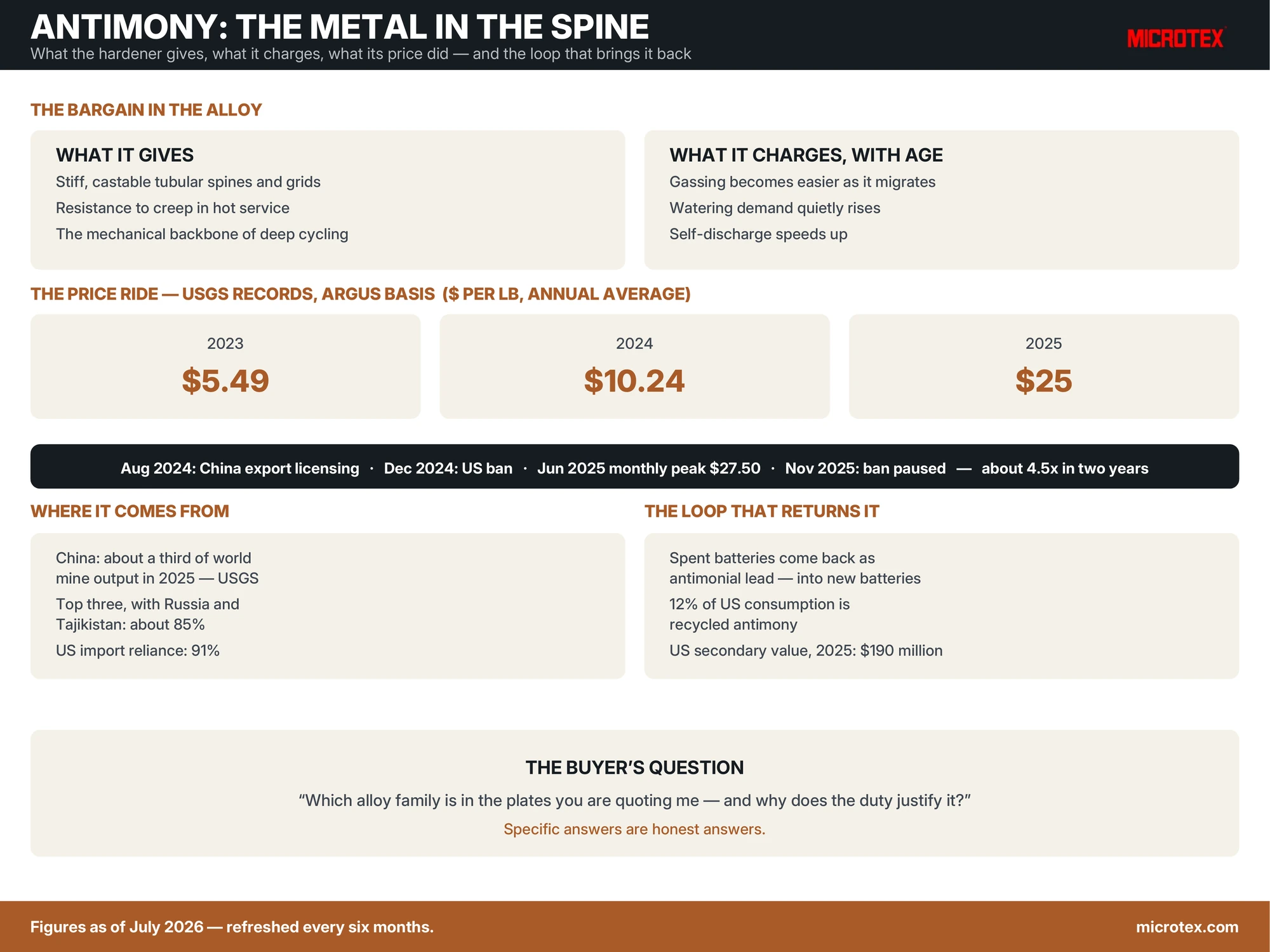
Pure lead is soft enough to mark with a thumbnail. A grid or a tubular spine cast from it alone would sag under its own weight, creep slowly out of shape in hot service, and tear during manufacture. Antimony fixes this: alloyed into the lead it stiffens the casting, makes the long, thin spine of a tubular plate castable at all, and gives the plate the mechanical backbone that deep, repeated cycling demands — which is why the battery literature (Pavlov; Rand) treats antimonial alloys as the traditional heart of traction and tubular batteries. But antimony has always charged rent. As the battery ages, antimony works loose from the positive and settles on the negative plates, where it makes gassing easier — so an old antimonial battery drinks more water and self-discharges faster than a young one. We have told that metallurgy honestly elsewhere: the golf-cart guide explains the antimony–self-discharge bargain, the explosion post owns the hydrogen arithmetic that gassing feeds, and the battery-water guide owns the thirst. Modern practice has answered with low-antimony alloys, grain-refined with traces of selenium so the lean alloy still casts soundly — and, for float duties like standby power, with calcium alloys that leave antimony out entirely. The metal earns its place today only where cycle life is the whole job.
Two wild years, by the numbers
Now the market story, from the US Geological Survey’s Mineral Commodity Summaries (February 2026), whose price series is based on Argus trade reporting. In August 2024, China — the world’s largest producer — announced export licensing for antimony; in December 2024 it banned exports to the United States outright. The monthly average price nearly doubled inside those four months, from $9.80 a pound in August to $18.10 in December, then climbed another 52 per cent to $27.50 by June 2025 before easing to $20.30 in November. The annual averages tell it plainest: $5.49 a pound in 2023, $10.24 in 2024, $25 in 2025 — roughly four and a half times over in two years (about $55,000 a tonne at the 2025 average; that conversion is our arithmetic, 2,205 pounds to the tonne). Trade press reported in November 2025 that the US ban was paused until late 2026 as part of a wider trade de-escalation, and prices have come off their peaks — but the structure that caused the squeeze has not moved. USGS estimates put China’s 2025 mine output at roughly 40,000 tonnes of a 110,000-tonne world total — about a third — with Russia and Tajikistan lifting the top three to around 85 per cent; and the processing layer is more concentrated still, China supplying 66 per cent of US antimony-oxide imports across 2021–24. The United States ended 2025 importing 91 per cent of what it consumed.
The loop that softens the blow
Here the lead-acid industry’s oldest virtue quietly pays out. Antimony does not leave the battery world when a battery dies: it comes back from the secondary smelter as antimonial lead, recovered from spent batteries and consumed straight back into new ones — the USGS records that this loop is generated by, and then consumed by, the lead-acid battery industry itself, and values US secondary antimony production in 2025 at $190 million, supplying 12 per cent of the country’s consumption. It is the same closed circle our recycling post describes for the lead: to a real extent, this industry mines itself. Fresh primary supply is also stirring — USGS notes one company began mining antimony in Montana in 2025, and a second project broke ground in Idaho with federal support — but mines are slow instruments, and none of it changes the buyer’s position this year.
What this means at the quotation table
First, understand what your battery maker can and cannot do. The USGS lists combinations of calcium, copper, selenium, sulphur and tin as the working substitutes for antimony in battery alloys — and that list is simply a description of what disciplined makers, ourselves included, have been doing for decades: lean alloys where duty allows, calcium where float service rules. What no honest maker will do is strip antimony out of a deep-cycle tubular plate to chase a metals index, because the metal is load-bearing there — remove it and you have traded away the cycle life you were buying. So ask your vendor two direct questions: which alloy family is in the plates you are quoting me, and why does the duty justify it? A maker who answers in specifics is telling you the truth; one who answers “latest technology” is not answering. Second, read price movements fairly: when antimonial alloys are quoted, alloy-metal costs now move quotations in a way they did not before 2024 — a vendor who explains a change with the metals table open is being straight with you. And third, remember the scrap side of the ledger: antimonial lead in a retired bank is value, not waste, and belongs in the end-of-life conversation. This page carries July 2026 figures and joins our twice-yearly refresh list; the metallurgy will still be true in a decade. If an antimony question is sitting inside your next battery decision, run it through the TCO ledger — or ask us directly, and we will answer with the alloy named.