
Somewhere in the world this week, a tender document is asking for a battery designed in 1860. Planté cells — the original lead-acid battery, named for the man who invented the chemistry itself — still appear by name in legacy specifications for power stations, substations and railways, decades after the industry moved on. That creates an odd situation buyers deserve to understand: the design earned a century of trust honestly, the reasons it faded are engineering reasons rather than fashion, and the right response to a specification that names it is neither blind compliance nor a shrug. This is the story of the plate that started everything — how it worked, why utilities loved it, what replaced it and why — told the way our complete lead-acid guide tells the wider history: with the reverence the achievement deserves and none of the nostalgia the datasheet cannot afford.
1860: the plate that made its own active material
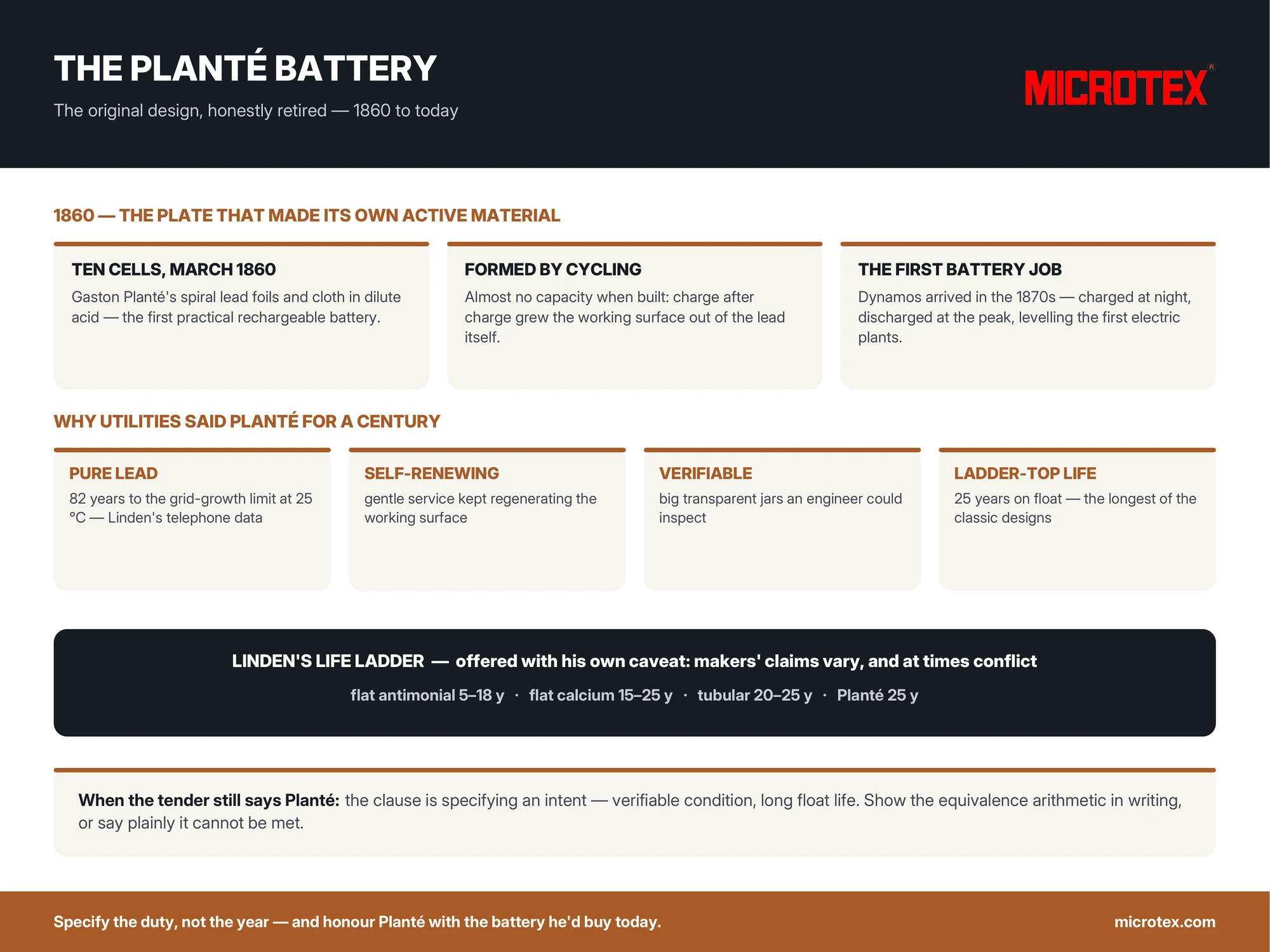
Gaston Planté presented his battery of ten cells to the French Academy of Sciences in March 1860 — the first practical rechargeable battery, and the ancestor of every lead-acid cell we build. His construction, as the standard handbooks record it, was two long strips of lead foil, kept apart by intermediate layers of coarse cloth, spirally wound and immersed in roughly ten per cent sulphuric acid. The genius and the weakness were the same fact: the cell had almost no capacity when built. Its active material did not exist yet — it had to be made, by charging and discharging the cell over and over, each cycle corroding a little more of the lead surface into lead dioxide on the positive and spongy roughness on the negative, growing the working surface the way weather grows a landscape. Linden’s handbook notes that the earliest formations were powered by primary cells — batteries that could not be recharged, sacrificed to awaken one that could — until the dynamos of the 1870s arrived and gave lead-acid its first real job: charged at night, discharged at the peak, levelling the loads of the first electric plants. That slow surface-growing process is the ancestor of the modern formation charge — today accomplished in a controlled factory step rather than months of patient cycling.
Why utilities specified it for a century
The mature Planté cell — large formed plates of pure lead in a transparent jar — earned its place in switchrooms on four virtues. Pure lead, first: Berndt’s handbook records pure lead as the Planté positive’s material, and pure lead corrodes with remarkable slowness — Linden’s telephone-system data puts the time for a pure-lead grid to reach the 4% growth limit at 25 °C at 82 years, against under 14 for the antimonial alloys. Second, the self-renewing surface: because the active material is formed corrosion product, gentle service kept regenerating working surface, holding capacity steady across decades instead of fading. Third, verifiability: big transparent cells whose plates an engineer could inspect on a walk-round — the same instinct our transparent-container stationary lines serve today. Fourth, sheer float longevity: in Linden’s life ladder for stationary designs — offered with the handbook’s own warning that makers’ claims “vary, and at times conflict” — Planté sits at the top at 25 years, with flat-pasted antimonial batteries at 5 to 18, flat-pasted calcium at 15 to 25, and tubular at 20 to 25. For most of the twentieth century, if failure was unthinkable and money was available, the specification said Planté — and the specification was right.
The honest bill, and the design that closed the gap
The bill was equally real. A plate that carries its active material as a formed skin on solid lead uses an enormous amount of lead per ampere-hour — Planté cells are heavy, bulky and expensive, with the lowest energy for their size and weight of any lead-acid construction. The formed surface that renews itself also sheds: worked hard or cycled deep, surface material lets go, which is why Planté batteries belonged to the gentlest duty — decades of float, the occasional emergency discharge — and nowhere else. And the economics never improved, because the design cannot be lightened without ceasing to be itself. Meanwhile the tubular plate closed the life gap from the other direction: armoured active material held under pressure around a conductive spine, immune to shedding by construction — the story our plate-construction guide tells — reaching, in Linden’s same table, twenty to twenty-five years at a fraction of the lead, the footprint and the price. When the life difference shrank to a rounding error, the reason to pay Planté prices quietly disappeared. Few makers still offer the type; the specifications simply outlived the factories.
When the tender still says Planté
Which brings us to that tender document. A specification that names Planté cells today is almost always specifying an intent — verifiable condition, very long float life, high-rate confidence at end of life — in the vocabulary of the year it was drafted. The professional response is equivalence, done in the open: state what the clause intends, show the construction that delivers it now, and put the comparison arithmetic in writing next to the compliance statement. That is exactly how our 2V HDP line answers Planté tenders — the duty delivered on tubular plates, smaller footprint, no shedding surface, honest economics — and where a specification strictly requires Planté with no equivalence clause, the honest bid says so plainly rather than forcing a fit. If you are the one *writing* the specification, the better path is to specify the duty rather than the 1860 design: our guide to writing a battery specification shows the six clauses that get you Planté’s virtues from a modern factory. And if a Planté-worded tender is sitting on your desk right now, send us the clause — we will tell you in writing whether we can meet its intent, and exactly how. Gaston Planté gave the world the rechargeable battery; the best way to honour him is to buy the battery he would specify today.